











Orbiting in Dating:
Meaning and Psychology behind it
Orbiting in Dating:
Meaning and Psychology behind it
Have you caught your ex loitering on your social media pages? Have you ever wondered what it means and why they’re still keeping up to date with what you’re up to? We all know that familiar pang of anxiety, hope, and confusion when their name pops up unexpectedly – the feeling that arises when you’re being orbited.
This dating term first popped up around 2018, and has increased in popularity as more and more of us begin to recognize this behavior online. But what is “orbiting”, and how do you know if you’re currently being orbited?
In this article, we’ll be discussing the meaning of orbiting in dating and the social media landscape, the psychology behind orbiting and its relation to attachment styles, and how you can manage being on the receiving end of orbiting in a relationship.

What is Orbiting?
Have you ever had somebody suddenly stop contact or end their relationship with you, only for them to keep popping up in your likes or social media views? They just might be orbiting – orbiting is when somebody cuts contact with you, but their social media presence continues to linger in your peripheries.
This is not quite the same as ghosting, which is when somebody completely disappears without a trace or explanation, usually by blocking your social media profiles, or breadcrumbing, where occasional contact is maintained, or roaching, where someone dates multiple people without transparency. It’s also different to the end of a romantic relationship where you might agree to stay friends; instead of maintaining any meaningful connection with you, orbiters will quietly hang around and often leave you wondering where you stand.
Do you think you might be limerent?
Take our limerence quiz and find out now – fast, easy, free
The Psychology Behind Orbiting
There are a handful of reasons somebody might exhibit orbiting behavior; social media users say they might do it out of curiosity, jealousy, or loneliness. In 2015, psychologists explored what made somebody more likely to engage in “social media monitoring” – an early description of what later became known as orbiting (Fox, 2015). They found that higher levels of distress predicted social media monitoring, and that the more committed somebody was to the relationship in the long term, the more distress they experienced when it ended.
While it may be tempting to think the worst when somebody is orbiting – that they might be purposefully leading you on or sending mixed signals – it seems that orbiters are usually just struggling to move on.
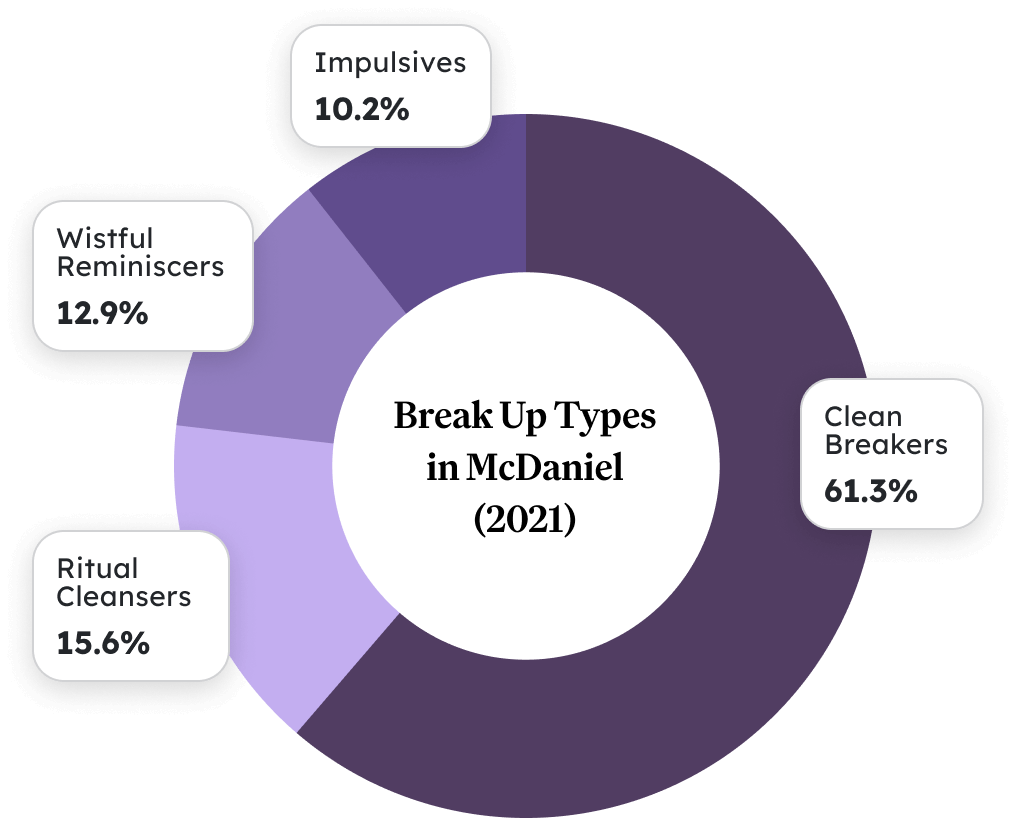
Another group of psychologists explored user’s behavior on social media after a break up (McDaniel et al., 2021). They were able to group their participants into 4 categories:
Clean breakers
By far the largest group, clean breakers did not monitor their ex-partners on social media, but did not delete their profiles either. They were unlikely to interact with their ex or their ex’s friends and family, and often deleted old posts and photos.
Ritual cleansers
Ritual cleansers were similar to clean breakers in their absence of engagement and monitoring, but completely removed their ex-partners from their profiles, including any posts and photos they had together.
Wistful reminiscers
Wistful reminiscers did not delete their ex-partners and posts from their social media, and they were more likely to actively engage in monitoring and staying in touch with their ex’s friends and family.
Impulsives
The smallest group, impulsives were highly likely to delete but still monitor and interact with their ex-partners.
In line with what we already thought about distress and orbiting, the two groups most likely to monitor and interact with their ex’s social media profiles – impulsives and wistful reminiscers – showed the highest levels of emotional distress.
Clean breakers showed the lowest levels of emotional distress, perhaps suggesting that they simply didn’t feel the need to delete their ex-partners because they didn’t feel anxious about their lingering connection.

Orbiting and Attachment Styles
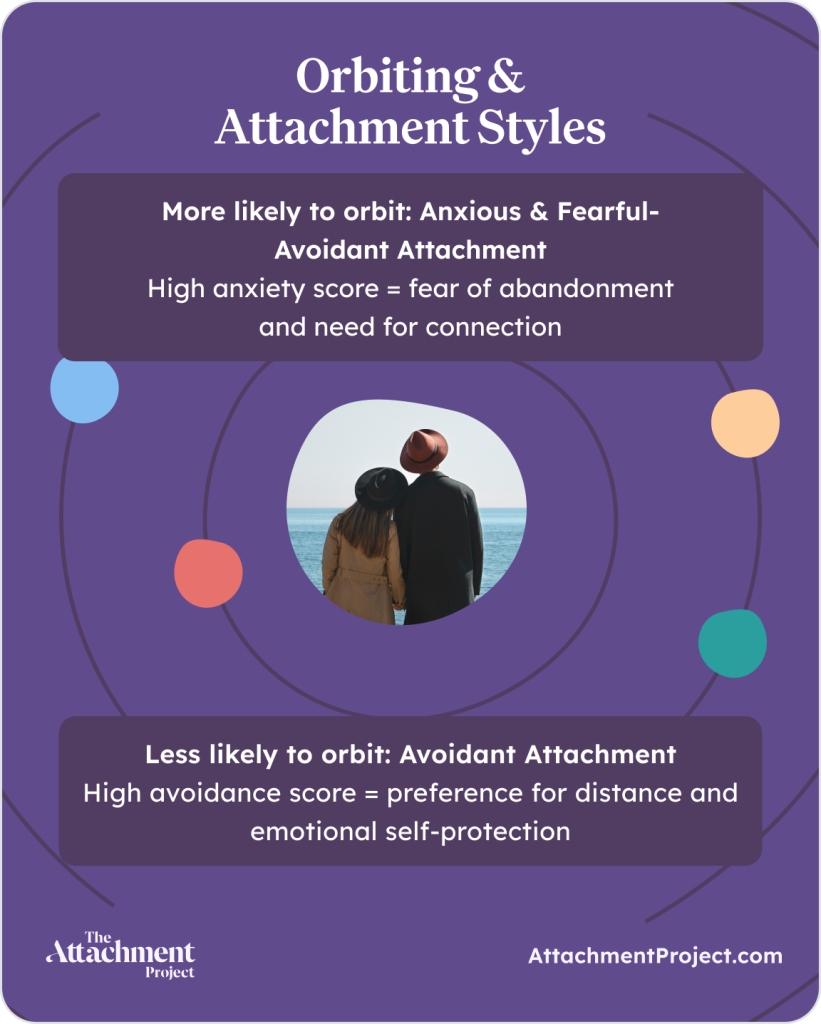
You might be wondering whether all this connects to someone’s attachment style – and you’d be right. The same study that found higher levels of distress led to more frequent orbiting behaviors in 2015 also had participants answer questions about their anxious and avoidant attachment style behaviors. Those who scored higher on anxious attachment behaviors were more likely to orbit, while those who scored higher on avoidant attachment behaviors were less likely to do so.
The same psychologists looked specifically at our attachment styles and social media monitoring a year prior (Fox, 2014). They predicted that people with an anxious attachment style would be more likely to orbit than others, so they compared this group with all of the other attachment styles.
They were almost correct: while, as predicted, anxious attachment types were more likely to orbit than secure and avoidant attachment types, they were just as likely to orbit as disorganized attachment types. Their conclusion was that the anxiety associated with both of these attachment types was the reason for the orbiting behavior.
In an exploration of “intermittent attachment”, comparable to anxious attachment, psychologist Vinenzo Maria Romeo notes the ways that orbiting exemplifies these behaviors:
“Orbiting can create a sense of lingering presence and unresolved tension, as the individual on the receiving end is left to interpret these indirect signals without the context of direct communication. This form of digital presence can prevent the emotional resolution of a relationship, perpetuating cycles of attachment and detachment that are characteristic of intermittent attachment.” (Romeo, 2023)
Do you know your attachment style?
Take our attachment quiz and find out now – fast, easy, free.
Social Media’s Role in Orbiting Behavior
The core concept of orbiting is not new – even though the name “orbiting” is fairly recent, orbiting behaviors can be explained through traditional psychosocial frameworks dating as far back as the 1980s.
However, the growth of social media has enabled us to display these orbiting behaviors with more ease than ever before. Where in previous decades we might have hung around our ex’s favorite coffee shops or asked around for their latest life updates, we can now do all this with the click of a button.
The more barriers there are between our impulse and our action, the more time we have to weigh the pros and cons, and the more likely we might be to change our minds – but social media removes these barriers completely. It enables us to instantly act on our emotions, instead of giving them time to pass.
The likes of Facebook, Instagram, and X make it easy to keep up with an ex, enabling us to stay in each other’s digital orbit without making direct contact. Sometimes, they even allow us to do this anonymously.
Impact of Orbiting in Relationships
This heightened ability to orbit has not made breakups any easier – in fact, the result seems to be the opposite. With the orbiter perpetuating their cycle of anxiety and the target left feeling uncertain about what their lingering presence means, both parties end up reporting higher levels of distress.
The target of the orbiting may take their ex partner’s behavior as a signal to try to reconcile the relationship, only to be met with rejection, reopening the original wounds left by the breakup. Over time, trust can erode and any remaining feelings of amicability can be broken down.
The one upside is that orbiting does appear to soften the initial blow of the breakup for the person being orbited, with many people reporting that their ex’s continued presence made them feel hopeful or acknowledged. One study participant stated:
“Honestly, when I discovered the first signs of orbiting, I felt appreciated, because somehow I know I was still in this person’s thoughts, for better or for worse.” (Pancani, 2021).
However, once the realization sets in, many on the receiving end of orbiting behaviors realize that the hope they’ve been given was false. They report a mix of anger, guilt, sadness, anxiety, and a sense of injustice. Without a proper explanation for the orbiter’s behavior, or the one they were hoping for, many people wonder whether they have done something wrong to cause it. The answer is usually no – as we’ve explored above, orbiting is usually down to the individual’s own distress and inability to separate.
Recognizing and Managing Orbiting
Dealing with an orbiter can be really distressing – breakups are often painful enough, and nobody wants to prolong that pain. If you think somebody in your life might still be orbiting, here are a couple of questions to consider:
- Do they continuously interact with your social media posts, even though they wanted to cut contact?
- Do they continue to follow your profiles, even if you’ve unfollowed theirs?
- Do they stay in touch with your friends and family, or ask them about you?
If you answered “yes” to any of these, your ex may still be orbiting.
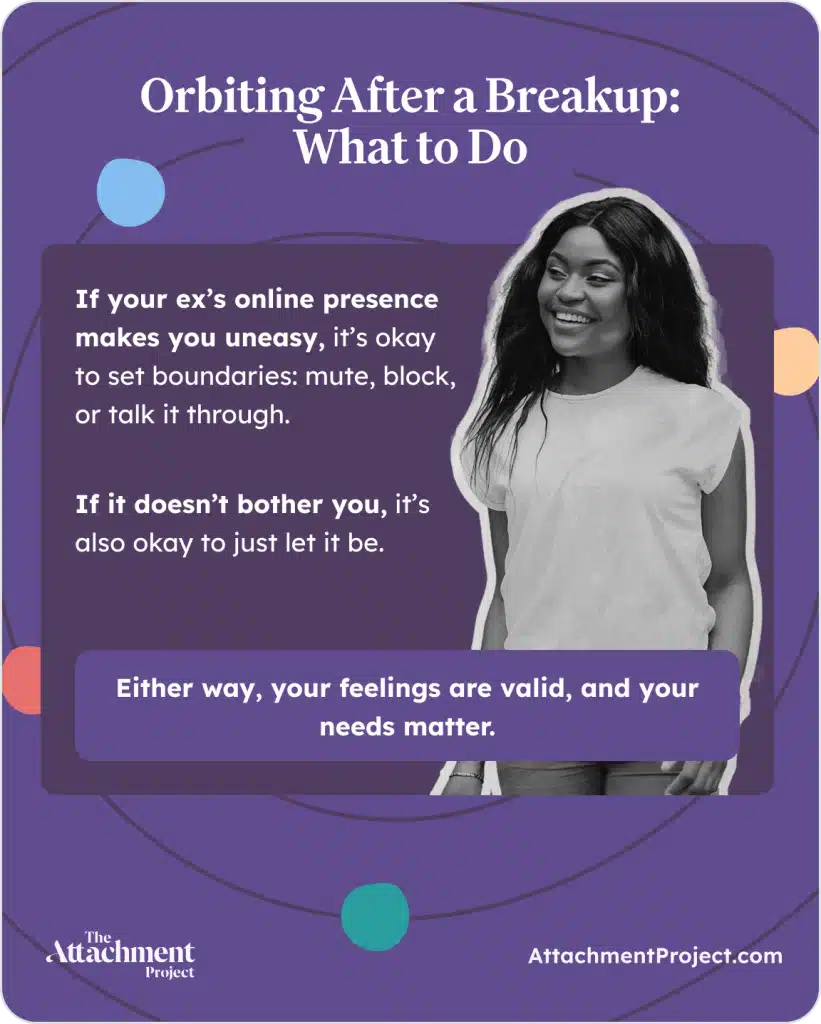
Everybody’s situation is different, and you may not be too concerned about this orbiting behavior. Some exes do decide to stay friends, and this can be particularly important when your social circles are small and you’re likely to cross paths again. If your ex’s orbiting doesn’t cause you distress or cross any of your boundaries, you probably don’t need to worry about it.
However, if you do find yourself feeling confused, anxious, or in any way unhappy with your ex’s orbiting behavior, you may need to consider putting more boundaries in place. If you still feel able to talk to your ex, you may wish to bring this up with them and discuss how it makes both of you feel. You might want to approach this conversation with renewed boundaries in mind, such as blocking or restricting your profile or removing friends and family.
You may also wish to put these boundaries in place without a discussion. Blocking their account and keeping your profiles private can prevent your ex from orbiting online, and you may wish to ask friends and family to do the same.
While usually enacted out of distress rather than malice, orbiting can prolong the pain and anxiety of a breakup for both parties. It’s important to acknowledge and care for your own needs during this time, and stronger boundaries may be the best solution to help the both of you move forward.

Fox, J., & Warber, K. M. (2014). Social networking sites in romantic relationships: Attachment, uncertainty, and partner surveillance on Facebook. Cyberpsychology, Behavior, and Social Networking, 17(1), 3-7.
Fox, J., & Tokunaga, R. S. (2015). Romantic partner monitoring after breakups: Attachment, dependence, distress, and post-dissolution online surveillance via social networking sites. Cyberpsychology, behavior, and social networking, 18(9), 491-498.
Hofmann, W., Friese, M., & Strack, F. (2009). Impulse and Self-Control From a Dual-Systems Perspective. Perspectives on Psychological Science, 4(2), 162-176. https://doi.org/10.1111/j.1745-6924.2009.01116.x
McDaniel, B. T., Drouin, M., Dibble, J., Galovan, A. M., & Merritt, M. (2021). Are you going to delete me? Latent profiles of post-relationship breakup social media use and emotional distress. Cyberpsychology, Behavior, and Social Networking, 24(7), 464-472.
Pancani, L., Mazzoni, D., Aureli, N., & Riva, P. (2021). Ghosting and orbiting: An analysis of victims’ experiences. Journal of Social and Personal Relationships, 38(7), 1987-2007. https://doi.org/10.1177/02654075211000417
Pancani, L., Aureli, N., & Riva, P. (2022). Relationship dissolution strategies: Comparing the psychological consequences of ghosting, orbiting, and rejection. Cyberpsychology: Journal of Psychosocial Research on Cyberspace, 16(2).
Romeo, V. M. (2023). Intermittent Attachment: A New Psychoanalytic Perspective. Journal of Contemporary Approaches in Psychology and Psychotherapy, Volume I, Issue, 1(1), 69 – 92. https://doi.org/10.57017/jcapp.v1.i1.06
 Get mental health tips straight to your inbox