









Stonewalling in Relationships: Attachment Styles and Emotional Shutdown

Has your partner ever suddenly stopped responding during an argument or an intense discussion? It might feel like they’ve switched off, or as if they’ve blocked you out so thoroughly that it’s like they don’t see or hear you anymore. Maybe you too have been so overwhelmed at times that it becomes difficult to engage – these are examples of stonewalling in relationships.
Stonewalling is a communication pattern in which one partner effectively “shuts down” during an overwhelming situation. It’s not a new term – “stonewalling” was first described by esteemed relationship psychologist John Gottman in 19911:
“Stonewalling is a behavior pattern in which the listener presents a stone wall to the speaker, not moving the face very much, avoiding eye contact or using what I call a monitoring eye contact pattern, holding the neck rigid and not using the usual listener responses such as head nods or brief vocalizations that tell the speaker that the listener is tracking.”
Gottman later included stonewalling as the final step in his Four Horsemen of the Apocalypse theory. The Four Horsemen of the Apocalypse are 4 behaviors measured during a couple’s conflict that predict a later break up: criticism, contempt, defensiveness, and finally, stonewalling2, 3. After stonewalling begins, both partners eventually emotionally withdraw from the conflict and from the relationship – Gottman’s method was able to predict 90% of divorces in only a 4-year period1.
As the last link in the chain, noticing and responding to stonewalling is vital to improving the way couples handle conflict. In this article, we’ll talk more about the psychology behind stonewalling, what it means when someone stonewalls you, and how you can develop healthier responses to conflict in your relationship.
START YOUR HEALTHY DATING JOURNEY
What is Stonewalling in Relationships?
Stonewalling describes the specific pattern of behavior where one partner stops responding entirely to the other during conflict. They may appear to have a flattened mood and seem unbothered by the argument. They can take on a stiffness or rigidity as if they’re not just ignoring you, but actively choosing to be unresponsive.
As with many psychological concepts, its common definition has broadened over time. You may see typical avoidant behaviors like changing the subject or physically leaving the room listed as stonewalling behaviors, but these don’t form part of its psychological definition.
Gottman’s original research found that men were much more likely to stonewall than women, based on observations of their behavior. More recent research (completed as part of a doctoral thesis) based on heterosexual couples has found that women rated their own use of stonewalling higher than their male partners – but this doesn’t mean that it truly was4. The men in this study did not rate their female partners’ use of stonewalling higher than their own, suggesting that perhaps one partner’s perception of stonewalling behavior was inaccurate.
No matter who’s doing the stonewalling, it’s never a good sign. Lower satisfaction in relationships predicts more stonewalling behaviors, and, as Gottman found, both of these relationship issues contribute to an eventual break up5, 1.
Stonewalling often arises during an intense conflict. Physiological markers of stress, like high heart rate and sweating, have been linked with stonewalling, suggesting it’s the emotional intensity of the conflict that’s behind the behavior instead of an intentional manipulation or the freeze trauma response3.
Stonewalling Examples: How to Recognize It in Relationships
So, how can you tell when someone is stonewalling?
During an argument, someone who’s stonewalling might:
- Stop responding verbally
- Have limited facial expressions
- Avoid eye contact or looking in your direction
- Stay still
- Appear unaffected
The basic idea of stonewalling is that the stonewaller stops giving any signs that they’re listening – it may look like they’re staring into space, thinking hard, or purposely ignoring you.

Silent Treatment vs. Stonewalling
Stonewalling can sometimes be mistaken for “the silent treatment”. When one partner gives another the silent treatment, they purposely cease to give their partner verbal responses. This is not the same as stonewalling.
During the silent treatment, the perpetrator might still show that they’ve heard their partner through expressions or other non-verbal cues, like nods or eye rolls. They might not seem as physically withdrawn, and they may continue the silent treatment for days.
In a 2022 research paper on the silent treatment, women who engaged in it did so to communicate distress, assert their value in their partner’s life, punish their partner, or to take a timeout to process their emotions6. This usually has a negative impact on relationships, leaving the original disagreement unresolved7. In some cases, the relationship ends abruptly because neither partner was willing to approach the other to end the silent treatment.
The psychological definition of stonewalling, on the other hand, describes an unintentional behavior that results from overwhelm or emotional flooding.
The Psychological Mechanism Behind Stonewalling
Emotional Flooding
Emotional flooding is when the emotional demand of the situation outweighs your emotional capacity. Studies have found that it’s more likely to happen when either partner feels angry, when the non-flooded partner displays their anger, and in relationships that are characterized by instability and aggression8.
When you start to feel emotionally overwhelmed, you might notice physical signs of stress: a faster and stronger heartbeat, sweating, and muscle tension. This is a good time to step away from the conversation and come back to it when you feel calmer.
Men typically have a lower threshold for flooding during relationship conflict, meaning they tend to be quicker to emotional overwhelm – which may explain why observations found that they had a greater tendency to stonewall3.
Stonewalling vs. Taking Space
During relationship conflict, it’s a good idea to take some space, especially if your emotions are starting to become overwhelming… but can taking space be mistaken for stonewalling?
When you need to take some space, don’t simply switch off from your partner. Let them know that you need some time to calm down or think about what’s happened and communicate the boundaries you need to set going forward, even if they may be temporary.
As long as you communicate your needs, taking space shouldn’t be confused with stonewalling.
Attachment Styles and Stonewalling Behaviors
We understand that communicating your needs is sometimes easier said than done, especially if you have an insecure attachment style. Your attachment style can play into how you handle conflict in relationships, including how you might resort or respond to stonewalling.
Since stonewalling appears to be quite an avoidant behavior, it’s often assumed that it will correlate with avoidance in attachment styles. However, this isn’t always the case – as we’ll see below:
DISCOVER YOUR ATTACHMENT STYLE
Dismissive-Avoidant Attachment and Stonewalling
Starting with avoidant attachment styles, yes, avoidance can be linked with stonewalling5. This does fit avoidant tendencies to disengage when faced with emotional conflict. As with other experiences of avoidant deactivation, this doesn’t mean the avoidant person is being intentionally hurtful or manipulative – their attachment system has simply learned that the best way to preserve a relationship is to withdraw from it when they feel it’s at risk.
How Anxious Attachment Experiences Stonewalling
Contrary to many assumptions, anxious attachment has also been associated with stonewalling4, 5. Stonewalling is just one of many dysfunctional communication styles, and anxiously attached partners tend to score highly on more of these – so stonewalling is no exception.
Whether people with anxious attachment styles are more affected by their partner’s stonewalling has yet to be studied. It could be assumed that anxious attachment styles are more likely to feel that their relationship is under threat and escalate the conflict in search of a response from their partner; one doctoral thesis did find that stonewalling is a particularly “aggravating factor” in divorce for people with anxious attachment styles9.
However, online forum users representing all 4 attachment styles report that they feel seriously upset when somebody stonewalls – including secure attachments.
Secure Attachment Responses to Stonewalling
Being on the receiving end of a stonewalling partner isn’t nice for anyone, and even people with secure attachment styles report that being stonewalled can be “triggering” and make them “very unhappy”.
While secure attachments might not make us immune to the effects of stonewalling, they could protect us from it happening in the first place. Relationships in which at least one partner has a secure attachment style have been found to be higher in quality and less likely to use dysfunctional communication patterns, which can help to prevent conflict reaching the stonewalling stage10.

The Emotional Effects of Stonewalling on Relationships
Stonewalling is not only hurtful in itself, but it’s symptomatic of bigger relationship problems. As the final of Gottman’s Four Horses of the Apocalypse, reaching the stage of stonewalling means that problem solving in a relationship has been continuously unsuccessful. When stonewalling is occurring frequently, this signals that unresolved conflict is repeatedly causing problems. It is not only the stonewalling that we should be looking out for, but the meaning behind it.
Impact on the Person Being Stonewalled
The person being stonewalled might feel that their partner is “checking out” – that they’re no longer interested in solving the problem or continuing the relationship. They might mistake stonewalling for the silent treatment and not realize that their partner doesn’t mean to punish or manipulate them.
Gottman’s research found that stonewalling by one partner in a relationship often leads to their withdrawal, which, after failed attempts to re-engage them, leads to their partner’s withdrawal too1. After this point, it is difficult to restore emotional investment in the relationship.
Impact on the Person Who Stonewalls
The person who stonewalls may not be doing it on purpose. When they are emotionally flooded, they may not know how to respond to conflict anymore. Stonewalling is distressing for both partners, and linked to lower relationship satisfaction in both.
As conflict continues to build, this partner’s ability to cope may become smaller and smaller, leading to higher likelihood of stonewalling with each disagreement. To intercept this process, it’s important to learn healthy patterns of communication.
How to Respond to Stonewalling
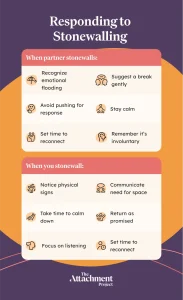
When your partner begins stonewalling, remember that it is not an intentional response; they are overwhelmed, and likely feeling the same hurt and frustration as you are. Try to give them some space, and communicate that you’re doing this from a place of care. It’s best to try to resolve conflict when both of you are feeling calm and ready to talk.
Immediate Strategies When Faced With Stonewalling
Since stonewalling arises from two-way conflict, it takes effort from both partners to improve communication skills. Whether you’re prone to stonewalling or often on the receiving end, the same advice can be helpful11.
When you’re feeling overwhelmed during conflict, the first step to de-escalating is to notice how you feel. This takes practice, but emotional awareness is a skill that can be learned. When you’re aware of how you feel, you can start taking steps to self-regulate. Once you feel calmer and more open to communication, you might feel more empathic and receptive to your partner’s needs.
When you notice you need space, let your partner know that you need it because you want to solve the problem, not avoid it. If you can, let them know when you think you’ll be ready to talk again so that they’re not facing an indefinite period of separation. It’s important that both of you act from a place of care and appreciation for each other, even if you feel frustrated.
Long-Term Approaches to Changing Stonewalling Patterns
If stonewalling is a frequent problem, it may help to set boundaries and expectations around disagreements. For example, this might look like an agreement that each of you can take space without judgement any time you start to feel overwhelmed, or that you will immediately take space when either certain triggers or the first of the Four Horsemen (criticism) arise.
Learning better emotional regulation and communication skills will also help both partners to better handle conflict.
It’s also important to address the underlying issue if stonewalling is a regular occurrence. If there’s a persistent unresolved problem in your relationship, you may find it helpful to seek support from a professional.
Since stonewalling is the last of Gottman’s Four Horsemen, its presence suggests that criticism, contempt, and defensiveness are already present in your relationship. Try to notice these when they come up and set boundaries around these behaviors too.
START YOUR HEALTHY DATING JOURNEY
Responding to an Avoidant Partner’s Stonewalling
If your partner has both an avoidant attachment style and a tendency to stonewall, remember that they will be especially repelled by attempts to re-engage with them. It’s extra-important to give your partner space to process how they’re feeling to avoid the demand-withdrawal cycle and avoidant deactivation.
To avoid triggering people with avoidant attachment styles during conflict, try to use soft communication styles – this has been found to reduce feelings of anger in the avoidant partner and lead to more successful discussions12.
Self-Care When Dealing With Chronic Stonewalling
If you’re feeling hurt by your partner’s frequent stonewalling, it’s important to look after yourself first. Even if their actions are unintentional, the hurt you feel is completely understandable.
Make sure you have a good support system outside of your relationship – whether it’s friends, family, or an activity group, it’s important to have other people to talk to (even if you don’t want to talk about your relationship with them!).
Have a think about whether or not you can continue to accept this dynamic. If the answer is no, find a good time when you’re both calm and receptive to tell your partner how stonewalling makes you feel. It could be good to learn about your communication style and practice emotional awareness and regulation skills together.
In any case, remember that your partner’s actions are ultimately a reflection of their internal processes, not one of you – if you continue to work on your own emotional wellbeing regardless of their behavior, you may find that conflicts become easier to solve.
Conclusion
Stonewalling can be very disruptive in itself, but it often signifies a continuous problem with communication in a relationship. Both avoidant and anxious attachment styles have been linked with the use of stonewalling, consistent with research findings that insecure attachment styles tend towards less effective conflict resolution skills.
The good news is that these patterns can be changed. It takes time and effort from both partners, but better emotional awareness and regulation skills can lead to more effective problem solving and ultimately intercept stonewalling before it even happens.
As stonewalling is the last of Gottman’s Four Horsemen, it’s really important to evaluate the conflict in your relationship before it turns to emotional withdrawal on both sides. Remember to approach this with compassion for both yourself and your partner, and you’ll be on your way to healthier communication.
FAQs About Stonewalling in Relationships
Is stonewalling always intentional?
Stonewalling, by its psychological definition, is not intentional. You might stonewall when you become emotionally flooded, or overwhelmed, by conflict with your partner.
What’s the difference between needing space and stonewalling?
Needing space is a healthy and ideally well-communicated approach to processing your emotions during an intense discussion. Stonewalling effectively blocks out your partner with no warning, leaving them feeling ignored and frustrated.
How do I know if my partner’s stonewalling is related to their attachment style?
If your partner has high attachment avoidance or attachment anxiety, they may be more likely to stonewall. This could be related to poorer communication skills.
Should I stay in a relationship where I’m constantly stonewalled?
If you’re being stonewalled constantly, this may signify deep problems within the relationship that both of you are finding difficult to solve. You may wish to consider whether you will be able to solve these problems at the root.
What if both partners stonewall during conflicts?
If both partners stonewall, this can lead to emotional withdrawal. Both partners should try to work on emotional awareness and regulation skills to de-escalate conflict before they become emotionally flooded.
What trauma causes stonewalling?
Trauma is not thought to lead to stonewalling, but it could lead to the freeze response, which may be mistaken for stonewalling. We know these are different because the freeze response involves parasympathetic nervous system activation, while the sympathetic nervous system stays activated during stonewalling.
How to fix stonewalling?
Stonewalling is a symptom of broader communication difficulties. The best way to avoid it is for both partners to improve their skills in emotional awareness, regulation, and communication, which can help to address the root problem.
References
- Gottman JM. Predicting the longitudinal course of marriages. Journal of marital and Family Therapy. 1991 Jan 1;17(1):3-7.
- Gottman JM, Levenson RW. Marital processes predictive of later dissolution: behavior, physiology, and health. Journal of personality and social psychology. 1992 Aug;63(2):221.
- Gottman JM. A theory of marital dissolution and stability. Journal of family psychology. 1993 Jun;7(1):57.
- Whelan SE. An exploration of marital interaction: The relationship between Gottman’s conflict resolution style and’four horsemen’, attachment theory, perception, gender and marital satisfaction (Doctoral dissertation, Swinburne).
- Fowler C, Dillow MR. Attachment dimensions and the four horsemen of the apocalypse. Communication Research Reports. 2011 Feb 2;28(1):16-26.
- Agarwal S, Prakash N. When silence speaks: Exploring reasons of silent treatment from perspective of source. International Journal of Trend in Scientific Research and Development. 2022;6(3):1458-72.
- Agarwal S, Prakash N. Psychological costs and benefits of using silent treatment. J Res Humanit Soc Sci. 2022;10(4):49-54.
- Malik J, Heyman RE, Smith Slep AM. Emotional flooding in response to negative affect in couple conflicts: Individual differences and correlates. Journal of Family Psychology. 2020 Mar;34(2):145.
- McNelis M. Exploring Gray Divorce Through Attachment, Communication and Repartnering (Doctoral dissertation, The University of Arizona).
- González-Ortega E, Orgaz-Baz B, Vicario-Molina I, Fuertes-Martín A. Adult attachment style combination, conflict resolution and relationship quality among young-adult couples. Terapia psicológica. 2020 Nov 6;38(3):303-16.
- del Castillo-López ÁG, Berenguer-Soler M, Pineda D, del Castillo JA. Emotional Flooding in Couple Relationships: Psychosocial Aspects and Regulatory Strategies.
- Overall NC, Simpson JA, Struthers H. Buffering attachment-related avoidance: softening emotional and behavioral defenses during conflict discussions. Journal of personality and social psychology. 2013 May;104(5):854.
 Get mental health tips straight to your inbox