



Why You’re Overthinking: The Psychology and Attachment Perspective

Key Points
- Overthinking is excessively worrying about things that are past, present, or future.
- Severe overthinking can become rumination, which describes compulsively focusing on negative thoughts.
- Stressful life events are linked to overthinking – anyone can find themselves overthinking, but some of us might be more susceptible to it than others.
- Overthinking isn’t a disorder, but it plays a role in existing diagnoses like ADHD, OCD, and PTSD.
- People with attachment avoidance can be just as likely to overthink as people with attachment anxiety.
Is overthinking taking over your life? Laying awake at night, replaying what happened before and imagining what might happen in the future – we all know what it feels like to overthink, but why do we do it when it causes so much distress?
With 73% of young adults reporting overthinking and research links to depression and anxiety, it’s important to understand why we overthink and how to stop overthinking.
In this article, we’ll explain the science behind overthinking and how we can look at it from an attachment perspective. We’ll talk about what causes overthinking, the signs of overthinking, and whether or not psychological research has linked overthinking to ADHD, OCD, or trauma.
What Is Overthinking?
Overthinking is excessively worrying about situations that have happened in the past or could happen in the future. In clinical terms, severe overthinking can become rumination: compulsively focusing on negative thoughts. Other psychological terms for rumination are “perseverative thinking” or “perseverative cognition” [1].
Rumination can be categorized in lots of different ways. Some studies differentiate between depressive, angry, and intellectual rumination, and others between reflection, brooding, intrusive, and deliberate rumination. All forms of rumination could be considered overthinking.
Some amount of overthinking is normal, but when it feels like it’s out of our control, it can become difficult to manage. The content of overthinking isn’t necessarily the problem, but the frequency and duration of overthinking is.

Overthinking, Rumination, and Worry: What’s the Difference?
Rumination and worry have been conceptualized as related but distinct ideas, with rumination sharing closer links to depression and worry to anxiety. In this article, we’ll consider both under the overthinking umbrella.
Sometimes it does help us to spend time thinking about a past or future situation – reflection and preparation can be productive when we engage with them healthily. However, when we overthink, we tend to go around and around without finding a solution.
What Causes Overthinking?
According to one study, stressful life events are associated with increased rumination, and the amount that we ruminate after a stressful life event influences later symptoms of anxiety and depression [2].
Rumination is associated with differences in cognitive mechanisms, particularly attentional inflexibility, or difficulty switching attention to a new task [3]. Depressive rumination has been associated with difficulty stopping the processing of previous information, while angry rumination (repetitive thoughts about angry experiences) and intellectual rumination (philosophical or intellectual self-reflection) have both been associated with difficulty switching attention to something new.
One study found that increased tendency to overthink was associated with [4]:
- Greater need to understand a situation
- Increased personal importance of the situation
- Dwelling on the causes and meanings of situations
- Greater disapproval of worry-related intrusive thoughts
- Coping with worry by replacing worrisome thoughts with other unpleasant thoughts
In summary, your tendency to overthink could be caused by the combination of cognitive vulnerability and the added impact of life stressors.
 Is Overthinking a Disorder?
Overthinking itself is not a disorder, but it does play a role in some other diagnoses. Overthinking has been noted to be involved and possibly a causal factor in almost all of the DSM-IV’s “Axis 1” disorders, which include mood disorders, anxiety disorders, psychotic disorders, eating disorders, and substance use disorders [5].
Overthinking on its own isn’t necessarily a sign of a disorder – it’s a natural human experience, especially when we’re experiencing something stressful. However, if you feel that overthinking is causing significant distress and getting in the way of you living your life, it might be worth talking to a licensed mental health professional.
Overthinking and ADHD
Rumination is a form of mind-wandering, which is common in ADHD (attention deficit hyperactivity disorder) [6]. Symptoms of depression and anxiety are also common in ADHD, and research has revealed that rumination plays a role in this relationship: higher ADHD symptoms were associated with greater tendency to ruminate, and a greater tendency to ruminate was associated with more severe symptoms of depression and anxiety [6].
Notably, this study also found that higher trait mindfulness – a natural inclination to be present and non-judgemental of your thoughts and feelings – was associated with lower depression and anxiety symptoms.
Overthinking and OCD
Intrusive thoughts and distress caused by them are central to obsessive-compulsive disorder (OCD). OCD isn’t an obsession with being clean, although it can manifest this way – rather, it’s uncontrolled intrusive thoughts that compel us to act in ways that might be irrational. For example, someone with intrusive thoughts about loved ones being unwell might feel compelled to repeat a mantra to keep them safe, even when this distracts them from daily tasks.
In line with this, rumination has been associated with obsessions and compulsions related to distressing thoughts in OCD [7].
Overthinking and Trauma
If we’ve been through something traumatic, whether or not it resulted in post-traumatic stress disorder (PTSD), we might experience rumination on what happened and worry that it will happen again. Rumination could directly contribute to symptoms of PTSD by increasing negative reactions to triggers [8].
Not all trauma leads to PTSD; our tendency to ruminate, but not worry, pre-trauma has been associated with later PTSD development post-trauma [9].

Overthinking and Attachment Styles
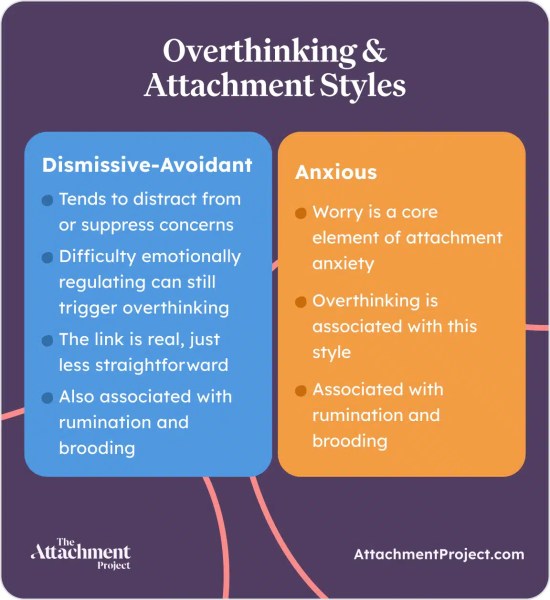
Even outside of the context of relationships, your attachment style can be associated with your tendency to overthink. One study found that high attachment anxiety was associated with increased rumination [10] – another found that both attachment anxiety and attachment avoidance were associated with brooding and depressive rumination [11]. Higher emotional intelligence was able to influence this association, which involves buildable emotional regulation skills.
Worry is a core element of attachment anxiety, so it makes sense that it might be associated with overthinking. Attachment avoidance, on the other hand, is characterized by distracting from, or not acknowledging, the things we’re concerned about – which might explain why some studies find no association between overthinking and avoidance.
However, avoidance still comes with difficulty emotionally regulating, so it also makes sense that some studies do find an association between attachment avoidance and overthinking [12].
Signs and Symptoms of Overthinking
If you’re overthinking, you might notice the following patterns of thoughts, feelings, and behavior:
- Lack of confidence
- Difficulty focusing on the present
- Difficulty making and sticking to decisions
- Taking time to reflect leads to distress instead of relief
- Feelings of regret or shame about the past
Remember, we all overthink sometimes, especially when life is getting stressful and we’re going through big changes – it’s normal to overthink on occasion. If overthinking is causing significant distress and preventing you from being able to complete day to day activities, it might be worth seeking support from a licensed mental health professional.

Overthinking in Relationships
We might experience overthinking in relationships because there are lots of potential emotional triggers – especially if we have an insecure attachment style. Relationships challenge our ability to emotionally regulate and often bring out parts of ourselves that we don’t feel a need to address outside of close relationships.
If you’re prone to overthinking, relationships can therefore be a significant trigger. You might overthink your past interactions with your partner, overthink your partner’s reactions or behaviors, and overthink the future of your relationship.
When you’re struggling with overthinking in your relationship, it’s important to get to the root of the problem and avoid blaming your partner. It can be helpful to seek support from a licensed mental health professional.
Conclusions
Overthinking is a common problem, and a normal thing to experience when life is full of stressors. However, when overthinking causes significant distress or stops you from doing what you want or need to do, it might be a major problem.
Overthinking is a risk factor for lots of different mental health conditions, but overthinking itself isn’t a disorder. Life stress and cognitive differences can make us more susceptible to overthinking.
Relationships challenge us in lots of ways, and might trigger overthinking if we’re already prone to it. We might be more likely to overthink if we have an insecure attachment style, and understanding this connection can help us to stop overthinking from affecting our relationships. For more, read our article on how to stop overthinking.
To find out more about your own attachment style and receive a free personalized attachment report, take our attachment quiz.

FAQs About Overthinking
Is overthinking a sign of ADHD?
Overthinking is associated with ADHD, but it’s also a normal human experience and doesn’t necessarily mean you have ADHD.
Is overthinking a trauma response?
Again, overthinking is associated with trauma, but it’s also a normal human experience and doesn’t necessarily mean you are experiencing a trauma response.
Can overthinking kill you?
Overthinking itself cannot kill you, even if you’re having intrusive, obsessive, or anxious thoughts about this. If you feel overwhelmed or unsafe, seek support from a licensed mental health professional.
Is overthinking a personality trait?
Overthinking is typically considered a behavior rather than a personality trait – we can learn how to stop overthinking.
How is overthinking connected to OCD?
OCD is characterized by intrusive, obsessive thoughts and compulsive behaviors. Rumination has been associated with distressing thoughts, intrusions and compulsions in OCD.
References
- Moulds ML, McEvoy PM. Repetitive negative thinking as a transdiagnostic cognitive process. Nature Reviews Psychology. 2025 Feb;4(2):127-41.
- Michl LC, McLaughlin KA, Shepherd K, Nolen-Hoeksema S. Rumination as a mechanism linking stressful life events to symptoms of depression and anxiety: longitudinal evidence in early adolescents and adults. Journal of abnormal psychology. 2013 May;122(2):339.
- Whitmer AJ, Banich MT. Inhibition versus switching deficits in different forms of rumination. Psychological science. 2007 Jun;18(6):546-53.
- Watkins E. Appraisals and strategies associated with rumination and worry. Personality and Individual Differences. 2004 Sep 1;37(4):679-94.
- Ehring T, Watkins ER. Repetitive negative thinking as a transdiagnostic process. International journal of cognitive therapy. 2008 Sep;1(3):192-205.
- Kandeğer A, Odabaş Ünal Ş, Ergün MT, Yavuz Ataşlar E. Excessive mind wandering, rumination, and mindfulness mediate the relationship between ADHD symptoms and anxiety and depression in adults with ADHD. Clinical psychology & psychotherapy. 2024 Jan;31(1):e2940.
- Raines AM, Vidaurri DN, Portero AK, Schmidt NB. Associations between rumination and obsessive-compulsive symptom dimensions. Personality and individual differences. 2017 Jul 15;113:63-7.
- Wisco BE, Vrshek‐Schallhorn S, May CL, Campbell AA, Nomamiukor FO, Pugach CP. Effects of trauma‐focused rumination among trauma‐exposed individuals with and without posttraumatic stress disorder: An experiment. Journal of Traumatic Stress. 2023 Apr;36(2):285-98.
- Spinhoven P, Penninx BW, Krempeniou A, van Hemert AM, Elzinga B. Trait rumination predicts onset of Post-Traumatic Stress Disorder through trauma-related cognitive appraisals: A 4-year longitudinal study. Behaviour Research and Therapy. 2015 Aug 1;71:101-9.
- Burnette JL, Davis DE, Green JD, Worthington Jr EL, Bradfield E. Insecure attachment and depressive symptoms: The mediating role of rumination, empathy, and forgiveness. Personality and Individual Differences. 2009 Feb 1;46(3):276-80.
- Lanciano T, Curci A, Kafetsios K, Elia L, Zammuner VL. Attachment and dysfunctional rumination: The mediating role of Emotional Intelligence abilities. Personality and individual differences. 2012 Oct 1;53(6):753-8.
- Messina I, Calvo V, Grecucci A. Attachment orientations and emotion regulation: new insights from the study of interpersonal emotion regulation strategies. Research in Psychotherapy: Psychopathology, Process, and Outcome. 2024 Jan 15;26(3):703.
 Get mental health tips straight to your inbox