









People Pleasing and Attachment: Why You Can’t Say No
If you’re a people pleaser, you might find it difficult to say no, set boundaries, and assert yourself. Putting other people first isn’t always a bad thing, but when you’re people pleasing, it’s to the detriment of yourself and the people you’re trying to please.
People pleasing has some surprising links to attachment theory. In this article, we’ll explore why you might be a people pleaser, how to spot the signs of a people pleaser, and how to stop people pleasing once and for all.
What is People Pleasing? Definition and Meaning
Taylor Swift popularized the phrase “pathological people pleaser”, but what does people pleasing mean, and can it really be pathological?
People pleasing itself is not a diagnosis, but people with diagnoses like anxiety, ADHD, and autism tend to report people pleasing as a significant part of their experience. People pleasing involves putting other people first even when you don’t want to, sometimes to the extent that it’s harmful to your own wellbeing; in this way, people pleasing can indeed be pathological in the sense that it can be compulsive, but it’s not always part of a diagnosis.

People Pleasing vs. Kindness: Understanding the Difference
Some people find it difficult to tell whether they’re people pleasing or just being kind, and there can be a thin line between them.
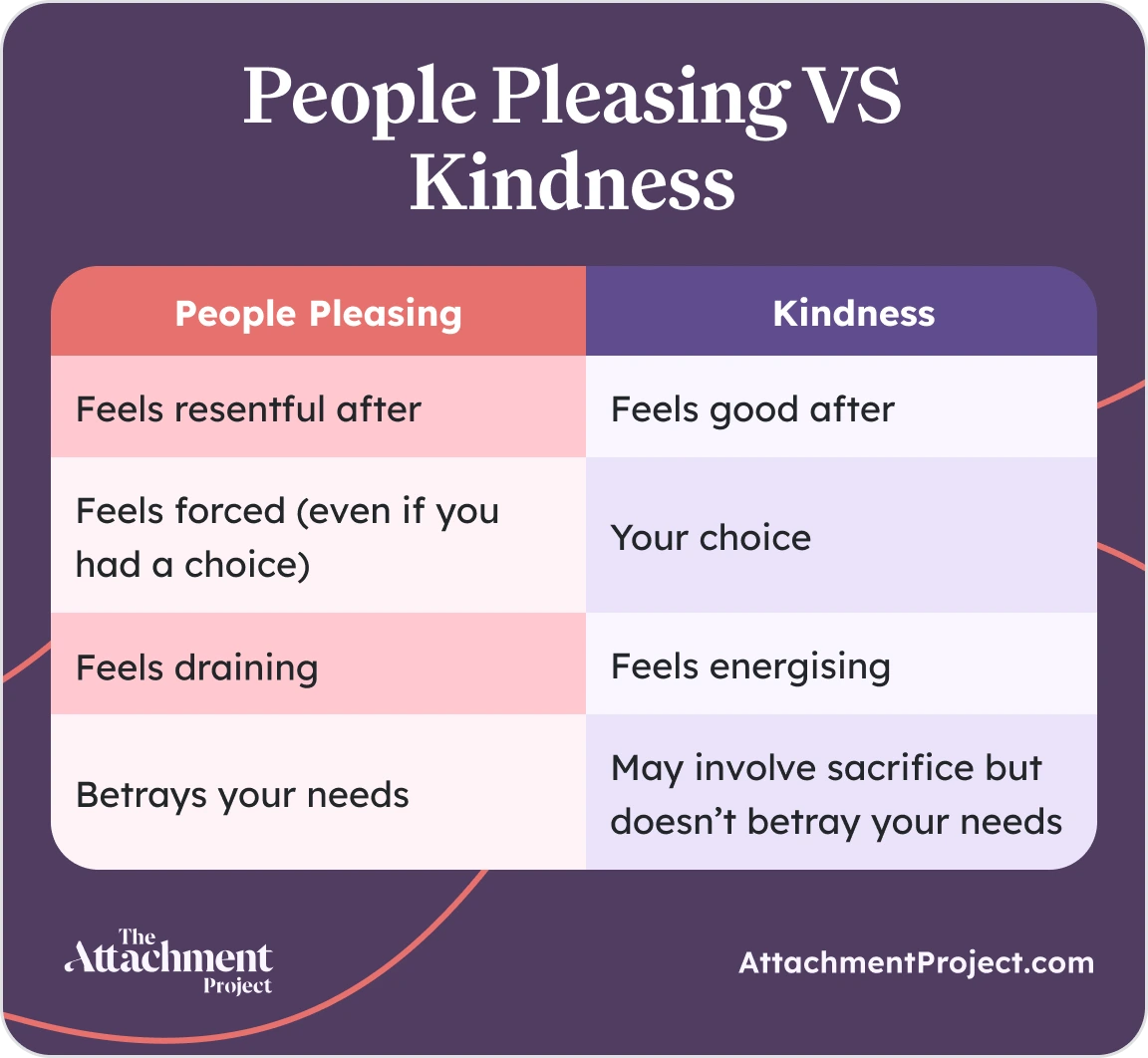
An important distinction is how you feel afterward – let’s say your coworker asks to switch their day off with you. You already had plans on your day off; your friend is in town from a long way away and you don’t know when you’ll next be able to see them, but your coworker has a medical appointment they can’t reschedule. You say yes, figuring you’ll have to see your friend for just an hour or two after work.
DISCOVER YOUR ATTACHMENT STYLE
If you feel warmly towards your coworker after this and hopeful that your friend will understand the circumstances, you can chalk this instance up to kindness. Kindness makes us feel good and socially rewarded, and you likely have a sense that you chose to take this action freely, not pressured into it.
However, if you feel resentful of your coworker and guilty or anxious about telling your friend, you might have been people pleasing. People pleasing might make us feel temporarily relieved, but relief from a negative feeling isn’t the same as experiencing a positive feeling. People pleasing can feel like you did something because you felt pressured to and not because you had a choice – even if you did.
10 Signs You’re a People Pleaser
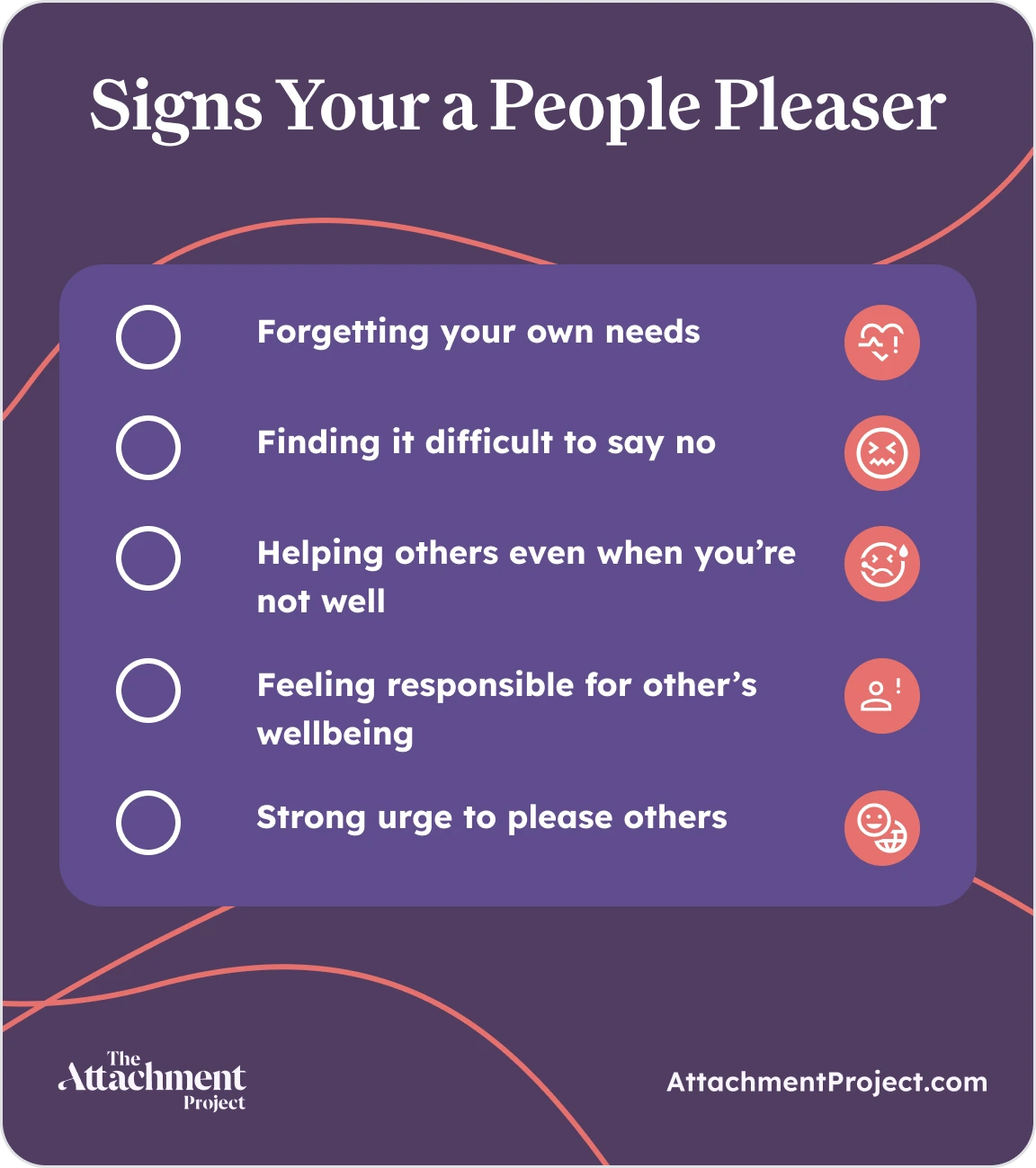
This year, German psychologist Christian Blötner created a 10-point questionnaire to measure people pleasing behaviors, with each question relating to either neglect of your own needs, a sense of responsibility for others, or concern for others’ expectations1. The signs they identified were:
- Forgetting your own needs
- Finding it difficult to stand up for your needs
- Preferring to help others over yourself even when you’re not well
- Neglecting your needs to help others
- Feeling responsible that others are fine
- Feeling responsible for others’ wellbeing
- Feeling a strong desire to care for others
- Trying to fulfill others’ expectations
- Having a strong urge to please others
- Finding it difficult to say no to others
These are context-dependent – for instance, it would be normal to feel this way about your own young children or people you are responsible for, but we cross into people pleasing when we feel this way in general and about people we have no actual responsibility for.
The Psychology Behind People Pleasing
People pleasers can find it difficult to understand why they act the way they do, especially when it often goes against their own wishes. People pleasing has been linked with rejection sensitivity, emotional monitoring, low self-worth, and anxiety2. The impact of rejection sensitivity can be particularly high for people with neurodivergent brains, such as people with ADHD.
Early Maladaptive Schemas and People Pleasing
We all have stories we tell ourselves about the world and how we fit into it – these are called our schemas, and they set our assumptions and expectations about how we interact with others. When we experience difficulties and unmet needs in childhood, we can develop early maladaptive schemas which influence us in negative ways.
Researchers in the Netherlands highlighted 3 maladaptive schemas, often occurring together, linked to prioritizing others’ needs over our own3:
Enmeshment and Undeveloped Self: Enmeshment describes an intensely dependent relationship in which personal boundaries are absent, and the undeveloped self describes a lack of personal identity. They don’t always appear together, but often do. People with the Enmeshment and Undeveloped Self schema find it difficult to separate themselves from close relationships and may feel a lot of jealousy and anxiety.
TAKE OUR MALADAPTIVE SCHEMA TEST
Subjugation: Subjugation arises from controlling caregivers and leads us to feel powerless. People with the Subjugation schema fear that expressing their needs will lead to punishment or rejection, so they put their needs aside to maintain closeness with others.
Self-Sacrifice: The Self-Sacrifice schema involves an excessive focus on the needs of others to avoid feelings of guilt or abandonment fears. Parents of people with the Self-Sacrifice schema might have needed lots of care and “parentified” their children.
Each one of these schemas on their own could lead to people pleasing behavior, but all 3 often come together – and when they do, we find ourselves highly focused on other people and eager to please them to avoid negative emotions.
Is People Pleasing a Trauma Response? People Pleasing and Fawning
One of the common trauma responses, fawn, is also linked to people pleasing4.
Fawning is linked with longer term interpersonal trauma, meaning someone else was a repeated source of fear rather than a one-off event or an accident or natural disaster. Your trauma responses are designed to help you survive, and when you fawn, it’s like your brain is thinking: “I can overcome the threat by making it happy; I can get the threat on my side.”
Since this is a matter of survival, this can quickly become a loss of independence, self-identity, and boundaries. Even when the threat is gone, these patterns are tough to break. Your brain has learned to keep itself safe through people pleasing, so you can find that you revert back to it any time you feel stressed or you’re in conflict.
However, people pleasing isn’t always part of the fawn response, so being a people pleaser doesn’t necessarily mean you have a history of trauma. If you are experiencing the fawn response, you may have other symptoms of trauma such as flashbacks, avoidance, and low mood.
Attachment Styles and People Pleasing
People pleasing is easily linked with attachment anxiety, since dependence and a need for closeness are characteristic of anxious attachment styles – but you may be surprised to hear that it’s also linked with attachment avoidance.
The Netherlands study published this year found that Enmeshment and Undeveloped Self and Self-Sacrifice schemas were related to attachment anxiety, while Subjugation was related to both attachment anxiety and attachment avoidance3. In turn, attachment anxiety and avoidance were both related to lower self-concept clarity (how well you understand who you are) – a common factor in people pleasing.
Anxious Attachment and People Pleasing
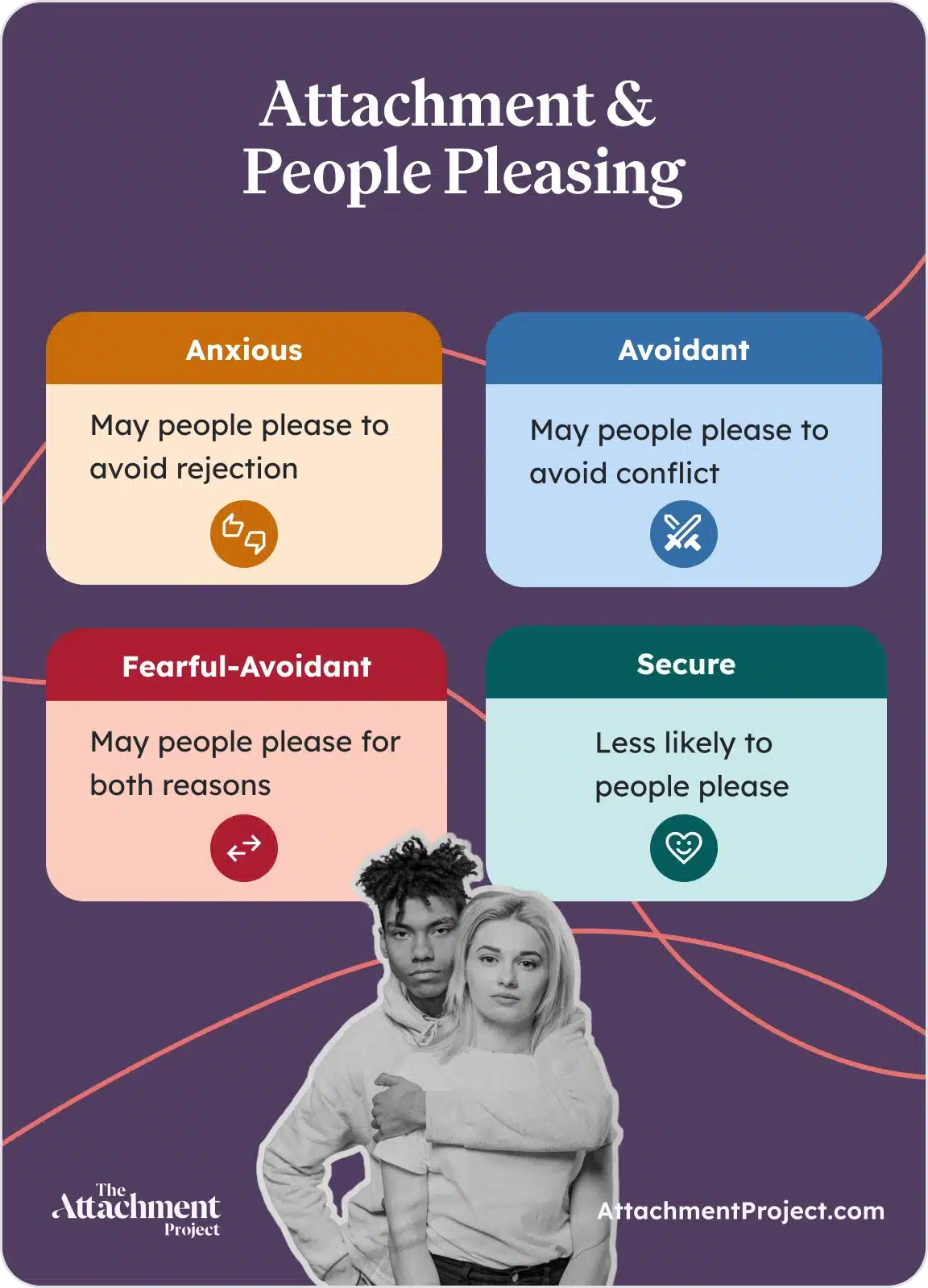
When you have an anxious attachment style, you tend to see others in a positive light and yourself less positively – this already sets you up to prioritize other people’s needs over your own. In addition to this, you can also find it difficult to experience conflict or separation and derive a sense of self-worth from other people’s approval.
People pleasing helps you to avoid rejection, but it can become a negative spiral in which your self-worth continues to lower as you don’t honor your own needs. This pushes you to need more approval from others, leading to more people pleasing, leading to still lower self-worth.
This happens because you learned that other people aren’t reliable, but you can get them to meet your needs if you do whatever you can to keep them close. The irony is that, when you’re people pleasing, you’re not meeting your own needs.
The Surprising Way Avoidants People Please
On the surface, you might not think attachment avoidance is associated with people pleasing. People with attachment avoidance prefer to remove themselves from conflict and stay away from close, trusting relationships, so it’s harder to spot people pleasing in avoidant attachment than in anxious attachment.
However, people with attachment avoidance say that they often people please in order to maintain this ability to avoid conflict. Some report that although they don’t need to be liked, they do need to not be disliked, and may people please in an attempt to strike a balance between independence and acceptance.
Fearful Avoidance and People Pleasing
If you have both attachment anxiety and attachment avoidance, you might find yourself people pleasing both to keep people close and to maintain distance from them. It might be more difficult to spot patterns in your people pleasing until you look closely.
People Pleasing and Self-Esteem
The vicious cycle of people pleasing means that while you search for comfort in the approval of others, you diminish your own self-esteem by not showing up for yourself. The lower your self-esteem, the more you need to people please in order to feel better, but the more you people please, the more your self-esteem suffers.
In another recent study, published in April 2025, researchers confirmed that the more people had thoughts, feelings, and behaviors associated with people pleasing – each in isolation and when combined – the more likely they were to evaluate themselves negatively2.
The good news is that this means that by working on your self-esteem, you may be able to improve people pleasing behaviors – and vice versa.
The Mental Health Impact of People Pleasing
Lower self-esteem isn’t the only mental health implication in people pleasing – the same 2025 study found that people pleasers scored higher on neuroticism and loneliness, and lower on mental wellbeing2.
The study didn’t investigate the direction of these relationships (whether one thing causes the other), but they likely go two ways, just like the link between people pleasing and self-esteem. The researchers even recommended that we should pay more attention to people pleasing behaviors in mental health interventions.
Why People Pleasers Struggle With Intimacy and Relationships
Paradoxically, although people pleasing aims to create and maintain connection or avoid conflict, it leads to relationships that are less fulfilling or less close because they lack authenticity.
On your end, resentment can quickly build as your needs go unmet, and your friends, partners or colleagues might start to take advantage of your agreeableness (even if they don’t realize it). People pleasers sometimes feel “well liked but not well loved”, as they feel that the people in their lives like being around them but don’t get to really know them as a person.
Intimacy requires us to be honest, transparent, and vulnerable, and it requires a give-and-take. People pleasing takes away our ability to be honest about our needs and boundaries, so our people pleasing relationships can never be fully intimate.
Honesty Creates Safety – Not the Other Way Around
People pleasing might create a sense of safety, but it’s built on unstable foundations: if you stop people pleasing, will they still want to be your friend? The possibility of this prevents your relationship from feeling safe and secure, and keeps it instead in a state of uncertainty.
Many people wait to feel safe in a relationship before being honest about their needs and boundaries, but it’s the acceptance and meeting of our needs and boundaries that creates real safety. It’s scary to be honest about our needs, and it requires us to prepare for the real possibility that the other person can’t meet our needs – accepting this is uncomfortable, but it’s an important step to being able to advocate for yourself.
How to Stop Being a People Pleaser: Breaking the Pattern
To break the pattern of people pleasing, it’s important to recognize what drives you to it in the first place. You don’t have to dive deep into your own history to do this – in fact, focusing on the past is in some ways less helpful than focusing on the present when we’re trying to understand our behavior.
This means that changing your behavior requires understanding what triggers it now, instead of what caused it to develop. It can be helpful to keep a people pleasing trigger diary and write down the thoughts, emotions, and events that happen before you engage in people pleasing. If you’re able to spot a pattern, you might be able to learn how to break it.
For example, you write down every instance of people pleasing over the last month and the events, emotions, and thoughts that came with them. You notice that you often people please when you feel out of your depth at work. To break this pattern, you can focus on building confidence and competence at work so that you feel more confident setting boundaries.
Becoming Comfortable with Discomfort
Being boundaried is usually uncomfortable – this is okay. It’s important to learn to sit with discomfort. Yes, people may react badly and may even like us less when we stop people pleasing, but this is a possibility we have to be okay with when we decide to prioritize ourselves. The discomfort you feel is a part of growth.
Some people find that practicing difficult physical activities, like tough workouts or yin yoga (where poses are held for a long time), help them to practice tolerating mental discomfort.
DISCOVER YOUR ATTACHMENT STYLE
Some prefer to take a graded exposure approach, in which you create a hierarchy of 10 uncomfortable situations and gradually work your way up to the most uncomfortable. For example, making a cup of tea without asking everyone if they want one might be 10% uncomfortable, while saying no when someone asks you to make them a tea might be your 100%. This method is best practiced with a mental health professional to help guide you through the emotions and experiences that come up.
Two Things Can Be True
Dialectical behaviour therapy (DBT) teaches us that two things can be true. For example, your friends can be uncomfortable with your boundaries and still be your friends. If people are used to you going above and beyond to accommodate them then your new use of boundaries might be confusing at first, but this doesn’t mean they don’t value you as a person beyond what you do for them; it may just take some time for your dynamic to shift.
Understanding that two things can be true at the same time is part of tolerating discomfort. If you’re finding it difficult to manage the thoughts, feelings, and urges associated with people pleasing, talking therapies like DBT or cognitive behavioral therapy (CBT) can help.
Conclusion
People pleasing, which is associated with both attachment anxiety and attachment avoidance, can quickly become a downward spiral as it both stems from and leads to lower self-esteem. While not a diagnosis in itself, people pleasing is anecdotally reported to be especially high in neurodivergent people.
Putting others first isn’t always people pleasing: in some contexts, putting others first is necessary or expected. What’s considered a normal boundary in one setting or culture might not be in another. You can distinguish kindness from people pleasing by paying attention to how you feel after the behavior.
Understanding what triggers your people pleasing, learning to be comfortable with discomfort, and practicing understanding that two things can be true at once can help you to set stronger boundaries and stop people pleasing.
To find out whether you might have an attachment style that plays into people pleasing, take our free attachment quiz.
FAQs About People Pleasing and Attachment
What kind of parenting causes people pleasing?
Since insecure attachment styles are associated with people pleasing, inconsistent or unavailable parenting could be a factor in people pleasing. Further, parents who are enmeshed, controlling, or who need lots of care themselves can raise children with maladaptive schemas linked to people pleasing.
Is people pleasing a form of manipulation?
People pleasing is technically manipulation, but not in the way you might be thinking. It usually aims to avoid discomfort or conflict, rather than achieve a certain outcome for personal gain.
Why do people pleasers struggle with intimacy?
People pleasers can struggle with intimacy because real connection comes from the acceptance and validation of our boundaries and needs. People pleasers sometimes wait to feel safe before being honest about what they need, but that safety has to come from honesty.
How is people pleasing related to attachment styles?
Attachment anxiety can relate to people pleasing to avoid abandonment, while attachment avoidance can lead to people pleasing to avoid conflict.
What is the difference between people pleasing and being kind?
When you’re kind, it feels good. You might feel proud or warm inside, and it makes you happy to think or talk about what you did. When you’re people pleasing, you’re more likely to feel resentment, anger, or guilt, because you acted in a way that betrayed your own needs.
What is the root cause of people-pleasing?
There are lots of things that could cause people pleasing, but it’s often linked to low self-esteem. Because people pleasing can both come from and lead to low self-esteem, it becomes a downward spiral.
What mental illness is associated with people pleasing?
Anybody could have difficulties with people pleasing, and they may or may not have a diagnosis associated with it. People pleasing often forms part of neurodivergent experiences like autism and ADHD, because neurodivergent people can both find it difficult to fit in and have needs that most people don’t consider.
References
- Blötner, C. (2025). Valuing Others Over Oneself: Development and Validation of a People Pleasing Scale. PsyArXiv. https://doi.org/10.31234/osf.io/cfw8k_v1
- Kuang, X., Li, H., Luo, W., Zhu, J., & Ren, F. (2025). The mental health implications of people‐pleasing: Psychometric properties and latent profiles of the Chinese People‐Pleasing Questionnaire. PsyCh Journal.
- Baroncelli, C. M., Lodder, P., van der Lee, M., & Bachrach, N. (2025). The role of enmeshment and undeveloped self, subjugation and self-sacrifice in childhood trauma and attachment related problems: The relationship with self-concept clarity. Acta Psychologica, 254, 104839.
- Gewirtz-Meydan, A., & Godbout, N. (2023). Between pleasure, guilt, and dissociation: How trauma unfolds in the sexuality of childhood sexual abuse survivors. Child Abuse & Neglect, 141, 106195.
 Get mental health tips straight to your inbox