









The Silent Treatment and Attachment: When It’s More Than Avoidance
Does your partner give you the silent treatment? Perhaps it happens in the middle of an argument, or it starts after you’ve done something they didn’t like. It could last for minutes, hours, or even days.
The silent treatment is a common response to relationship conflict. It’s not always used with malicious intent, but no matter the intention behind it, the silent treatment can be incredibly destructive.
Your attachment style can play into how you might use or respond to the silent treatment. In this article, we’ll talk more about why people use the silent treatment including the psychology behind it, how the silent treatment relates to your attachment style, and how to manage the silent treatment in your relationship, whether it’s coming from you or your partner.
DISCOVER YOUR ATTACHMENT STYLE
What is the Silent Treatment?
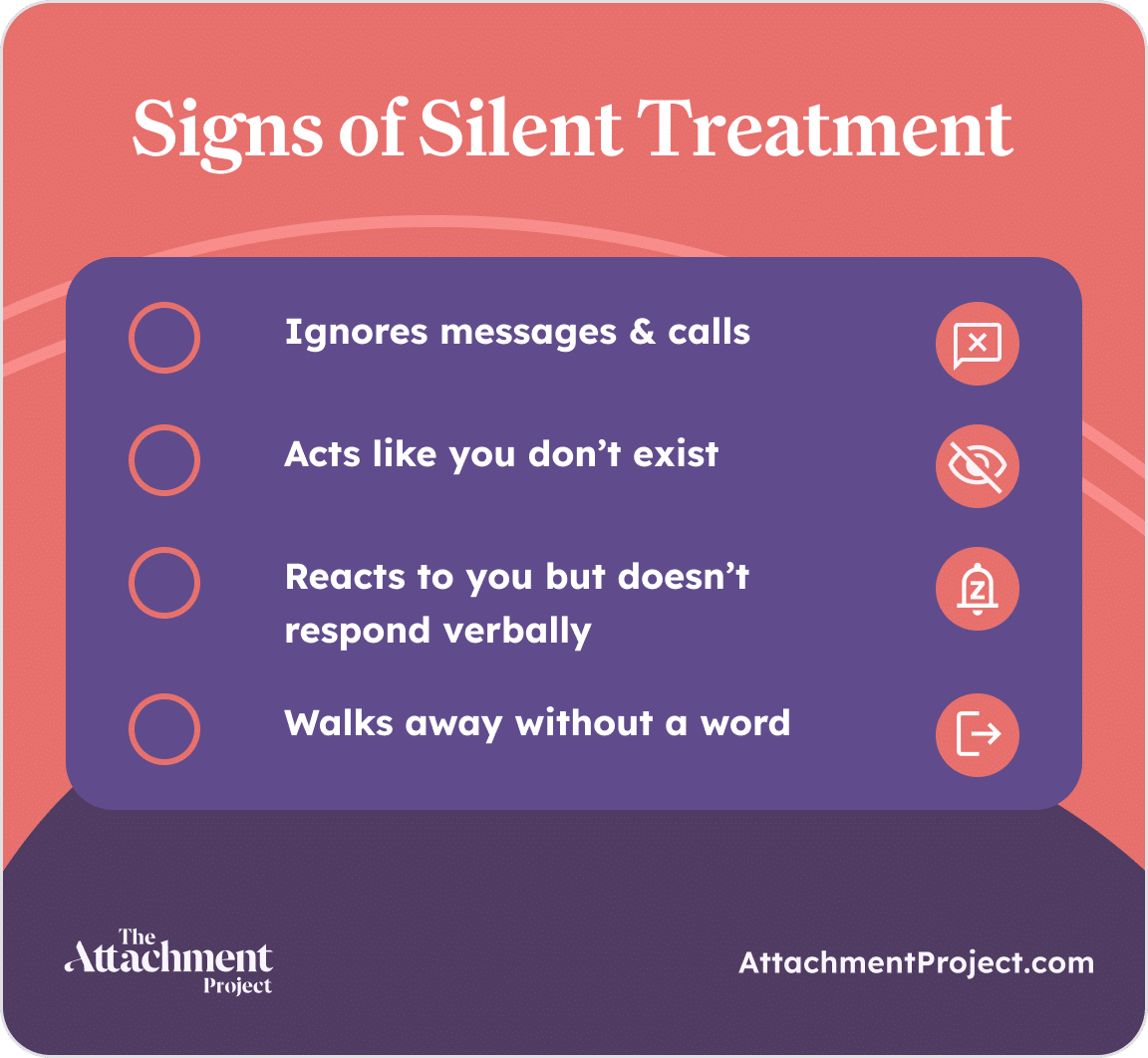
The silent treatment refers to a complete withdrawal of communication and emotional presence. When giving you the silent treatment, somebody might even act like you aren’t there. The silent treatment could include:
- Avoiding eye contact
- Avoiding any reaction to you
- Ignoring messages and calls
Needing space or communicating a need for silence during or after conflict is normal and healthy, and not the same as the silent treatment. What makes the silent treatment different is its intention and lack of clear communication about what’s happening.
Silent Treatment vs. Stonewalling vs. Taking Healthy Space
It’s important to understand the difference between the silent treatment, stonewalling, and taking healthy space.
- The silent treatment: intentional withdrawal from communication
- Stonewalling: shutting down in response to emotional overwhelm during conflict
- Taking healthy space: communicating a need for temporary separation with a clear intention to resume contact when ready
Take the examples below – let’s say you and your partner are in a disagreement over household chores. You tell your partner you feel unappreciated because they don’t acknowledge your contributions. They might respond by…
Silent treatment: Ignoring you, passive-aggressively doing chores without acknowledging your presence, leaving and ignoring texts or calls
Stonewalling: Shutting down, appearing “flat” or emotionally unaffected by your words or actions
Taking healthy space: Telling you they feel overwhelmed and asking for space, letting you know they’ll be back in an hour or two
The Psychology Behind the Silent Treatment
The silent treatment is usually intended to elicit a reaction, whether it’s for the purpose of regaining a sense of connection or control. People may have varying levels of behavioral and emotional awareness about their silent treatment behavior and may not always understand why it’s so harmful.
When Emotions Are in the Driving Seat
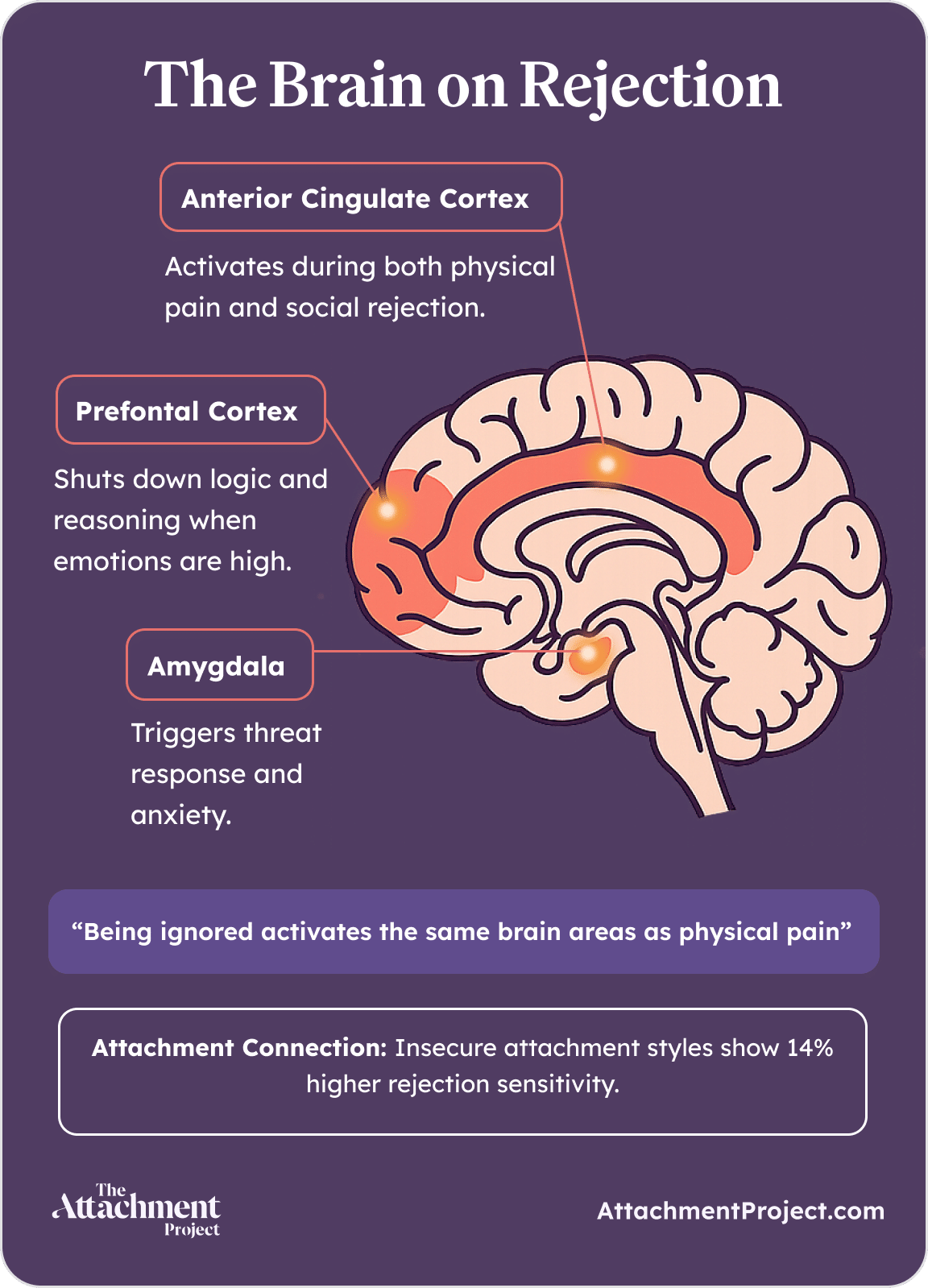
Our emotions are an evolutionary mechanism designed to drive us toward action1. When our emotions are in control, our logical thinking can be overridden – meaning that even if we know the silent treatment is bad, if we feel hurt or angry enough, we might respond with the silent treatment because it’s how we’ve learned to meet our needs.
For example, if giving the silent treatment usually results in your partner apologizing and restoring connection, this behavior gets reinforced because it gave us what we needed: acknowledgement and closeness.
However, in this scenario, the issue isn’t really resolved – it’s like a band-aid over a broken leg. It might feel temporarily better, but the conflict is likely to resurface with the additional problems caused by the silent treatment and lack of effective communication. Understanding repair and rupture in relationships can help break this cycle.
When Silence is a Control Tactic
Sometimes, the silent treatment is used with intention; the rational brain is in control, not the emotional one, and the person giving the silent treatment has weighed up their options and chosen to behave this way.
In this case, the silent treatment is being used as a method of manipulation and control. It can be difficult to tell the difference between silent treatment that’s control-driven or emotion-driven, but the outcome is the same – in both cases, you can end up feeling manipulated, confused, and exhausted. This type of deliberate manipulation shares characteristics with gaslighting and other forms of emotional abuse.
The Neuroscience: Why Being Ignored Physically Hurts
Studies have found that being ignored activates the same brain areas as physical pain2. The evolutionary theory behind this is that rejection is painful because social acceptance is built into our survival mechanisms – the pain of rejection drives us to seek connection because people who were accepted by others were more likely to live longer and reproduce.
This is why we sometimes end up giving into the silent treatment, even if we’ve already noticed it’s a problem and set a boundary around it. For some of us, rejection is more painful than for others. Insecure attachment styles have been associated with higher rejection sensitivity, and in one study, attachment styles were found to explain 14% of the participants’ rejection sensitivity scores3.
Attachment Styles and the Silent Treatment
Your early relational experiences shape your attachment style and how you learn to manage conflict. Your attachment style can not only make you more prone to giving the silent treatment, but also more prone to being on the receiving end of it.
Attachment Avoidance and the Silent Treatment
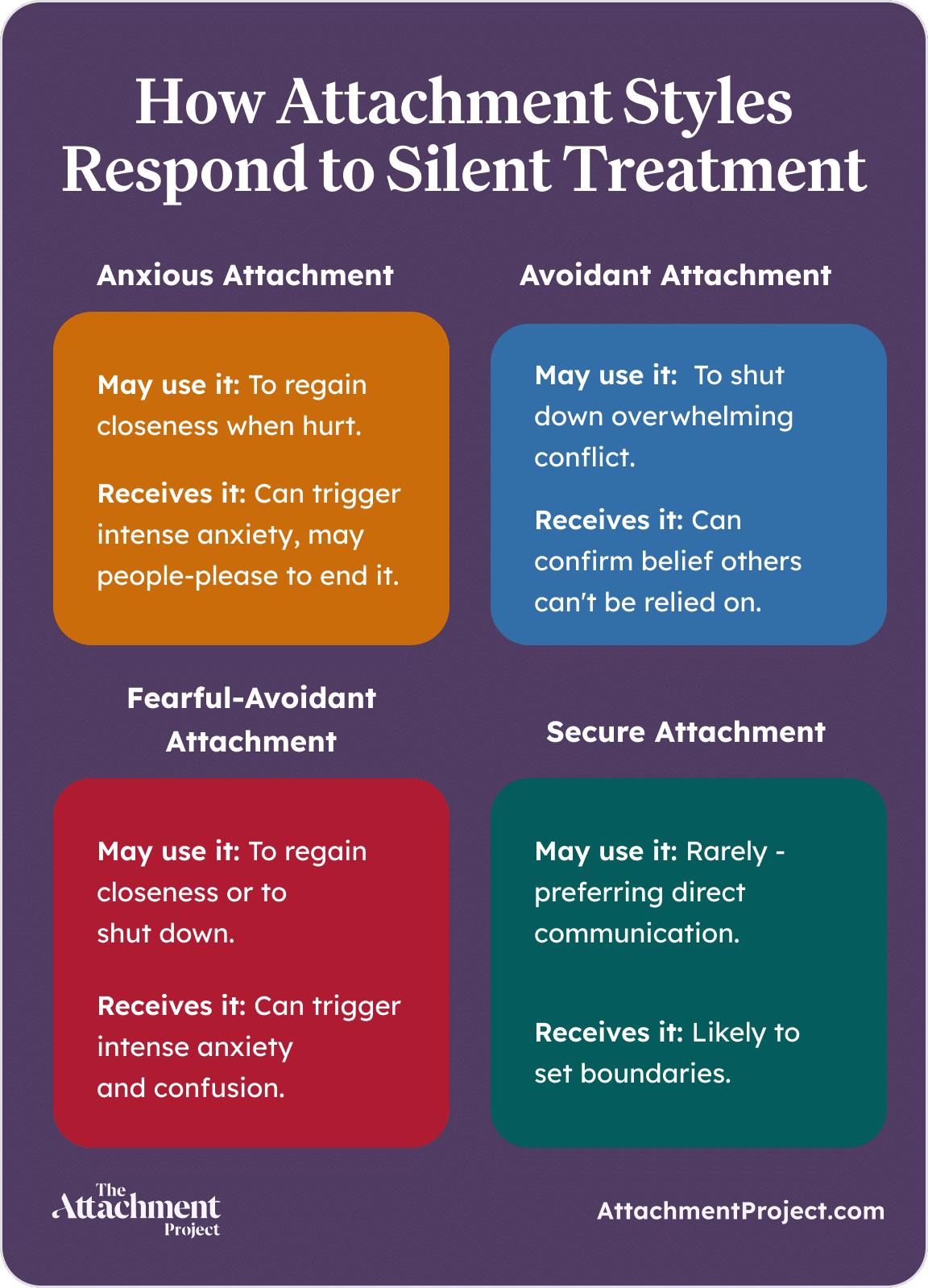
If you have an avoidant attachment style, you prefer to stay away from intensity in relationships, whether it’s in closeness or in conflict. You can still experience high emotions, but your instinct is to avoid them – so you might use the silent treatment as a way to shut down an argument. This isn’t the same as the avoidant shutdown or stonewalling.
Because you have an insecure attachment style, you might also find it more difficult to set boundaries and respond to conflict in relationships. This can make you more susceptible to experiencing the silent treatment from someone else, as you might deal with it by people-pleasing to end the conflict or simply waiting it out without discussing how it affects you.
Experiencing the silent treatment could confirm the avoidant assumption that people cannot be relied upon to stick around, initiating your attachment avoidance. The silent treatment is more likely to push you away than pull you in, so it might not “work” on you, despite still causing hurt. Learn more about avoidant attachment triggers to better understand these dynamics.
START YOUR HEALTHY DATING JOURNEY
Attachment Anxiety and the Silent Treatment
If you have attachment anxiety, you might be frequently led by your emotions. This could drive you to use the silent treatment to regain closeness, especially if it’s worked in the past – which could have been modelled by a caregiver.
Again, because you have an insecure attachment style, you may find that you have partners who give you the silent treatment because you’re not able to communicate well with each other. The silent treatment can be very difficult for you to experience, as it activates your anxious attachment system.
Anxious attachment system activation can lead you to people-please or “give in” to the silent treatment easily, which might reinforce that behavior in the future. Learning how to set boundaries and communicate healthily is important for people with any insecure attachment style. Understanding self-regulation and anxious attachment triggers can help you respond more effectively.
How to Deal with and Respond to the Silent Treatment
Dealing with the silent treatment is important, as this kind of behavior can quickly erode trust and security in a relationship.
How to Stop Using the Silent Treatment
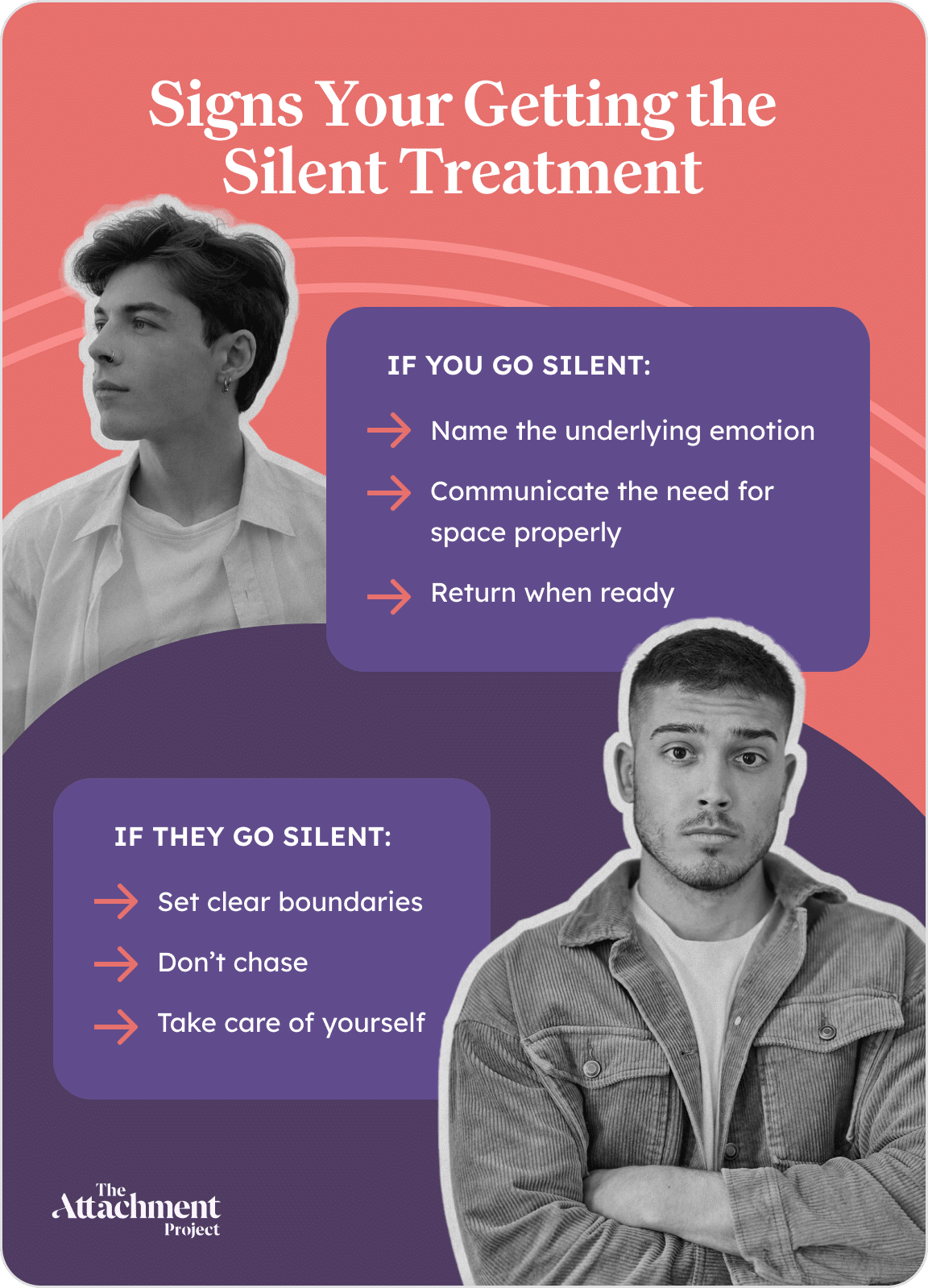
If you’re the partner who’s engaging in the silent treatment, first, try to understand why. What emotions are you feeling when you want to use the silent treatment? What are the underlying fears or anxieties involved?
Practicing naming your emotions comes in useful here – this is an important part of emotional regulation.
Once you understand the mechanisms behind your silent treatment better, can you think of any healthier ways you might communicate your needs? For example: if your use of the silent treatment is associated with a fear that your partner doesn’t care about you, and you need them to show that they do, can you tell your partner that you need connection directly? If this is too vulnerable during conflict, can you work together to come up with a codeword or a signal that you need to pause the discussion to reconnect?
Explaining to your partner that you’ve realized that you use the silent treatment, apologizing, and discussing how you intend to work on it can also help your partner to feel more secure, giving them the ability to better regulate their response in turn.
How to Set Boundaries Around the Silent Treatment
If your partner uses the silent treatment, you may need to set boundaries. Remember that boundaries are for you, not for someone else – you can’t control what they do, but you can control how you respond to it.
Decide what crosses the line for you, and how you’ll respond to it. Then, communicate this with your partner and stick to it. For example, you might decide that ignoring your messages is fine, but ignoring you in person is a boundary. Your reaction to this boundary should be based on what you need, not a punishment.
In this example, perhaps their ignoring you makes you feel unwanted, so you decide that if they do this, you’ll spend the night with friends or family – people who make you feel wanted – instead.
It’s important to discuss your boundaries; your partner doesn’t have the opportunity to respect them if they don’t know what they are. You might also agree on boundaries together, working as a team to better your communication.
Healthy Communication During Emotional Overwhelm
Remember, the silent treatment isn’t the same as taking healthy space. It’s okay and normal to need space during or after conflict, especially if it was emotionally intense.
When you need space, communicate this with your partner and let them know when you intend to return, even if this is happening in a digital space. This gives them a sense of certainty and can soothe any anxiety, which is natural to feel when your partner needs some time away.
Whether it’s you or your partner who requested space, use this time to process your emotions and ground yourself. You might need space to think about how you felt and how you’ll proceed, and what you might learn from the conflict together. Practicing emotional hygiene during these moments can help you return to the conversation with clarity.
When to Walk Away from the Silent Treatment Pattern
If your boundaries are repeatedly crossed and you or your partner are not able to communicate healthily, it might be time to walk away. If the silent treatment comes alongside other signs of control, such as gaslighting or coercion, consider whether your partner might be using abusive tactics.
Understanding trauma bonding can help you recognize if you’re in a harmful relationship pattern. If you notice signs of trauma bonding, it may be time to seek support.
If you feel unsafe, contact or explore resources at the National Domestic Violence Hotline (USA, disponible en español) or find local domestic violence support. If you or someone else is in immediate danger, call 911 (USA) or your local emergency number.
START YOUR HEALTHY DATING JOURNEY
Conclusion
The silent treatment is a common occurrence, but it’s very destructive to trust and healthy relationships. It’s more intentional and passive-aggressive than both stonewalling and taking healthy space. It may be driven be emotions or control, but in either case, it’s so damaging that it can be considered emotional abuse.
Healthy communication and clear boundaries are vital for trusting relationships. Practicing these with your partner can help both of you to build more security within your attachment. If you feel unsafe in your relationship, contact or explore resources at the National Domestic Violence Hotline (USA, disponible en español) or find local domestic violence support. If you or someone else is in immediate danger, call 911 (USA) or your local emergency number.
Frequently Asked Questions
Is silent treatment abuse?
The silent treatment is widely considered abusive behavior, even if it’s driven by intense emotions and a need for connection.
How to respond to silent treatment?
When responding to silent treatment, it’s important to set clear boundaries and stick to them.
How long does the silent treatment last with avoidants?
The silent treatment can last anywhere from minutes, to hours, to days.
What does the silent treatment do to a person?
The silent treatment is very harmful for individuals and relationships. Rejection activates the same brain areas as physical pain.
Should you ignore someone who gives you the silent treatment?
You should respond to the silent treatment by setting boundaries that clearly outline what you won’t tolerate and what will happen if your boundaries are crossed. These should be based on what you need to feel respected and valued, not used as punishment.
References
- Berridge, K. C. (2018). Evolving concepts of emotion and motivation. Frontiers in Psychology, 9, 317391.
- Eisenberger, N. I., Lieberman, M. D., & Williams, K. D. (2003). Does rejection hurt? An fMRI study of social exclusion. Science, 302(5643), 290-292.
- Araiza, A. M., Freitas, A. L., & Klein, D. N. (2020). Social-experience and temperamental predictors of rejection sensitivity: A prospective study. Social Psychological and Personality Science, 11(6), 733-742.
 Get mental health tips straight to your inbox