









What is Trauma Bonding? Definition and Examples

Trauma bonding is when we form an unhealthy emotional attachment or connection to someone who causes us emotional or physical harm. In other words, we can form trauma bonds in abusive dynamics.
It’s important to note that not everyone who experiences abuse forms a trauma bond. However, some people may be more prone to forming a trauma bond due to their early experiences as a form of repetition compulsion.
If you need to shut this article down quickly, you can do so using the following shortcuts:
Windows or Linux: Ctrl + W or Ctrl + F4
Mac: ⌘ + W
Trauma bonding can happen over any period of time–from a matter of days to weeks, months, and years. Furthermore, this bond can happen out of someone’s consciousness: it tends to form when we rationalize or empathize with the perpetrator of the abuse.
Due to how the trauma bond often happens outside of a target’s awareness, this article covers the following topics to help increase awareness of this insidious form of abuse:
- What trauma bonding is
- How to identify the signs of trauma bonding
- Examples of trauma bond relationships
- What trauma bonding in narcissistic relationships is and how it’s forged
- How to break free from and overcome the effects of trauma bonding
- Frequently asked questions on trauma bonding
What Is Trauma Bonding?
Trauma bonding is a theory devised by Dr. Patrick Carnes in 1997 to conceptualize the relationship that sometimes forms between an abuser and the abused (which we will refer to from here on as the “target”). Usually, in relationships, “bonding” has a positive interpretation – it means we’re truly connecting with another person on a deep, emotional level. In contrast, the definition of trauma bonding involves an unhealthy connection to someone who inflicts trauma.
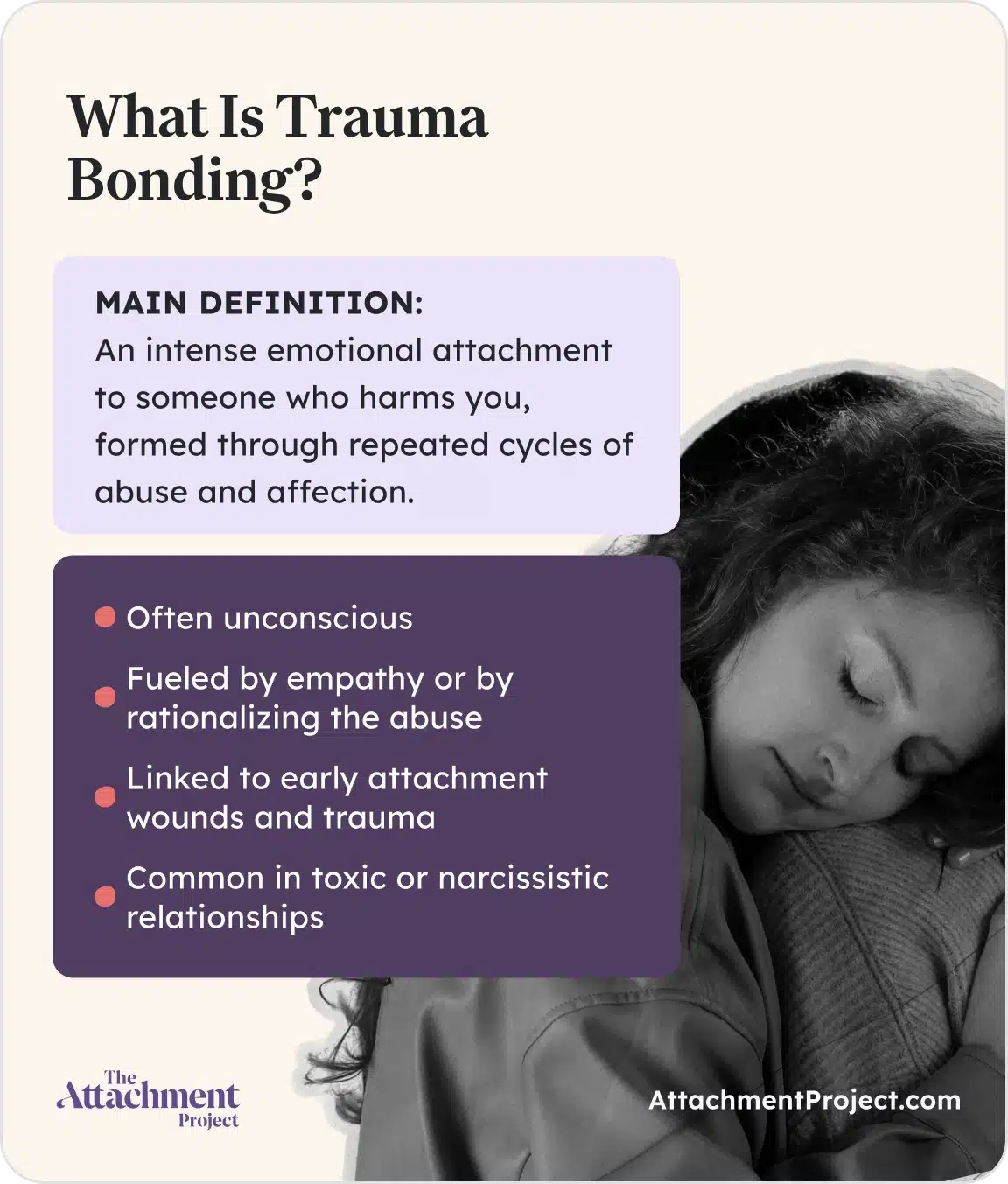
Most of us have an understanding of what defines abusive relationships; the abuser inflicts physical, emotional, or sexual harm on another person. However, trauma bonding is more complicated for people to grasp. Trauma bonding, in effect, is when someone acts alternates between extremes of affection (such as love-bombing) and abuse.
These actions typically happen in a cycle or loop, and during episodes of affection, the victim of the abuse is positively reinforced to stay in the relationship. If you would like more information on the stages of trauma bonding, our article on the topic can help.
Trauma bonds can happen in any form of relationship: romantic, familial, friendship, and even workplace. However, it is most commonly associated with romantic relationships, especially if this relationship involves narcissism.
The characteristics of trauma bonding include:
- Not wanting to leave the relationship even though you’re aware the other person is inflicting emotional, physical, or sexual harm
- Defending or condoning the abuser’s behaviors toward others
- Covering your true feelings or opinions to others and the abuser
- Desiring to help the abuser, even if the relationship is over
- Incessantly thinking about the abuser, even if the relationship is over
It’s important to recognize that a trauma bond doesn’t develop overnight. It is a phased process in which the abuser develops trust, dependence, and control.
START YOUR ATTACHMENT HEALING JOURNEY
Identifying Signs of Trauma Bonding
A trauma bond is an emotional attachment that results specifically from cycles of abuse and affection. Because of this cycle, the target of the abuse often struggles to differentiate between the intense emotions they feel as a result of intensely loving behavior and abusive actions. It’s human to desire to be loved, so the target of the abuse is often inclined to stay in the relationship because they’ve been conditioned to expect the positive reinforcement of affection and love.
To help you better understand if you’re involved in a trauma bond, we cover the signs of a trauma bond relationship in our article Signs of Trauma Bonding.
Trauma Bonding Examples
The different forms of trauma bonds can create a variety of examples, so we’ve provided a couple of these to help increase understanding.
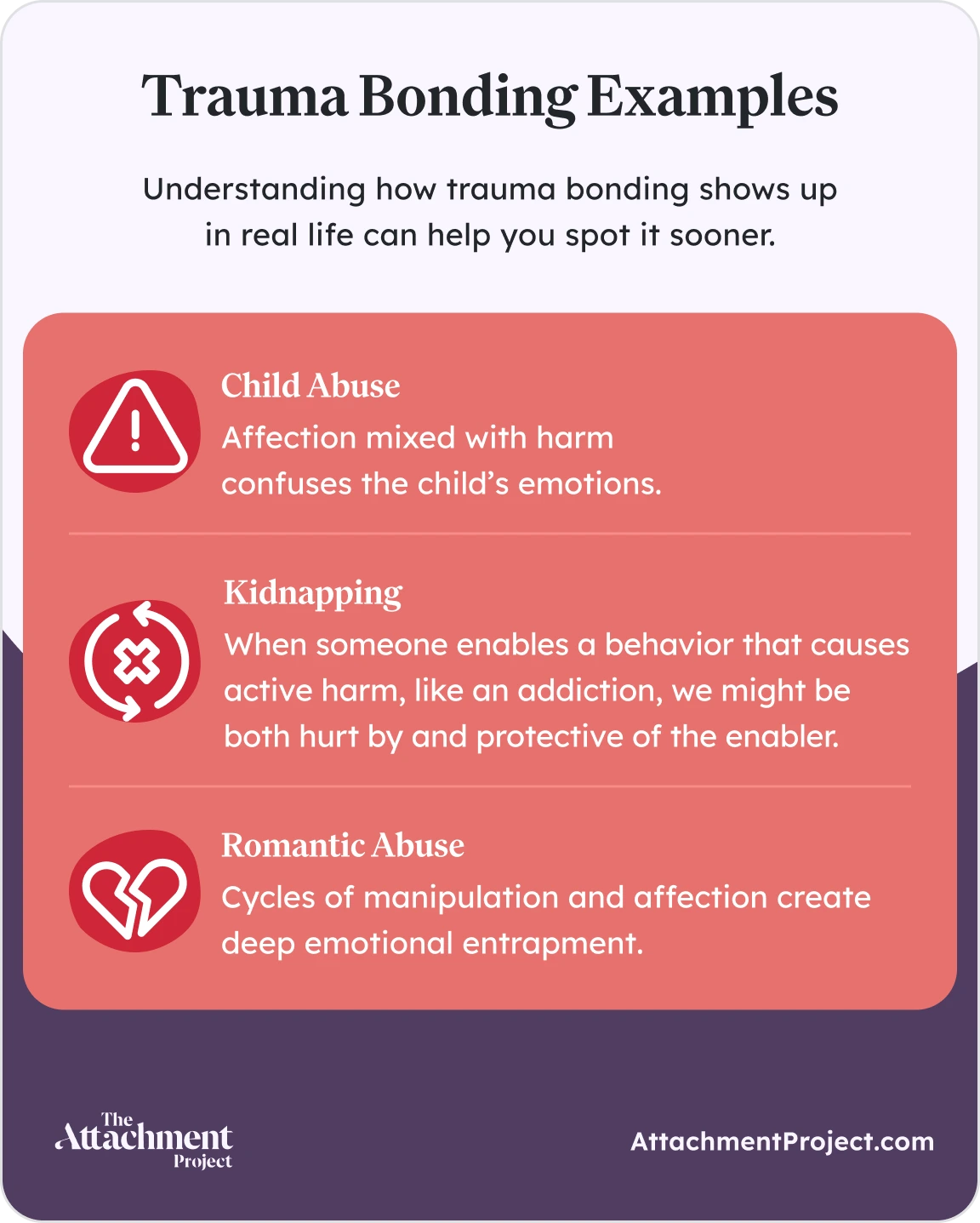
Child abuse: In a situation where a child is being abused by an adult, the adult typically starts by telling the child things like “You’re special,” or “You’re beautiful.” They may also buy the child gifts or shower them with affection. Then the cycle of abuse begins. The child becomes highly confused, and may even mix up feelings of fear with excitement and affection. Over time, they may actively choose to see the abuser even though they are afraid of them.
Kidnapping: Commonly known as “Stockholm Syndrome” in popular culture, an infamous case of trauma bonding in a kidnapping scenario can be traced back to 1973. In Stockholm, an escaped convict held four bank employees hostage for six days. After their rescue, the hostages demonstrated astounding behaviors: They sympathized with their captor and even demonstrated hostility to the people who rescued them.
Romantic relationships: Such relationships involve a target being criticized, manipulated, or physically abused. Yet, the abuser can also be so “amazing” at times, that the target chooses to stick it out. In time, the target feels incapable of leaving, sometimes because they have been socially isolated or feel unsafe, but also because they feel intensely emotionally connected to the abuser.
Trauma Bonding in Narcissistic Relationships
Narcissism as a personality trait is characterized by a strong sense of entitlement and a need for admiration and attention. Narcissistic behaviors range on a continuum from having a couple of narcissistic traits to pathological levels of narcissism – pathological levels are typical of narcissistic personality disorder.
Pathological levels of narcissism can be highly destructive, involving an obsession with self-perceived superiority, oversensitivity towards challenges to authority, and militantly scrutinizing potential competitors.
The grandiose sense of self-importance associated with narcissism leads to a lack of empathy and a need to exploit or manipulate others to fulfill personal desires and needs. This is where narcissism connects with trauma bonding.
How Narcissists Create Trauma Bonds
Specific elements of how a trauma bond is formed directly relate to narcissism. In fact, certain stages of trauma bonding are sometimes referred to as “narcissistic abuse” for this reason.
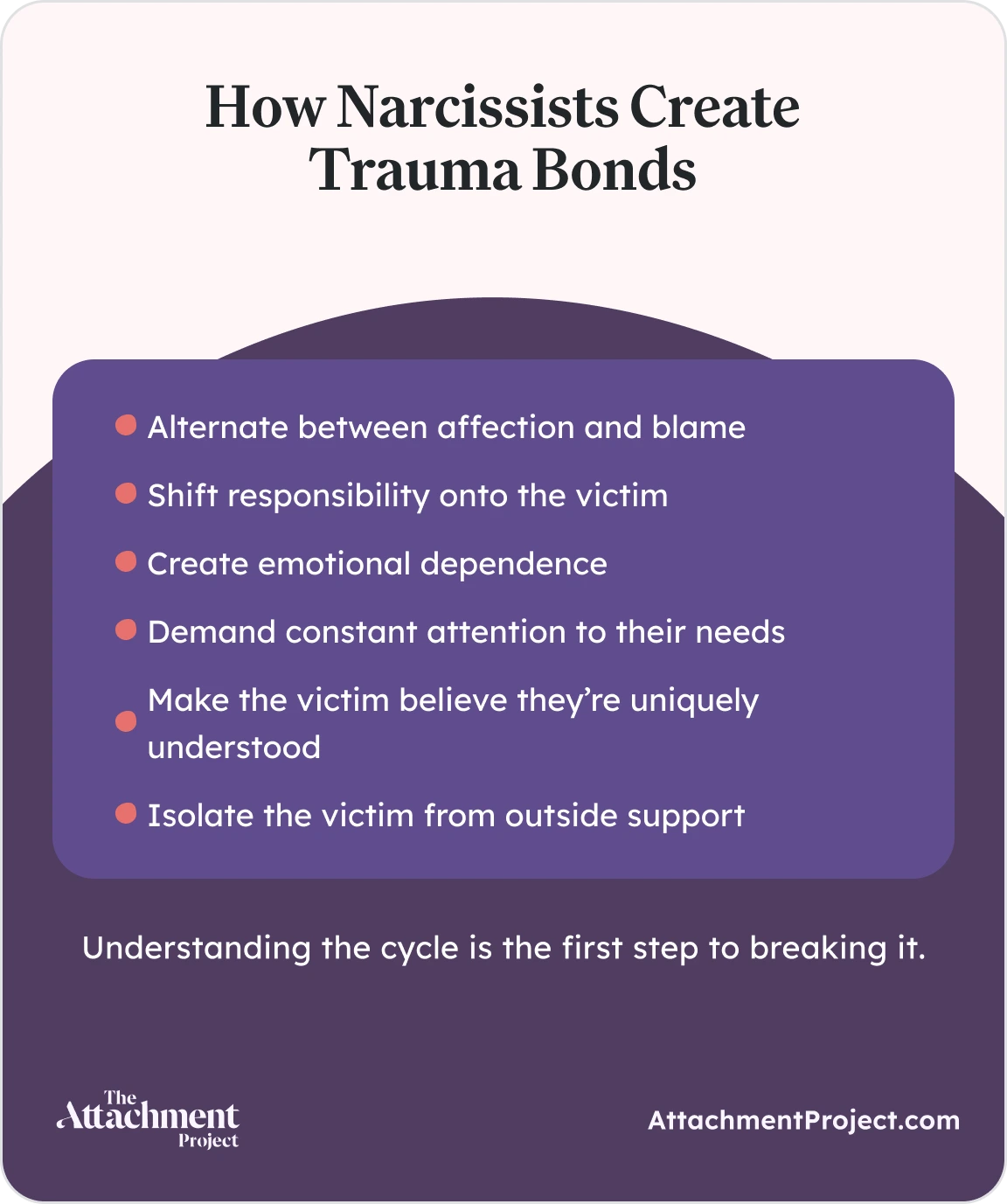
People with narcissistic personality disorder feel a deep-rooted need for power and to avoid feelings of shame, resulting in traits of superiority and authoritativeness. This can lead to destructive behaviors and manipulative tactics associated with the trauma bond, such as love bombing, gaslighting, and emotional abuse. Visit our article on how to handle a narcissist for effective strategies to protect yourself in these relationships
These manipulative tactics create challenges for the target of abuse in narcissistic relationships, and, ultimately, result in harm. After the initial love bombing and building trust phases of the trauma bond, narcissistic abuse leads to tactics such as disparaging, name-calling, separating the target from loved ones, and so on. The overall aim of these tactics is to control the target and, therefore, forge dependence on and create an emotional attachment to the abuser.
Recognizing a narcissistic trauma bond can be difficult, as narcissists often come across as charming, charismatic, and likable – especially in public. Yet, this can further deepen the trauma bond for the target, as they believe that they are at fault for the narcissistic behaviors behind closed doors.
Furthermore, a target of abuse may hyperfocus on the narcissist’s needs and experience a loss of empathy for anyone other than the narcissist, as well as a loss of sense of self. In addition, the target of narcissistic abuse may struggle with a range of emotional issues as a result, including psychological problems such as PTSD and mood disorders. They may also experience physical ailments stemming from their increased psychological distress.
For the reasons discussed, if you suspect you are experiencing narcissistic abuse, it’s important to understand how to break free from a trauma bond.
Breaking Free and Overcoming the Effects of Trauma Bonding
A trauma bond is an unhealthy emotional attachment or connection to someone who causes us emotional or physical harm. In other words, we can form trauma bonds in abusive dynamics.
The trauma bond can start to form over a period of time from days to weeks, months, and years – and the damage to the target of the abuse can become more significant as time passes. Furthermore, the target of trauma bonding is often unaware of the pattern of abuse. Instead, they believe they are at fault for their abuser’s actions.
It’s also normal to experience trauma bond withdrawal symptoms after breaking a trauma bond. Our article, Trauma Bond Withdrawal Symptoms can help.
DISCOVER YOUR ATTACHMENT STYLE
FAQs on Trauma Bonding
Trauma bonding can be quite a complicated topic. For this reason, we’ve included some FAQs and answers to help increase understanding of the trauma bond – and whether it may be something you’re experiencing in your relationship.
1. Why does trauma bonding occur?
A trauma bond is a psychological response to cycles of abuse in which an abuser alternates between cycles of affection and love with belittlement and blame. Due to these cycles, the target of the abuse feels to blame for their abuser’s actions and develops sympathy for them. They are, therefore, conditioned to stay within the relationship.
However, it’s important to note that not everyone who experiences abuse becomes caught in a trauma bond. It’s thought that people who form a trauma bond develop a form of unhealthy attachment. The target of the abuse seeks comfort and safety from the abuser, even though they’re the ones who caused the hurt.
2. How do you know if you have a trauma bond?
Trauma bonding can be difficult to spot if you’re currently caught in the cycle of abuse. This is because the love bombing stage of a trauma bond involves periods of affection and dependency forging. Other signs of the trauma bond include dependency on the abuser, defending their actions to others, and rationalizing their behaviors. Furthermore, an abuser in a trauma bond may isolate the target from loved ones, and make them feel to blame for the abuser’s actions.
Make sure to check out the seven stages of trauma bonding for more detailed information on the trauma bond.
3. What does a trauma bond with a narcissist look like?
A trauma bond, in general, can have detrimental effects on the target’s emotional and physical well-being, including loss of self, isolation, and mood disorders.
However, a trauma bond with a narcissist can also cause a lack of empathy on behalf of the target of the abuse for people who aren’t their abuser. This is due to how skilled a narcissist is at manipulating the target into believing they are the only ones who understand them. Therefore, due to this loss of empathy, the target is inspired to cater solely to their abuser’s needs and desires. Make sure to read the section on narcissism and the trauma bond included in this article for more detailed information.
4. How long does a trauma bond last?
The trauma bond can last from days to weeks, months, and years. The trauma bond develops over seven stages in which the abuser practices manipulative cycles of dependence forging and abuse.
Furthermore, the length of time it takes for someone to break the trauma bond depends on the severity of the abuse, plus their individual circumstances and willingness to break the bond.
5. What is the difference between love and trauma bonding?
There are a few key differences between a loving relationship and a trauma bond. One of these differences is the pace of the relationship: A trauma bond involves love bombing at the start so it will develop rapidly. In contrast, a loving relationship takes time to forge a deep, meaningful, and mutually respectful bond.
Furthermore, another key difference involves the amount of highs and lows in the relationship. A trauma bond has cycles of extreme highs and lows as it includes love bombing and abuse. On the other hand, loving relationships tend to be relatively stable – there may be ups and downs, but they don’t involve fear or abuse.
Finally, loving relationships require mutual support and open, honest communication. However, trauma bonds are characterized by an imbalance of power; the abuser needs to control the target to feel dominant and in authority.
Allen, J. (2008). Coping With Trauma: Hope Through Understanding. American Psychiatric Publications.
Carnes, P. J. (1998). The Betrayal Bond. Health Communications.
Dutton, D. G. & Painter, S. (1993). Emotional Attachments in Abusive Relationships: A Test of Traumatic Bonding Theory, Springer Publishing Company, 8(2).
Hadeed, L. (2021). Why women stay: Understanding the trauma bond between victim and abuser case studies were written, Gender and Domestic Violence in the Caribbean.
Lawson, D. M., Skidmore, S. T., & Akay-Sullivan, S. (2020). The Influence of Trauma Symptoms on the Therapeutic Alliance Across Treatment. Journal of Counseling & Development, 98(1), 29-40.
 Get mental health tips straight to your inbox