









Developing A Secure Attachment With Dr Pascal Vrticka

Who Is Dr Pascal Vrticka?
Dr. Vrticka is an Associate Professor and Principal Investigator of the Social Neuroscience of Human Attachment (SoNeAt) Lab within the Department of Psychology, University of Essex (Colchester, United Kingdom). After his initial BSc & MSc degrees in Science (specializing in Biology) from the Swiss Federal Institute of Technology (ETH) in Zurich, he obtained a PhD in Neuroscience from the University of Geneva. Dr Vrticka then held several postdoctoral and senior researcher positions at the University of Geneva, Stanford University School of Medicine, and the Max Planck Institute for Human Cognitive and Brain Sciences in Leipzig, Germany.
Dr Vrticka’s research focuses on the neurobiological basis of human relationships, attachment, and caregiving. With his work, he is promoting a new area of investigation – the social neuroscience of human attachment (SoNeAt). As coordinating board president of the Special Interest Research Group on the Social Neuroscience of Human Attachment (SIRG SoNeAt) and member of the executive board (Secretary) of the Society for Emotion and Attachment Studies (SEAS), Dr Vrticka furthermore participates in attachment theory development and refinement.
One important goal that SIRG SoNeAt and SEAS share is to make attachment science more accessible to help resolve confusion and misconceptions associated with attachment theory and research. Being an associate trustee of the UK Charity Babygro, Dr Vrticka is also involved in translating his research to make it more accessible for parents, practitioners and organizations – check out their freely available Babygro Book and professional training courses.
Developing A Secure Attachment
In a wide-ranging interview, Dr Vrticka offered his insight and expertise when answering our far-reaching questions. Below, you will find part one of our interview with the theme: developing a secure attachment.
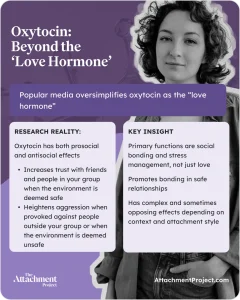
Dr Vrticka: In the press and on social media, oxytocin (OT) is often labeled the “love hormone”. Although OT undoubtedly plays an important role in love, sex, childbirth, bonding, attachment, and caregiving, such an account unfortunately is too simplistic.
The main problem is an overemphasis on OT’s prosocial and relationship-promoting effects. This tendency goes back to a 2005 study in humans [1] that reported increased trust after a single dose of OT given by nasal spray.
However, many subsequent studies using a similar procedure were inconclusive and often failed to show the same results [2]. What’s more, many studies found OT to have opposing and apparently anti-social effects. For example, OT administration increased dishonesty/lying and the inclination for aggression, and made more insecure-anxiously attached adults remember their mothers as less caring and close [3], [4], [5].
How can we reconcile these quite different roles of OT for human relationships and attachment? Current theories suggest that OT’s function is most likely related to stress management, which is a complex task that requires us to keep track of many different sources and kinds of information.
We constantly need to monitor our immediate environment for clues of both safety and danger. Usually, safety can be found when interacting with one’s “in-group” like family and friends, and danger more likely originates from “out-group” members and strangers. It therefore makes sense to show prosocial behavior towards the former but more wary or even hostile behavior towards the latter group. Such behaviors are also known as “tend-and-defend”, and have been linked with the action of OT.
A related but slightly different theory suggests that OT is importantly involved in “tend-and-befriend” behavior [6]. Such behavior enhances the desire for social closeness and connection (preferably to in-group members) when we are distressed and in need, and thus emphasizes OT’s role in social stress regulation. Interestingly, there is corresponding preliminary evidence that “tend-and-befriend” behavior is more readily shown by individuals with insecure-anxious than insecure-avoidant attachment.
Integrating both above theories is an overarching account that describes OT more generally as an allostatic hormone that modulates both social and non-social behavior with the main goal of maintaining stability through changing environments. This account overlaps nicely with our latest thoughts on the link between attachment, social connection, and energy conservation through co-regulation (i.e., social allostasis).
Overall, the currently available evidence and theory suggest that OT certainly can be a “love hormone” – especially within romantic and parent-child relationships that provide safety and help with stress management. However, we must not forget that OT has many other functions that can have very different and even opposite effects. Such considerations are particularly important when we think of interventions based on OT administration.
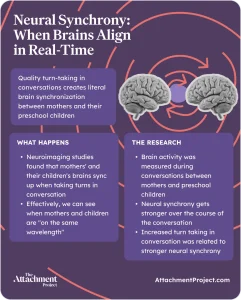
Dr Vrticka: In one of our functional near-infrared spectroscopy (fNIRS) hyperscanning projects as part of our CARE studies, we specifically looked at interpersonal neural synchrony (INS) during mother-child conversations [7].
Verbal coordination and turn-taking during parent-child communication are important for children’s language and socioemotional skills development. Intervention studies in children furthermore indicate that the promotion of turn-taking can lead to higher-quality social interactions.
Communication between individuals, and more specifically turn-taking, has recently been linked to interpersonal neural synchrony. When a speaker and a listener perceive and act upon cues provided during communication, their brain activities become aligned in time – what we refer to casually as being “on the same wavelength.” It remained unclear, however, how interpersonal neural synchrony during parent-child conversation relates to their interaction and relationship quality.
Our study revealed two main findings. In 40 mothers with their 5-to-6 year-old preschool children, we observed interpersonal neural synchrony to generally increase the longer their conversations lasted. We think that this finding may reflect a constant re-synchronization process that is necessary for a highly complex task such as verbal communication. Furthermore, we saw that interpersonal neural synchrony increased more strongly with conversation duration in those parent-child dyads that showed higher verbal turn-taking. Our second finding illustrates the intrinsic relation between verbal turn-taking and interpersonal neural synchrony as it unfolds over time. Moreover, it suggests an indirect link between parent-child interpersonal neural synchrony during verbal conversation and interaction and relationship quality.
Attuned, sensitive, and reflective parent-child communication – i.e., parents carefully observing and responding to their children’s verbal clues, thereby helping them develop their language skills and becoming more aware of themselves and their social surroundings – has been reliably linked with both higher parenting quality and child-parent secure attachment. In our study, however, we could not provide a direct link between interpersonal neural synchrony, verbal turn-taking, and child-parent attachment. More research is needed to look into these associations.
I am not aware of any studies in adolescents or adults specifically looking at interpersonal neural synchrony during conversation, turn-taking, and attachment. However, I would assume that the general principles of attuned, sensitive, and reflective communication do not only apply to parent-child conversation but also to any type of communication across the life span.
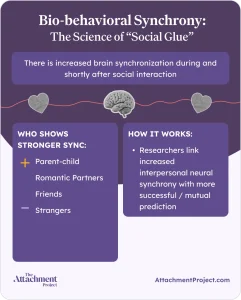
Dr Vrticka: Interpersonal neural synchrony is embedded within the larger realm of bio-behavioral synchrony (BBS). The latter refers to the attunement or temporal coordination of several behavioral and neurobiological variables during and shortly after social interaction. These variables include observable behavior (e.g., eye gaze, touch, vocalizations), physiology (e.g., heart rate, breathing frequency), endocrinology (e.g., secretion of hormones such as oxytocin and cortisol), and brain activity.
The general idea is that bio-behavioral synchrony is higher in individuals who share a closer or more intimate social bond with one another – like parents with their children or romantic partners. For interpersonal neural synchrony more specifically, the latest theory emphasizes mutual prediction as an important underlying mechanism [8]. If two people interact with one another, they must constantly predict what is going to happen next: what their interaction partner will do as a reaction to their own actions and how this, in turn, will affect their subsequent behavior. If both interaction partners succeed in such a “social dance” of mutual prediction, they are likely to engage similar brain processes at roughly the same time, which should yield increased interpersonal neural synchrony. What this latest theory furthermore spotlights is the attribution of subjective positive value to interactions with heightened interpersonal neural synchrony. Being on the same wavelength with somebody else makes us feel good and socially connected – it acts like a “social glue” that binds us and others together.
According to the above, several studies have shown that interpersonal neural synchrony is increased when children interact with their own parents in comparison to unknown adults, and if adult participants interact with their romantic partners and friends versus strangers. These findings are explained with mutual prediction being more prominent and potentially easier for people who already know each other well, as well as are attuned to and trust one another.
At the same time, we and others have shown that interpersonal neural synchrony is not uniformly high in people who share a close and intimate bond with each other. We think that such variations in interpersonal neural synchrony can – at least in part – be explained by individual differences in interaction and relationship quality. And one way of characterizing such individual differences is by looking at attachment and bonding. Because secure attachment bonds – particularly between children and their parents – are usually linked to more attuned, reciprocal, sensitive, and reflective interaction behaviors, we predict that interpersonal neural synchrony should be higher when the underlying attachment bond is more secure.
In a first preliminary study in 28 mother-child dyads (children aged 8-12 years), we measured INS during a collaborative computerized task and related it to self-reported child attachment towards the mother [9]. We found that in one prefrontal brain region, interpersonal neural synchrony was negatively correlated with children’s avoidant attachment scores. In other words, the more the children indicated to be avoidantly attached towards their mothers, the lower interpersonal neural synchrony was during collaboration. However, this finding did not survive correction for multiple comparisons and thus needs to be regarded as preliminary.
In a series of subsequent projects as part of our CARE Studies, we assessed interpersonal neural synchrony during parent-child interactions and conversations and obtained different measures of both parent and child attachment.
On one hand, we video-recorded parent-child interactions and coded them with an attachment theory-inspired manual. In doing so, we found that in mother-child dyads, interpersonal neural synchrony during cooperation was positively correlated with behavioral reciprocity, which served as an indirect indication for a more secure-like parent-child interaction and relationship.
On the other hand, we performed the Adult Attachment Interview (AAI) in parents (both mothers and fathers), the AAI consisting of an extensive interview allowing us to classify parents as either secure or insecure in their overall attachment representations. And we then related parental attachment representations to parent-child interpersonal neural synchrony during cooperation.
What we found was very interesting and, at first sight, a bit counterintuitive. Our findings revealed that those mother-child dyads in which mothers were classified as insecure (versus secure) in their attachment representations showed increased interpersonal neural synchrony. We therefore think that insecure attachment representations in mothers may make it harder for the mother-child dyad to cooperate effectively and mutually, with more cognitive effort and attention needed from both interaction partners.
Our latest data is in line with the notion that more synchrony may not always be better. As Beebe & McCrorie already suggested in 2010 [14], high-quality and mutual social interactions likely work best if there is an optimal amount of synchrony – not too low but also not too high amounts of it. If synchrony is “too high”, this could reflect interaction and/or relationship difficulties and be a sign of interactions that are marked by high cognitive effort, intrusiveness or overstimulation. A secure attachment bond, especially between children and their parents, should therefore not be understood as a bond within which there always is high synchrony, but rather an optimal amount of synchrony depending on the specific context and individuals involved.
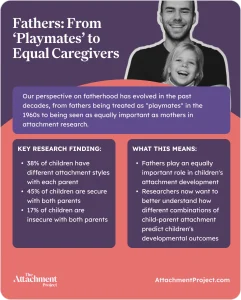
Dr Vrticka: Attachment theory initially mainly focused on mothers and the mother-child relationship. Luckily, this has started to change, as nicely summarized by Inge Bretherton in her 2010 review paper “Fathers in attachment theory and research” [11].
In a first phase during the late 1960s, fathers were not considered equal caregivers and attachment figures. They were rather regarded as playmates and subsidiary attachment figures, with infant-mother attachment being seen as the focal one in most cases. Only two empirical studies even considered infant-father attachment as relevant at the time.
In a second phase during the 1970s, there was a strong upsurge of studies using the then novel Strange Situation Procedure (SSP) that was exclusively performed in mother-child pairs. Accordingly, only a very small number of studies also considered fathers. These studies in fathers, however, yielded interesting conclusions, including the realization that father-infant and mother-infant relationships may involve different kinds of experiences for infants, resulting in differential influences on children’s personality development from infancy onward.
In the following third phase during the 1980s, more data emerging from the SSP started to suggest that infants can have distinct attachment relationships to mothers and fathers, independent of their own personality or temperament. This was underscored with first meta-analyses becoming available on similarities versus differences between child-mother and child-father attachment derived from the SSP. Interestingly, while 45% of children were secure with both parents and 17% were insecure with both, 38% of associations were non-concordant – that is, children classified as secure with one parent but insecure with the other. Such a finding of a sizeable proportion of non-concordance raised the question whether distinct qualities in an infant’s relationship with each parent may affect personality and sense of self development in childhood.
Finally, in a fourth phase that began during the 1990s, two research questions started emerging. The first question asked to what extent fathers and mothers in different types of families play differentiated or equal roles in fostering secure attachment and secure exploration. And the second question asked what fathers’ versus mothers’ unique and joint impact is on the child’s developing capacity for exploration and relatedness.
As evident from the above, attachment theory has gone from attributing very limited importance to fathers in their role as caregivers and attachment figures initially, to specifically asking what their unique involvement is for child development. Remarkably, resulting research from such a shift in thinking has recently yielded the realization that mothers’ and fathers’ attachment-related behavior is associated with parental sensitivity, and the influence of child-parent attachment on child developmental outcomes related to behavioral problems is rather similar for mothers and fathers [12], [13].
Current thinking encourages researchers to look beyond parent-child attachment and to also include mothers’ and fathers’ parental collaboration or conflict and thus their spousal relationship. Furthermore, what is nowadays being considered is whether a child needs two secure attachments for optimal socioemotional development, or whether one secure attachment is enough to potentially “buffer” any risk associated with another more insecure attachment.
Dr Vrticka: The most recent meta-analytic evidence I have read on parental sensitivity, child behavioral problems and child language competence associated with child attachment security point to similarities rather than differences between mothers and fathers. This does not mean that mums and dads interact in the same way with their children or that mother-child and father-child relationships are identical. What it means is that both mothers and fathers can achieve the same goal, which is sensitively raising securely attached children with fewer behavioral problems and stronger socioemotional and cognitive skills, even if they do so in different ways.
The question on potentially different roles of mums and dads for child development from an attachment perspective is part of a current effort to better understand attachment dynamics within families. In doing so, the overall conversation is centered around the so-called integrative hypothesis, which states that the configuration of children’s attachment networks with both parents predicts early childhood developmental outcomes better than children’s attachment relationships with either parent alone.
For such considerations, two main scenarios are viable. On the one hand, it could be that the more secure attachments a child forms, the better their developmental outcomes (i.e., additive hypothesis). Accordingly, it would be better to have two secure attachments than one secure and one insecure or two insecure ones. On the other hand, it could also be that a secure attachment to one parent can help buffering an insecure attachment to the other (i.e., buffering hypothesis). Accordingly, a secure attachment to one parent could potentially offset possible detrimental effects of an insecure attachment to the other parent.
In the meta-analyses I refer to above, there seems to be evidence for both the additive and buffering hypotheses. What this means, is that for optimal child development, it appears better if children can establish more than one attachment bond – because this increases their chances for having at least one secure attachment relationship. And we know that one secure attachment relationship can beneficially influence child development either in an additive or a buffering manner.
Besides the additive and buffering hypotheses, there are two more hypotheses that are part of the overall integrative hypothesis. For such considerations, the question whether one parent contributes more than the other to developmental child outcomes becomes important. Again, there are two possible scenarios. On the one hand, a secure attachment to either parent could lead to better outcomes than a secure attachment to the other (i.e., hierarchical hypothesis). On the other hand, a secure attachment to either parent could lead to similar outcomes as a secure attachment to the other (i.e., horizontal hypothesis).
In the meta-analyses I refer to above, there seems to be evidence for the horizontal hypothesis and thus equal contribution of child-mother and child-father attachment. These findings therefore rather point to similarities than differences.
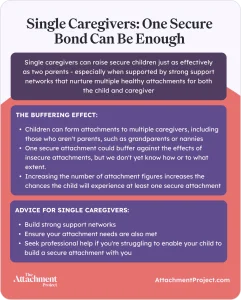
Now, what do these findings and theoretical considerations mean for single-caregiver families? For single caregivers, it is helpful to know that children can establish secure attachments to both mum or dad, regardless of who is the single caregiver, and that the long-term effects of these secure attachments are similar. It is also important to keep in mind that children can establish secure attachments to other close individuals beyond their primary caregivers like their grandparents and additional extended family members.
For single-caregiver families, it is furthermore recommended to build strong support networks which give children the opportunity to form more than one attachment relationship. This increases the likelihood that at least one secure attachment bond is present – regardless of whether we assume the additive or buffering hypothesis to be more adequate. Relatedly, it is also important for the support network to comprise attachment figures for the single caregiver because the ability to provide care and to seek for attachment oneself are tightly connected. If a single caregiver’s attachment needs are not met, it is more difficult for them to care for others. And, of course, if single caregivers struggle to enable a secure attachment in their children, they should not hesitate to seek professional help.
Thank you to Dr Vrticka for your time and words. For more information, please visit Dr Vrticka’s personal website at www.pvrticka.com.
 Get mental health tips straight to your inbox