








Burnout and Attachment at Work: Burnout Prevention and Protection
In this installment of our Attachment at Work series, we investigate the risk of burnout at work and how having secure relationships at work could protect us from burnout.
Although the term “burnout” has become widely popular in more recent years, it was first used to formally describe work-related exhaustion in the 1970s by a psychologist named Herbert Freudenberger1.
Freudenberger described burnout in lots of ways, often involving themes of giving more energy than you have to spare, working overtime, and feeling unrewarded. Although Freudenberger is often credited with coining the term “burnout”, he notes that it was used collectively by staff at his own workplace and in the communities he served2.
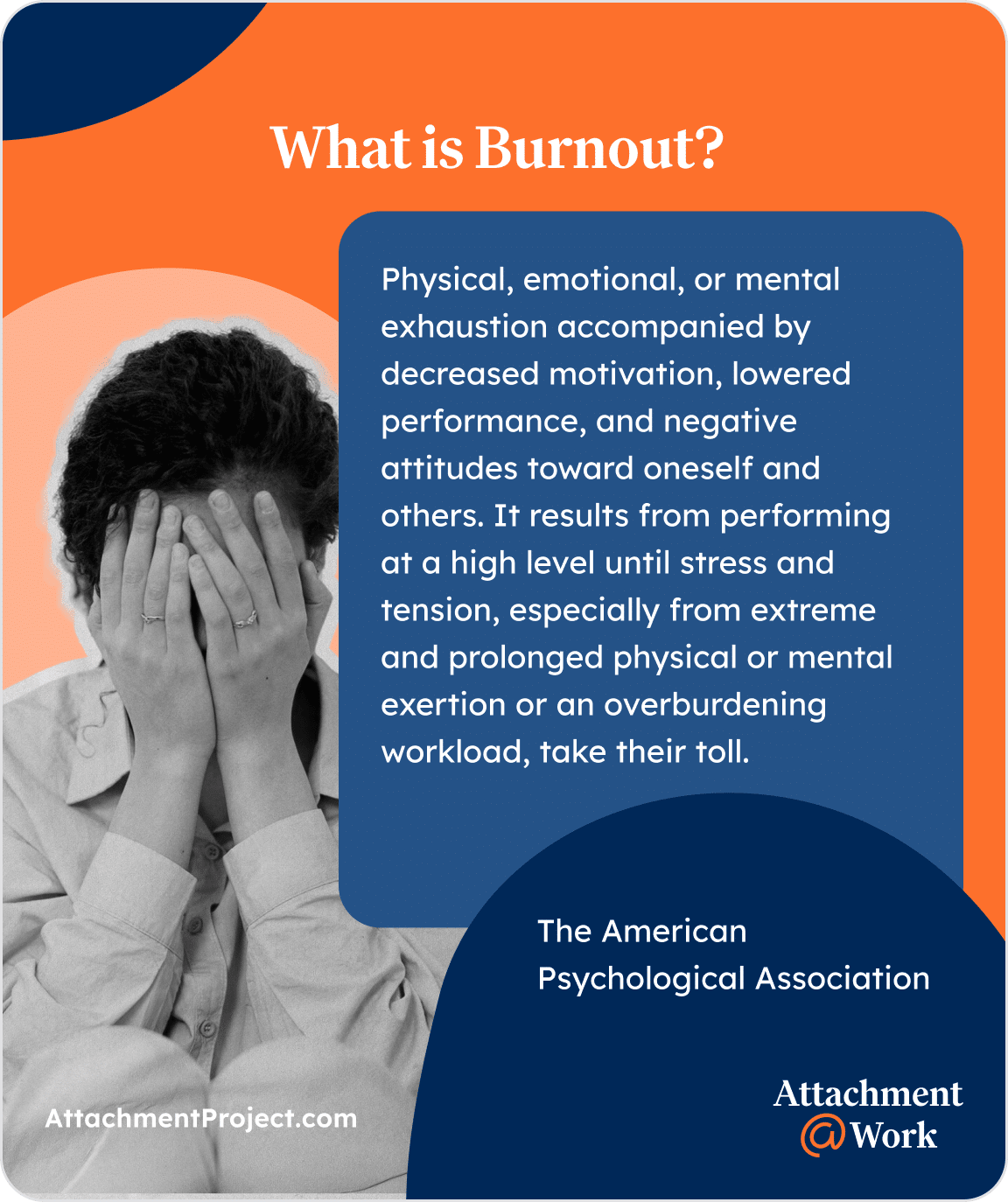
The American Psychological Association describes burnout as:
Physical, emotional, or mental exhaustion accompanied by decreased motivation, lowered performance, and negative attitudes toward oneself and others. It results from performing at a high level until stress and tension, especially from extreme and prolonged physical or mental exertion or an overburdening workload, take their toll.
What Does Burnout Look Like?
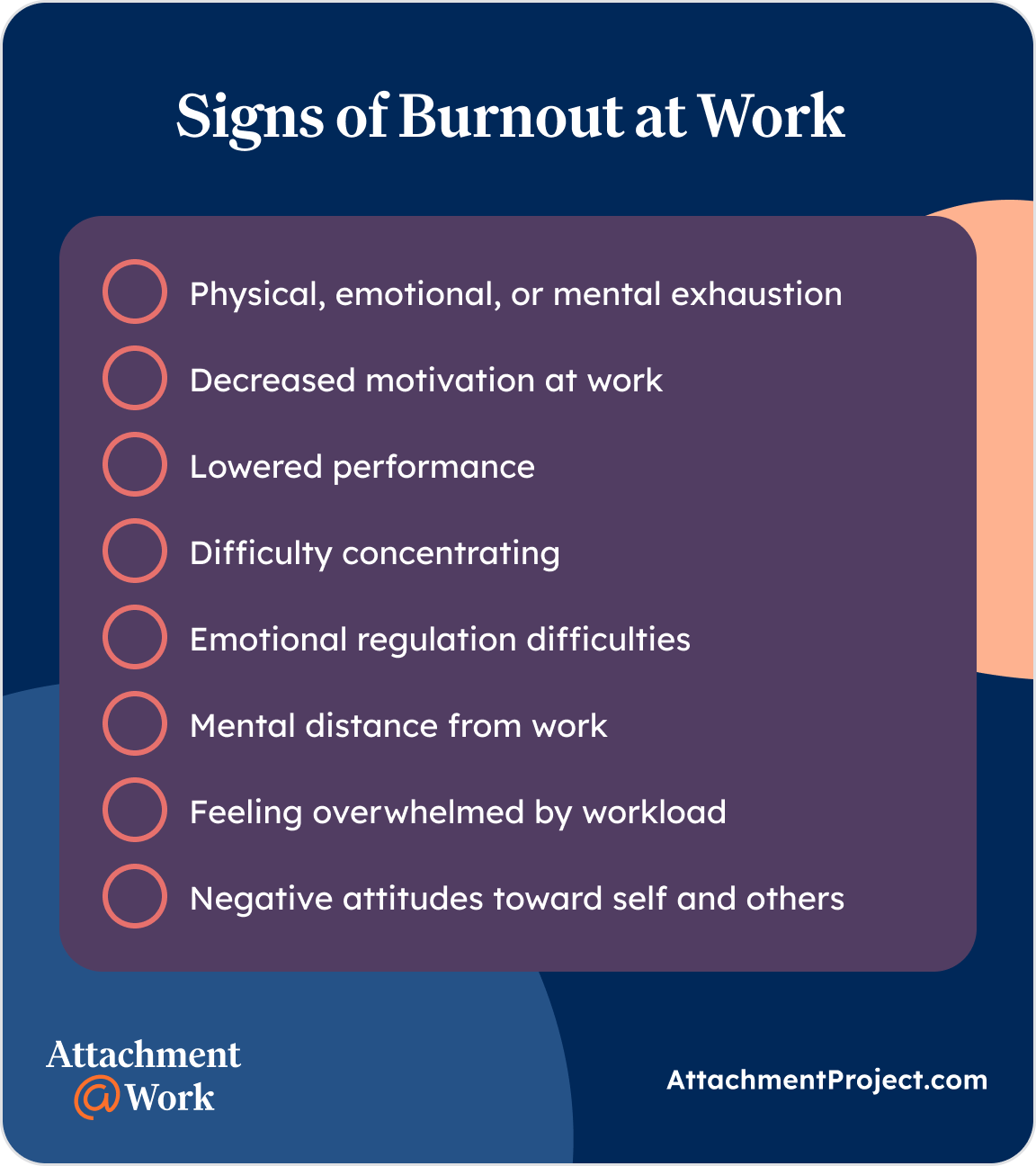
Burnout can have severe consequences in both our personal and professional lives, and for the company as a whole when burnout risk is high. For example, studies have found associations between burnout and depression, as well as burnout and anxiety3. Anecdotally, people who have experienced burnout discuss feeling overwhelmed by work, crying often, and feeling generally unwell.
We can also feel burnt out from our responsibilities at home and in family systems, which often compete and overlap with demands at work. Our measure specifically focused on burnout in our professional lives and what happens when the demands of the workplace become too high.
This isn’t all in your head – studies have shown that burnout leads to stress markers like higher cortisol levels, inflammation, and a suppressed immune system4.
Due to the significant impact burnout can have on people and organizations, we decided to include it in our Attachment at Work study.
About Our Attachment at Work Study
Our Attachment at Work study aimed to find out how your workplace attachment style – how anxious or avoidant your attachment is to your colleagues – relates to your experiences at work and in your inner life.
From our trialling process, we were able to identify a set of questions that successfully measure attachment at work as a new idea, separate to the attachment we experience with our romantic partners, family, or friends!
64,240 people took part in our study across several different surveys, answering different sets of questions to make up our complete set of data.
For a detailed overview of the Attachment at Work study, check out our article: What is Attachment at Work?
We compared our data to look for the most interesting and important connections. To measure and compare burnout, we used the Burnout Assessment Tool (BAT) by Schaufeli et al. (2006), in which higher scores indicate higher levels of burnout5.
This tool measures burnout on 4 domains:
- Exhaustion at or after work
- Mental distance (a sense of mental separation from work)
- Cognitive impairment (difficulty concentrating at work)
- Emotional impairment (difficulty with emotional regulation at work)
We were then able to find correlations between these scores and attachment scores to understand the relationships that might exist between them.
TAKE OUR FREE ATTACHMENT AT WORK TEST
Burnout and Attachment at Work
Higher scores on workplace attachment avoidance and workplace attachment anxiety indicate higher insecurity in the relationships we have at work.
People with higher burnout scores reported less secure Attachment at Work, or workplace attachment security. We don’t know the direction of this relationship – that is to say, we don’t know whether having a less secure workplace attachment style puts you at greater risk of burnout, or experiencing burnout leads to a risk of insecure workplace attachment.
We do know that this relationship makes sense. Without a secure attachment style, we might have less stable support networks and more difficulty with emotional regulation, which can spell burnout risk. At the same time, burnout can come with a sense of detachment and disconnection from the workplace, which may contribute to workplace attachment anxiety or workplace attachment avoidance. 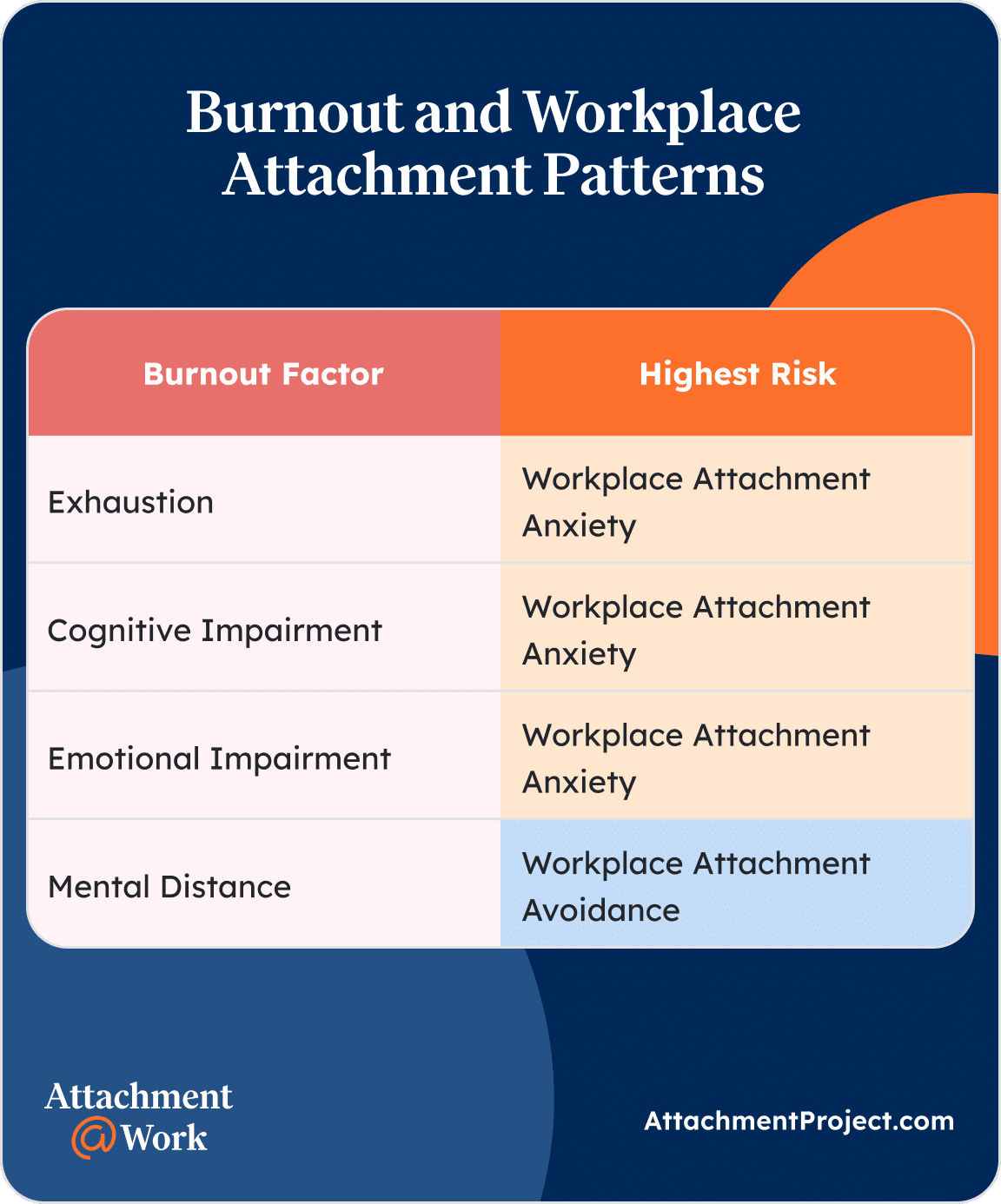
Interestingly, our study found that anxiety was the most closely related to all but one of the burnout subscales; why might this be, and what does it mean for your workplace attachment style?
Burnout and Workplace Attachment Anxiety
Our study found that people who scored highly on workplace attachment anxiety were also more likely to score highly on exhaustion, cognitive impairment, and emotional impairment – but not mental distance.
The relationship was particularly strong between workplace attachment anxiety and emotional impairment. This isn’t surprising, as intense emotions and difficulty regulating them is characteristic of attachment anxiety, where our brains have learned that displays of emotion can result in our needs being met.
It could be the case that these intense emotions lead to a greater sense of exhaustion and difficulty focusing at work, although the relationship between these subscales and workplace attachment anxiety was not much stronger than the relationship between the subscales and workplace attachment avoidance.
Burnout and Workplace Attachment Avoidance
Unlike the other three subscales, mental distance was more closely related to attachment avoidance than attachment anxiety – although the difference was the smallest in the dataset.
Attachment avoidance is associated with using emotional distance to protect from assumed negative outcomes. For instance, you assume that your coworker would not like to spend their breaktime with you so you avoid taking a break at the same time as them, perhaps reasoning that you’d prefer to be alone anyway.
In the same way, purposefully finding mental distance from your job could be one way that somebody who scores higher in workplace attachment avoidance copes with stress or the onset of burnout. It could also be the case that, if someone already tends to maintain distance from their coworkers because of their workplace attachment avoidance, they may be at higher risk of burnout.
Other Factors in Burnout
To find out whether other factors could also be related to burnout, we explored any differences in burnout scores depending on your workplace setup (remote/hybrid/office-based), professional role, gender, and parenthood status.
Burnout and Workplace Setup
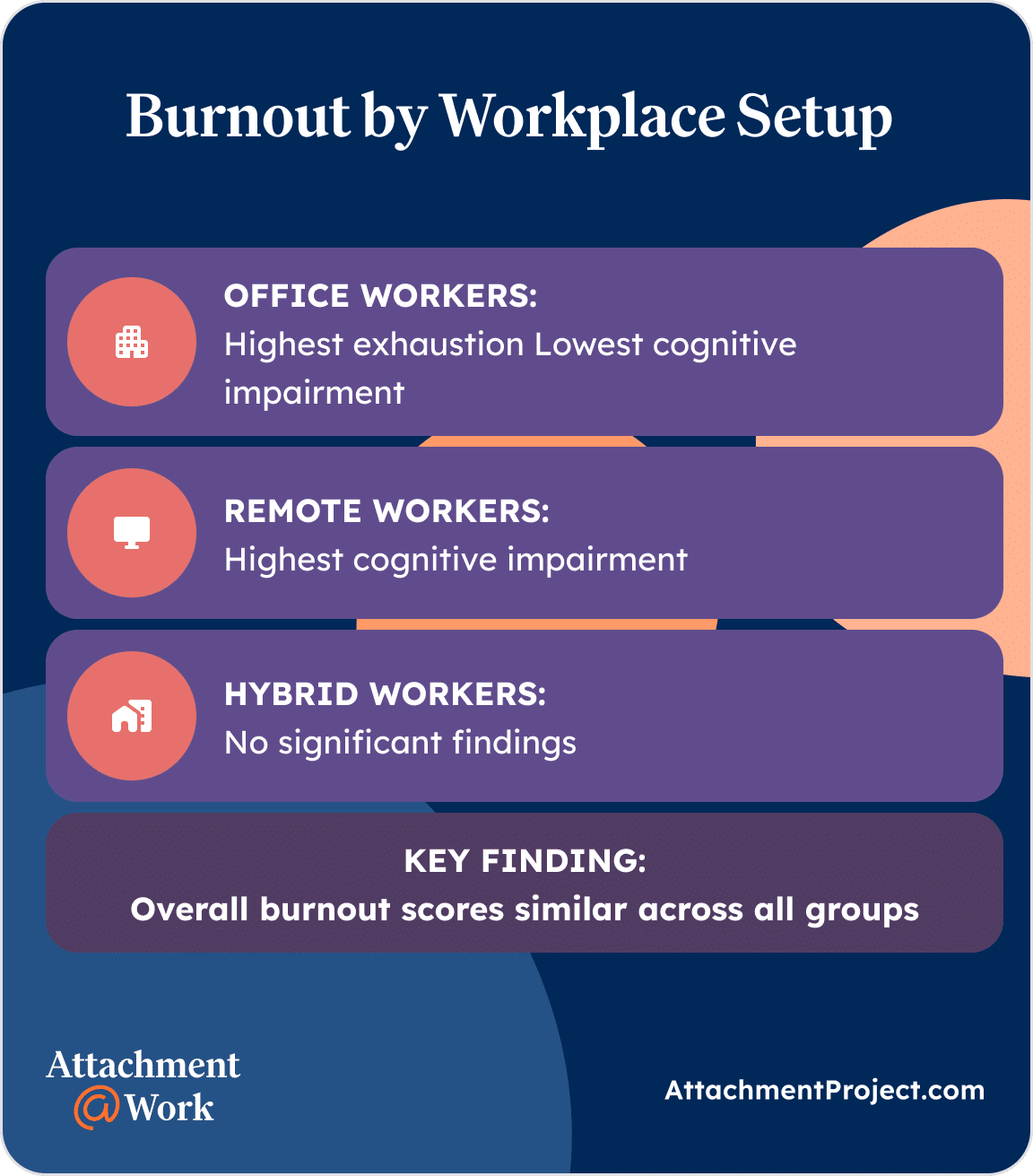
Office workers reported higher exhaustion than hybrid and office workers, and higher emotional impairment than remote workers. However, office workers reported the lowest cognitive impairment, while remote workers reported the highest. There was no difference in the overall burnout scores across these groups; to explore these findings more, you can read our report on workplace setup and Attachment at Work here.
Burnout and Professional Status
Professional status categories were business owners, contractors, employed managers, employed non-managers, and unemployed. The unemployed group reported the highest levels of burnout across all subscales, followed by employed non-managers. Business owners reported the lowest levels of burnout, again across all subscales, while contractors reported similarly low burnout but with markedly higher emotional impairment.
It seems that people with the least levels of autonomy at work are the most likely to experience burnout. The unemployed group could be unemployed because of their experiences of burnout, or, they could be experiencing signs of burnout due to the often difficult and stressful nature of looking for work.
TAKE OUR FREE ATTACHMENT AT WORK TEST
Burnout, Gender, and Parenthood
Men and women scored similarly on burnout, except in the exhaustion subscale, where women scored higher. People with children report lower burnout overall, except when it comes to cognitive impairment.
It may be surprising that parents report lower levels of burnout, until we look at our other data: people with children also reported higher levels of resilience. This could be because having children often comes with a strong sense of responsibility which necessitates the need to bounce back quickly. It makes sense that parents can have a harder time focusing at work, as many report feeling “split”, or as if a part of their mind is always with their children.
Managing Burnout Risk in Teams
Burnout can be catastrophic, and protecting yourself or your team from burnout is key to supporting resilience, happiness, and productivity at work.
Understanding your attachment patterns at work can give you clues into your burnout risk, and developing a secure Attachment at Work can become a protective factor.
People with lower levels of autonomy at work could benefit the most from burnout support. When it comes to differences in workplace setup, gender, and parenthood, the importance of different subscales means that support could be tailored to each group’s specific needs.
These findings represent broad patterns, but each organization and individual experiences unique challenges and points of resilience. While these findings can give you an idea of what might be happening in your workplace dynamics, a personalized report can give you greater insight and specific recommendations to build secure Attachment at Work.
For your personalized report, take our unique and validated Attachment at Work quiz.
References
- Schaufeli WB. Burnout: A short socio-cultural history. InBurnout, fatigue, exhaustion: An interdisciplinary perspective on a modern affliction 2017 Apr 29 (pp. 105-127). Cham: Springer International Publishing.
- Fontes FF. Herbert J. Freudenberger and the making of burnout as a psychopathological syndrome. Memorandum: Memory and History in Psychology. 2020;37:1676-69.
- Koutsimani P, Montgomery A, Georganta K. The relationship between burnout, depression, and anxiety: A systematic review and meta-analysis. Frontiers in psychology. 2019 Mar 13;10:429219.
- Bayes A, Tavella G, Parker G. The biology of burnout: Causes and consequences. The World Journal of Biological Psychiatry. 2021 Oct 21;22(9):686-98.
- Schaufeli WB, Bakker AB, Salanova M. The measurement of work engagement with a short questionnaire: A cross-national study. Educational and psychological measurement. 2006 Aug;66(4):701-16.
 Get mental health tips straight to your inbox