









Am I in Love or Just Limerent? How to Tell the Difference

Published on November 5, 2025 Updated on November 6, 2025
If you’re constantly checking your phone for their messages, thinking about them at work or school, or laying awake at night analyzing your interactions, you may think you’re in love – but there’s another word for this specific kind of love that takes over our lives. Psychologist Dorothy Tennov called this type of love “limerence“, noting how it’s distinctly more intense and all-consuming than other experiences of love. It’s easily mistaken for love, but there are 5 major signs that it’s limerence instead. Knowing the difference can help you to navigate a crush or new relationship and understand the common experiences that come alongside them.
What Dorothy Tennov’s Research Revealed About Love vs Limerence
Realizing that experiences of love could be vastly different, Tennov coined the term “limerence” to describe the intense infatuation we can experience when interested in somebody romantically1.
Limerence is considered a cognitive experience, characterized by persistent and intrusive thoughts about the person (referred to as the Limerent Object or LO) and a longing for reciprocation. When in limerence, your mood can be dictated by your interpretation of your LO’s response to you. Physical signs of stress and anxiety can appear, such as heart racing and palpitations, clamminess, and blushing. Limerence is not a diagnosis, so formal statistics on how many of us experience it haven’t been investigated. Some informal sources estimate that as many as 30-60% of us feel we’ve experienced limerence at some stage – in any case, it isn’t something that everybody experiences, but it’s common enough that it’s useful to define and understand it.
How to Know If You’re Actually Limerent: The 5 Signs
It can be difficult to tell the difference between limerence, love, and a healthy crush. Limerence is typically more distressing and confusing, especially because it involves a lot of uncertainty. If you’re unsure, there are 5 signs of limerence that you should look out for:
- You have persistent intrusive thoughts about the LO, to the extent that it’s difficult to focus on other things and no longer enjoyable.
- You fantasize about the LO in detail, often in ways involving reciprocation. Again, these fantasies can often distract you from other important tasks.
- You read deeply into their actions, looking for clues about how they feel about you. Small gestures of kindness might be taken as a sign they reciprocate, while small moments of disconnection might be taken as complete rejection.
- Your mood is heavily dependent on your interpretation of your LO’s actions – perceived reciprocation can make you feel euphoric, while perceived rejection can lead to feelings of depression and hopelessness.
- You put your LO on a pedestal – everything about them is wonderful, and you might wilfully ignore any red flags for bad behavior or incompatibility.
The Breadcrumb Effect in Limerence
Unavailability, ambiguity, and an absence of reciprocation are typical of limerent relationships. Sometimes, the LO might “breadcrumb” to keep you interested – this is when, consciously or unconsciously, the LO gives you small pieces of hope to keep you interested. It works because it makes you feel like there’s a chance – you’re not unreasonable for responding to it. Nevertheless, breadcrumbing is a very difficult thing to be on the receiving end of. People who have been breadcrumbed report feelings of depression, loneliness, and loss of trust in others2, 3, 4. Breadcrumbing can mimic patterns of addiction – unpredictable patterns of rewards, which release dopamine in the brain, can make us highly driven to look for the next hit of dopamine5.
What Your Physical Feelings Tell You About Your Emotions
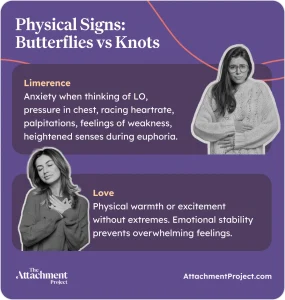
Paying attention to how you feel physically can help you to distinguish between limerence and love. People in limerence typically report feelings of anxiety when they think about their LO, which can manifest as pressure in the chest, a racing heartrate, palpitations, and feelings of weakness. When in the euphoric state, normal senses might seem heightened. Love, on the other hand, does not come with these physical extremes. While there may be physical feelings of warmth or excitement associated with love, emotional stability prevents these feelings from becoming overwhelming. Some people have visualized the comparison of love vs limerence as butterflies vs knots in their stomach.
Can Limerence Turn Into Love?
According to Tennov, limerence can turn into love, or “affectional bonding” – but a specific set of conditions need to be met first1. First, the LO needs to reciprocate feelings and attention. In limerence, this isn’t always the case; sometimes your LO doesn’t even know who you are. For affectional bonding to develop, the LO needs to return your attention.

This needs to be consistent enough to remove uncertainty about the relationship. When attention is returned inconsistently, this can create a breadcrumbing dynamic and encourage limerent feelings. When the ambiguity about the relationship is over, limerence tends to dissipate. The transformation of limerence to love is a healthy, positive process, but the loss of limerence can still bring up some difficult feelings. Without the excitement of the ups and downs, some people wonder if they truly love their partner, or if they could have “lost” their feelings. Understand that love changes naturally over time, and the development of a stable, predictable dynamic is part of a healthy relationship.
The Role of Attachment Styles in Limerence Becoming Love
Many people feel that their early attachment experiences have influenced their tendency towards limerence6. Limerence does share some characteristics with attachment anxiety, which is high in both Anxious-Preoccupied and Fearful-Avoidant attachment styles. Emotional dependence, difficulties with self-esteem, and fear of rejection are all involved in both attachment anxiety and limerence – but limerence is focused on one person at a time, while attachment anxiety describes a broader pattern of relating to yourself and others. Attachment security allows trust and intimacy to build at a healthy pace, and enables couples to have open, honest communication. This reduces uncertainty and emotional ups and downs, which can help limerence to subside as affectional bonding strengthens.
DISCOVER YOUR ATTACHMENT STYLE
Why Some People Get Stuck in Limerent Cycles
According to Tennov, limerences usually last between 18 months and 3 years, with very few lasting less than 6 months and some lasting a lifetime1. Some people experience long lasting patterns of limerence. Sometimes, this happens when limerence doesn’t fully transition to love. This can happen when uncertainty isn’t entirely resolved – the limerent feelings can transition from one person to another, causing the end of the previous relationship and restarting the cycle. Tennov predicted that limerence would be associated with a particular personality or characteristic, but found that, actually, limerence seemed to be able to happen to anyone. However, some traits have been associated with limerence. In one Master’s thesis submitted to the University of Maryland, lower self-esteem, mind wandering, validation-seeking, social anxiety and attachment anxiety were all associated with limerence7.
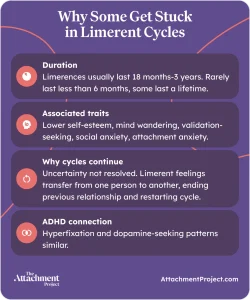
Comparisons have been drawn between limerence and Attention Deficit Hyperactivity Disorder (ADHD) – people with ADHD can hyperfixate, or focus intensely on their interests, and seek stimulation to make up for depleted levels of dopamine8.
Signs You’re in Love vs Signs You’re Limerent
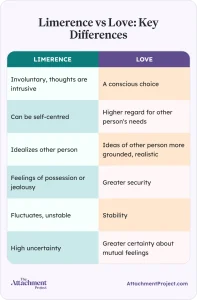
If you’re wondering whether you’re limerent or in love, there are a few key differences that can help you to tell the difference. Firstly, limerence has a sense of involuntariness about it: thoughts are intrusive and often unwanted. In love, on the other hand, there’s a sense of choice and intentionality. While thoughts of the other person might still pop into your head, they don’t distract you from day to day life and cause distress. Limerence can also be somewhat self-centred, as your main concern is with your LO’s response to you instead of their own needs. You might push too hard or ignore their boundaries to try to get what you need, instead of prioritizing them. In limerence, you might put the LO on a pedestal – everything about them is amazing, they can do no wrong, and you might even willfully ignore any red flags. In love, you recognize that your partner has imperfections like everybody else. You love this person as a whole, with a grounded and realistic view of them. You may also feel jealous, uncertain of your relationship’s future or current status, and emotionally unregulated while in limerence. In love, you have a greater sense of trust, stability, and certainty.
Are You Limerent or In Love? Take Our Limerence Test to Find Out
Still unsure whether it’s love or limerence? Our comprehensive limerence assessment tests your limerent thoughts, feelings and behaviors and gives you a personal limerence score in less than 5 minutes. You also have the option to receive a free 15 page report on your limerence score. Find out whether you’re in love or just limerent:
Moving From Limerence to Healthy Love
If you’re in limerence but you want to be in love, there are a few ways you can build healthier, grounded relationships.
Nurturing a Secure Attachment
Attachment security not only helps you to have healthy relationships, but also builds self-esteem and emotional regulation. Repeated positive experiences in relationships can help us to build attachment security, but we can also work on it on our own. Focusing on ourselves and building rich lives full of hobbies and good support networks can support our self-esteem, and there are things we can do to practice emotional regulation.
Building Emotional Regulation Skills
Emotional regulation is not a trait, but a skill – this means anyone can practice and improve upon it, even though some of us might find it easier than others. If you have a mental health or neurodivergent diagnosis, you might find it especially difficult to practice emotional regulation. This doesn’t mean it’s out of your reach. The first stage of emotional regulation is awareness: being able to recognize and label your internal experiences. When you’re having a difficult feeling, try to step back and notice where and how you feel it physically in your body. Some people find it helpful to visualize the feeling as an object – what would be its shape, color, and texture? If you find it difficult to name the feeling, emotion wheels like the one below can be useful tools. Start from the inside and work your way out to find the most specific label for your emotion. This practice can be most effective when reflecting on a feeling, rather than when you’re experiencing it in real-time. It’s best to practice techniques like these when your emotions are less intense, as this is when your brain is in learning mode. With enough practice, this becomes second-nature when emotions are high. This is why mindfulness can be an effective tool – when you practice mindfulness, you practice noticing and accepting thoughts and feelings without judgement. Once you’re able to recognize your emotions, you can choose the right tools to manage them.
When to Seek Professional Support
Mental health professionals can help you to find the right tools to manage difficult emotions. If you find it challenging or overwhelming to practice emotional regulation, this might be a suitable route for you. It may also be beneficial to seek support from a mental health practitioner when your thoughts and feelings become overwhelming and disruptive to everyday life. If your intrusive thoughts and urges are impacting your ability to work, manage responsibilities, or maintain your relationships, a professional can help you to problem solve or get to the bottom of your experiences. The right kind of therapy depends on what works for you. Some therapists use psychoeducation to help you understand what’s happening for you without digging into your past, while some dive deep into your past and present. It’s okay to shop around until you find an approach that works for you.
Conclusion
Knowing the difference between love and limerence can help you to understand whether your relationship to the other person is healthy and grounded. Psychologist Dorothy Tennov presented the idea of limerence as an alternative explanation for the intense ups and downs that some people feel when they’re “falling in love”. Although it’s often romanticized, limerence is characterized by dependence, anxiety, and uncertainty, with periods of euphoria when feelings seem to be reciprocated. Limerence can turn into love if certain conditions are met. This is a good thing, as it results in more stable, healthy relationships, but it’s easy to mistake the absence of intensity for the absence of love. Emotional regulation, attachment security, and professional support can help us to reduce the intensity of limerence and transition into grounded love. If you’re not sure whether you’re truly in love or just limerent, take our comprehensive limerence test – in only a few minutes, you’ll receive a limerence score and a free, personalized 15-page report.
LEARN HOW TO OVERCOME LIMERENCE
Frequently Asked Questions
Q: Isn’t limerence just what people call the early stages of love?
Limerence isn’t experienced by everybody – informal sources estimate 30-60% of us have been limerent, and limerence doesn’t always transition into love. This is why Tennov proposed that limerence should be considered separate from the early stages of love.
Q: How can I tell if my intense feelings are love or limerence?
If your intense feelings cause anxiety, depression, or euphoria depending on whether you perceive the other person to reciprocate, they are likely limerence instead of love.
Q: Can you be limerent toward someone you’re in a relationship with?
Yes, you can be limerent with someone you’re in a relationship with. Limerence gradually dissipates when relationships feel more certain.
Q: Why does limerence feel so much more intense than love?
Limerence feels more intense than love because it’s a difference cognitive state, characterized by intrusion, anxiety, and uncertainty rather than choice, security, and certainty.
Q: Can limerence happen in long-term marriages?
Limerence can happen in long-term marriages – even though it usually dissipates, Tennov noted that some limerences can last a lifetime.
Q: What should I do if I realize I’m limerent, not in love?
If you realize that you’re limerent and it’s affecting your emotional wellbeing, try to practice emotional regulation skills. Focus on other people in your support network and develop self-reliance through building skills and hobbies. It’s okay to still be interested in and excited about the other person, but this shouldn’t get in the way of daily life.
Q: Is mutual limerence the same as love?
Mutual limerence isn’t the same as love because the experience of limerence is different. Love, or “affectional bonding”, is more grounded, stable, and selfless.
Q: Why do some people seem to only experience limerence and never love?
Limerence can be experienced by anybody, but some might be more prone to limerence due to low self-esteem, attachment anxiety, and a tendency to let the mind wander. It can be difficult for limerence to transition into love if relationships never reach the level of certainty needed for this to happen, but this doesn’t mean that limerence-prone people aren’t able to experience love.
References
- Tennov D. Love and limerence: The experience of being in love. Scarborough House; 1998 Dec 29.
- Cobzeanu A, Măirean C. Online Fairytales: Breadcrumbing and Ghosting Behavior Among Young Adults. Deviant Behavior. 2025 Feb 5:1-20.
- Khattar V, Upadhyay S, Navarro R. Young adults’ perception of breadcrumbing victimization in dating relationships. Societies. 2023 Feb 8;13(2):41.
- Navarro R, Larrañaga E, Yubero S, Víllora B. Psychological correlates of ghosting and breadcrumbing experiences: A preliminary study among adults. International journal of environmental research and public health. 2020 Jan;17(3):1116.
- Laskowski CS, Dorchak DL, Ward KM, Christensen DR, Euston DR. Can slot-machine reward schedules induce gambling addiction in rats?. Journal of gambling studies. 2019 Sep 15;35(3):887-914.
- Willmott L, Bentley E. Exploring the lived-experience of limerence: a journey toward authenticity. The Qualitative Report. 2015;20(1):20-38.
- Wolf NR. Investigating limerence: predictors of limerence, measure validation, and goal progress (Master’s thesis, University of Maryland, College Park).
- Bradbury P, Short E, Bleakley P. Limerence, hidden obsession, fixation, and rumination: A scoping review of human behaviour. Journal of Police and Criminal Psychology. 2024 Apr 25:1-0.
Related Articles

How to Get Over Your Ex: 7 Tips for Personal Growth After a Breakup
16 Feb 2021
Breakups are not an easy or pleasant part of our journeys. And yet, it’s exactly those tough moments in our lives that help us grow and learn.

What Is Anxious Ambivalent Attachment and What Causes It?
25 May 2021
Anxious ambivalent attachment typically develops in children whose caregiver may have acted nurturing and responsive one minute and unavailable or insensitive the next.

How a Secure Attachment Style Develops in Your Baby
21 May 2021
A secure attachment style forms through a special type of bond between children and their caregivers.
 Get mental health tips straight to your inbox


