









Anxious vs Avoidant Attachment: Key Signs, Differences, and Common Questions
Published on January 13, 2026 Updated on January 19, 2026

Lots of people first find out about attachment theory because they’ve noticed a pattern in their relationships and want to know why. Maybe you find that you always seem to need more from your partners, or your partners seem to need more from you. You wouldn’t be alone – around 40-50% of adults have an insecure attachment style.
Attachment theory helps us to understand these patterns, but it comes with lots of new terms and ideas that can be a bit confusing at first. It’s often easy enough to understand that you have an insecure attachment style, but how do you know whether you’re anxious or avoidant? Can you be both anxious and avoidant, and how would you know if you were?
DISCOVER YOUR ATTACHMENT STYLE
In this article, we’ll explain the difference between anxious and avoidant attachment styles with clear examples and behaviors for you to refer to. We’ll answer your questions about whether you can be both anxious and avoidant, and explain what our free attachment test can tell you about your attachment style.
Key takeaways:
- Anxious attachment styles are characterized by a need to pull partners closer and closer to satisfy a fear of abandonment.
- Avoidant attachment styles are characterized by a need to push partners away in anticipation of inevitable abandonment.
- You can be anxious and avoidant at the same time (fearful-avoidant attachment style).
- Our free attachment test can tell you whether your attachment style is secure, avoidant, anxious, or fearful-avoidant based on your answers.
The Two Scales of Attachment
Taking an anxious vs avoidant attachment test can help you to better understand the patterns that appear in your relationships and develop healthier, stronger attachments to others. We’ll get into the details about anxious vs avoidant attachment soon, but first, we need to explore the foundations of attachment theory.
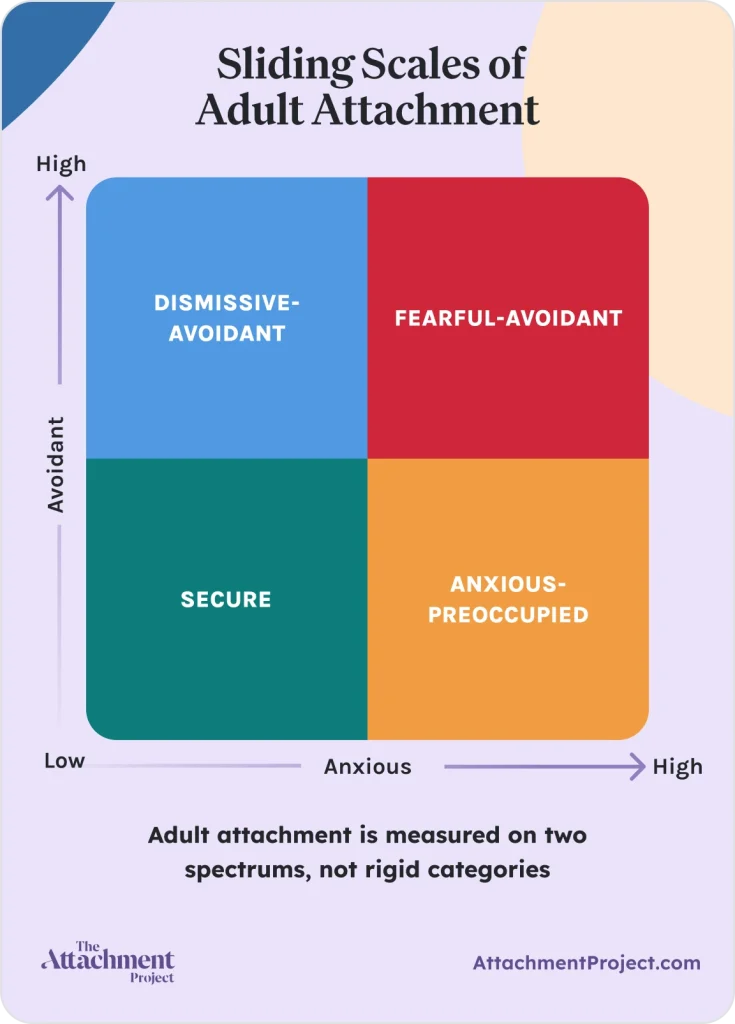
Mary Ainsworth first described the 3 infant attachment styles, with the disorganized attachment style added as a later addition for infants who didn’t always show predictable behavior.1,2 Instead of categories, our adult attachment styles are measured on two sliding scales: anxiety and avoidance.3,4
Am I Anxious or Avoidant? A Side-by-Side Comparison
Although both the anxious-preoccupied and dismissive-avoidant attachment styles involve difficulty in relationships, their associated thoughts, feelings, and behaviors are almost opposite.
Both attachment styles are prone to fear, rejection, and uncertainty, but the things that trigger these feelings are a little different. The anxious-preoccupied attachment style is more likely to feel afraid when separated from their partner, rejected when small problems aren’t given enough attention, and uncertain when their partner feels distant.

On the other hand, the dismissive-avoidant attachment style is more likely to feel afraid when the relationship feels intimate, rejected when small problems are raised, and uncertain when their partner feels too close. While the anxious-preoccupied style pulls partners in to relieve these feelings, the dismissive-avoidant style pushes them away.
Anxious-Preoccupied Attachment Style
If your experiences of relationships (including in infancy) are of others as sometimes unreliable, you may have an anxious-preoccupied attachment style – also known as an anxious attachment style. You might have a strong fear of abandonment and need for closeness with others, and your relationships may be characterized by emotional intensity and uncertainty.
Examples of Anxious Attachment in Relationships
When Jen and Alex first got together, Jen wanted to move very quickly. She felt secure when physically with Alex, but would become worried, anxious, or irritated when Alex took too long to reply to her messages. She doesn’t mind talking about relationship issues and wants to talk through things often, but when Alex doesn’t respond the way she’d hoped she feels rejected and hurt. She feels nervous when Alex goes out with their friends – she doesn’t discourage them from going out, but she checks in often and thinks about them constantly until they get home.
Jen shows a few signs of an anxious attachment style in this example:
- Wanting to move very quickly
- Becoming distressed when there’s no contact for a short time
- Wanting to talk through relationship issues often
- Feeling rejected and hurt when conflicts aren’t resolved
- Feeling nervous when your partner goes out with others
- Checking in often when your partner is busy
- Thinking about your partner constantly
If you recognize several of these signs, you might have an anxious attachment style. If you only relate to one or two, you may still have a different attachment style.
It’s also important to note that these examples are context dependent – not hearing from your partner for an abnormally long time is naturally distressing, and wanting to talk through relationship issues when needed is a sign of attachment security. Understanding your attachment style through the behaviors above should be looked at as a general pattern, rather than a checklist exercise.
Dismissive-Avoidant Attachment Style
If your experiences of relationships are of others as consistently unreliable and untrustworthy, you may have a dismissive-avoidant attachment style – also known as an avoidant attachment style. You might have a fear of intimacy and need for emotional and physical distance from romantic partners. Even though you might still want to be in a close loving relationship, milestones and real intimacy can feel uncomfortable. Your relationships may be characterized by confusion and miscommunication.
Examples of Avoidant Attachment in Relationships
When Ali and Thea first got together, Ali needed to take it slow. He would sometimes take a long time to plan a date or reply to Thea’s messages, even though he wanted to. When Thea raised this as a problem, at first he felt attacked and walked away from the conversation. He still finds it difficult to talk about problems in their relationship and almost never brings them up himself, and when they do resolve conflict he sometimes feels uncomfortable with the emotional intimacy this creates. Planning a holiday together next year made him feel nervous about the future of the relationship, but he pushes this feeling down and tries to focus on having fun with Thea.
Ali shows a few signs of an avoidant attachment style in this example:
- Needing to take it slow at first.
- Taking a long time to plan or respond even though you want to.
- Feeling attacked when problems are raised.
- Walking away from difficult conversations.
- Feeling uncomfortable with conflict, even with its resolution.
- Finding it uncomfortable to make future plans.
- Ignoring your feelings about the relationship.
Again, if you recognize several of these signs, this may indicate an avoidant attachment style – but only relating to one or two doesn’t necessarily mean you struggle with attachment avoidance.
These examples are also context dependent. Conflict is naturally uncomfortable to an extent, and taking it slow can be a healthy approach to relationships. Again, these behaviors should be treated as a general pattern and not a checklist.
START YOUR ATTACHMENT HEALING JOURNEY
What Happens When We Argue? How Each Style Responds to Relationship Stress
One key difference between anxious and avoidant attachment is their responses to conflict in relationships. When difficult conversations or disagreements come up, both experience a fear that this might be the end of the relationship – but the way that they handle it looks very different.
If you have high attachment anxiety, your attachment system hyperactivates (goes into overdrive) when your relationship feels threatened. Strong emotions might drive you to avoid distance in your relationship by any means, which might look like ignoring your own boundaries or needs, constantly seeking reassurance, and compulsively calling or texting your partner.
On the flip side, if you have high attachment avoidance, your attachment system hypoactivates (shuts down) during conflict. The underlying belief is that attempts to save the relationship are useless and may even push your partner further away, so the best way to preserve the relationship and your feelings is to create distance.
Even though their reactions look different, studies have shown that people with avoidant and anxious attachment styles both experience greater physiological stress during conflict, compared with secure attachment styles.5 Increased heart rate, blood pressure, and cortisol – all signs of stress – have been reported, with one study finding that avoidance is particularly associated with high cortisol in women and anxiety is associated with high cortisol in men.5
Communication Patterns: Anxious vs Avoidant
The difference in communication patterns can create confusion between anxious and avoidant attachment styles. If you’re anxiously attached, you might be especially prone to interpreting an avoidantly attached partner’s communication style as cold and uncaring. If you’re avoidantly attached, you might be particularly likely to interpret an anxiously attached partner’s communication style as overbearing.
The truth is that both of you are doing your best to protect your relationship – but you need to learn to speak the same language if you want to communicate well. Anxiously attached partners express needs openly and might often seek reassurance, while avoidantly attached partners are more likely to suppress their needs and avoid confrontation.

When conflicts do arise, people with avoidant attachment styles are more likely to speak frankly rather than ‘sugarcoat’.6 However, taking the same approach with them can further trigger their avoidance – people with avoidant attachment styles respond better to softer communication styles during conflict.7
People with anxious attachment styles are more likely to communicate softly, but may need more emotional reassurance.
Can You Be Both Anxious and Avoidant?
Some people will relate to all of the above – so can you be both anxious and avoidant? Yes: if you score highly on both attachment anxiety and avoidance, you have a fearful-avoidant attachment style.
Fearful-Avoidant Attachment Style
The fearful-avoidant attachment style is characterized by a push-pull dynamic involving both anxiety and avoidance. One study suggested that people with the fearful-avoidant attachment style tend to respond with avoidance first, then anxiety.8
Fearful-avoidance may be more likely to develop if we have an insecure attachment style or experiences of trauma in childhood, but having a fearful-avoidant attachment style doesn’t necessarily mean you have experienced trauma.9,10
Am I Avoidant or Anxious Test: How Can I Tell My Attachment Style?
To find out your attachment style, we can start with some self-reflection – have you noticed a pattern in your existing relationships? When conflict comes up, do you prefer to talk it out immediately, or take space? How do you cope with distance from your partner – do you associate it with anxiety, or relief?
Your answers to these questions might not be black-and-white; while our attachments create a blueprint for our relationship patterns, our attachment behaviors can change depending on who we are, who our partners are, and what we’re experiencing.
The good news is that you don’t have to figure out your attachment style all by yourself – our attachment quiz, based on a version of the ECR scale, is free, easy, and quick. This test will tell you what your attachment style is based on your answers – whether secure, avoidant, anxious, or fearful-avoidant. You’ll receive personalized results to see where you are on the anxious and avoidant scales and further insights into what this means for you.
DISCOVER YOUR ATTACHMENT STYLE
FAQs
Q: Can you have both anxious and avoidant attachment styles?
Yes – if you have both high anxiety and avoidance, you have a fearful-avoidant attachment style.
Q: Which attachment style is more common: anxious or avoidant?
Statistics differ, but research generally finds that the avoidant attachment style is more common than the anxious attachment style.
Q: How do I know if I’m anxious or avoidant in relationships?
To find out if you’re anxious or avoidant in relationships, take our free attachment quiz.
Q: Can your attachment style change from anxious to avoidant?
Your attachment style can change over time, often as a result of your relationship experiences.
Q: Is it better to date someone with the same attachment style?
Dating someone with the same attachment style isn’t necessarily better – this depends on the unique dynamics of your relationship. In general, relationships where at least one person is secure are more successful.
References
- Ainsworth MDS, Wittig BA. Attachment and exploratory behavior of one-year-olds in a strange situation. In: Foss BM, editor. Determinants of infant behavior. Vol. 4. London: Methuen; 1969. p. 113–136.
- Main M, Solomon J. Procedures for identifying infants as disorganized/disoriented during the Ainsworth Strange Situation. Attachment in the preschool years: Theory, research, and intervention. 1990;1:121-60.
- Hazan C, Shaver P. Romantic love conceptualized as an attachment process. In Interpersonal development 2017 Nov 30 (pp. 283-296). Routledge.
- Brennan KA, Clark CL, Shaver P. Self-report measures of adult romantic attachment. Attachment theory and close relationships. 1998:46-76.
- Powers SI, Pietromonaco PR, Gunlicks M, Sayer A. Dating couples’ attachment styles and patterns of cortisol reactivity and recovery in response to a relationship conflict. Journal of personality and social psychology. 2006 Apr;90(4):613.
- Sessa I, D’Errico F, Poggi I, Leone G. Attachment styles and communication of displeasing truths. Frontiers in psychology. 2020 Jun 5;11:1065.
- Overall NC, Simpson JA, Struthers H. Buffering attachment-related avoidance: softening emotional and behavioral defenses during conflict discussions. Journal of personality and social psychology. 2013 May;104(5):854.
- Dan O, Zreik G, Raz S. The relationship between individuals with fearful-avoidant adult attachment orientation and early neural responses to emotional content: An event-related potentials (ERPs) study. Neuropsychology. 2020 Feb;34(2):155.
- Taunton M, McGrath L, Broberg C, Levy S, Kovacs AH, Khan A. Adverse childhood experience, attachment style, and quality of life in adult congenital heart disease. International Journal of Cardiology Congenital Heart Disease. 2021 Oct 1;5:100217.
- van Bussel EM, Wierdsma AI, van Aken BC, Willems IE, Mulder CL. The Associations between Attachment, Adverse Childhood Experiences and Re-Victimization in Patients with a Psychosis Spectrum Disorder. Medical Research Archives. 2024 Jul 31;12(7).
Related Articles

An Attachment Bond isn't in Every Relationship. Here’s Why.
11 Aug 2021
Not every close relationship we form is an attachment relationship...and not everyone we love is an attachment figure.

What Is Anxious Avoidant Attachment and What Causes It?
2 Jun 2021
Anxious avoidant attachment typically develops in the first 18 months of life. During this formative period, a child’s caregiver may have been emotionally unavailable to them most of the time.

Am I in Love or Just Limerent? How to Tell the Difference
5 Nov 2025
If you’re constantly checking your phone for their messages, thinking about them at work or school, or laying awake at night analyzing your interactions, you may think you’re in love – but there’s another word for this specific kind of love that takes over our lives. Psychologist Dorothy Tennov called this type of love “limerence“, […]
 Get mental health tips straight to your inbox


