









How to Communicate With an Avoidant Partner

Published on December 1, 2022 Updated on May 16, 2025
You’ve noticed your partner hasn’t been themselves lately, but when you try to ask them how they’re doing they shut you down. Maybe they seem to have no interest in solving relationship problems, or every attempt at resolution ends in time apart.
If this sounds familiar, your partner may have an avoidant attachment style.
People with avoidant attachment styles manage conflict and difficult feelings by distancing themselves physically and emotionally. If you have another attachment style, this can be really confusing and sometimes upsetting.
They don’t mean to make you feel this way – our attachment styles develop in infancy in response to the way our caregivers looked after us. Attachment styles are survival strategies, and an avoidant attachment occurs when an infant’s needs are consistently unmet. To manage their unmet needs, avoidant children learn to ignore them.
Children with avoidant attachment styles become hyper-independent, and this pattern can continue into adulthood. Adults with avoidant attachments can therefore be distrusting of others, afraid of intimacy, and find it difficult to express their emotions.
Communicating with an Avoidant Partner
As a result of an avoidant partner’s actions, many people wonder how to love an avoidant partner in a way that matches their partner’s needs. Loving someone with an avoidant attachment isn’t the hard part, but knowing what to say to an avoidant partner can be a challenge when you don’t understand their point of view.
This is where we at The Attachment Project can help. Building upon your awareness of how avoidant attachment presents in romantic relationships, as well as the effects of different communication styles, can help you and your avoidant partner to feel safe and more connected within your relationship.

If you’re wondering how to communicate with an avoidant partner, we’ll cover the following information in this article:
- How do people with avoidant attachment styles communicate?
- What do people with avoidant attachment styles do in relationships?
- How can I communicate effectively with an avoidant partner?
Avoidant Partner: Communication Style & Behaviors

Someone with an avoidant attachment style may struggle to let their walls down in a romantic relationship. It might feel like they’re keeping you at arm’s length, preventing intimacy and emotional closeness. This keeps them in their comfort zone, but it creates relationships that feel “surface level”.
In situations where they feel threatened, such as during an argument, disagreement, or misunderstanding, someone with an avoidant attachment style may be more likely to use behaviors that create distance between themselves and their partner. This might look like walking out of the room or shutting down the conversation. Behaviors like this are sometimes called “deactivating coping strategies.”
Deactivating coping strategies could help an avoidant individual to suppress their emotions, making them less susceptible to uncomfortable feelings like pain, anxiety, and distress.
Understanding Their Defensive Behaviors
When an avoidant partner emotionally “shuts down” like this, a behavior known as stonewalling, they may seem cold and uncaring to their romantic partner. But try to remember that these actions are how they’ve learned to cope – it’s not that they don’t care. They’ve just been taught from an early age to protect themselves by shutting down their emotional system.
In stressful situations, avoidantly-attached individuals may also become defensive, refuse to talk about the problem, and avoid physical contact. They may show black and white thinking – a cognitive distortion that stops people from being able to understand nuance or grey-areas. This can lead them to believe that you’re labelling them the source of the problem, even if this isn’t your true perspective or intention.
When wondering how to help someone with avoidant attachment, recognize that it might not always be easy, especially during moments of conflict. However, effective communication is possible when you understand how your attachment styles interact and what you both need to enable a productive conversation.
Remember, you are a team – it’s important for both of you to recognize the roles of your own attachment styles on your communication and make the effort to learn and adapt.
10 Tips on How to Communicate With Someone With Avoidant Attachment
Communicating effectively in any relationship can be challenging, especially if you don’t understand your partner’s attachment style. With understanding, patience, and support, you and your partner can work with each other’s attachment styles to deepen your connection and emotional intimacy.
The following are 10 useful and evidence-based tips on how to talk to an avoidant partner:
#1. Soften Your Communication
According to a 2013 study1, people who use “soft” communication during relationship conflicts have a calming effect on their avoidant partner.
Soft communication can be verbal or non-verbal, and generally involves 2 major principles: communication that is sensitive to the needs of the avoidant partner, and that reminds the partner that they are valued.
The researchers included the following in their definition of soft communication:
- Downplaying negative mood or severity of the problem
- Acknowledging your avoidant partner’s past efforts
- Highlighting the positives
- Validating your partner’s emotions and perspective
- Holding back on negative reactions
- Using humor to minimize harshness
- Showing care, acceptance, and positive regard for your partner
- Treating the problem with an optimistic outlook
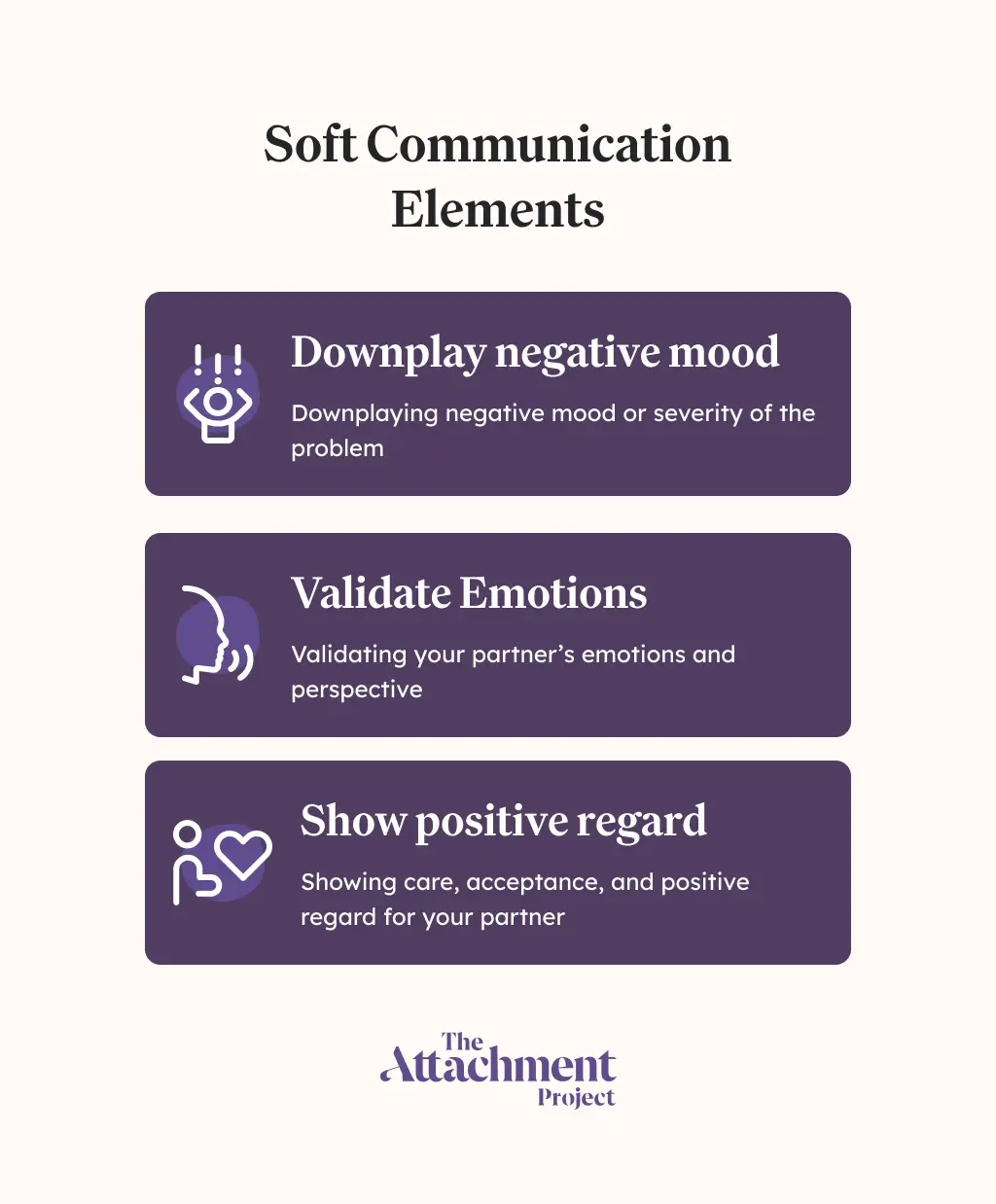
This communication style affirms to your partner that the conflict isn’t a threat to your relationship. It reminds them that you will be there for them even when you’re facing challenges and avoids triggering anger and avoidance.
#2. Avoid Guilt-Tripping
When emotions are high, it’s easy to fall into negative communication patterns. When frustrated, we might overemphasize expressions of hurt or the negative impact of someone else’s behavior, or seek reassurance that our partners still love and care for us.
This kind of communication usually serves to induce feelings of guilt, even if we’re not consciously aware that this is the goal. Sometimes this does help us to reach a resolution in the long run, but it usually escalates conflict in the short term and can be especially triggering for people with avoidant attachments.
Researchers call these strategies “negative-indirect” communication: negative because they aren’t supportive of constructive problem-solving, and indirect because they don’t address the real problem. People with anxious attachments can be particularly prone to resorting to this kind of communication strategy.
People with avoidant attachments can find dependence, control, and obligation suffocating. So, negative-indirect communication often results in anger and a push for independence from the avoidant partner, making it much more difficult to resolve the initial conflict.
3. Focus on Yourself
To communicate with anyone, but especially in conflict with an avoidant partner, it’s important to look after your own emotions.
When dealing with conflict with an avoidant partner, or any kind of frustration, it’s natural to express how you feel through crying, shouting, or displays of anxiety. In this way, we might communicate to our partner that we are struggling to manage our emotions and need support. While this might be a natural reaction in anxiety-provoking situations, it could trigger an avoidant partner’s attachment traits.
As we’ve mentioned, independence is usually very important for someone with an avoidant attachment style. So, when someone communicates “I need emotional support” to an avoidant attacher, this could trigger their fear of dependence.
When you learn to catch your emotions before displaying a strong emotional response, you can avoid spiralling into this push-and-pull conflict. This is called emotional- or self-regulation.
To practice emotional regulation, first practice noticing and naming how you feel. Mindfulness practice has been shown to help with this, by helping you to pay attention to the present3. You can find lots of great mindfulness resources online.
Once you’re able to notice your feelings, it becomes easier to override the impulse to have a strong reaction.
#4. Assume Positive Intent
When your partner emotionally withdraws or “shuts down” in conflictual or stressful situations, it can be challenging to remember that they aren’t doing so maliciously. You may fall into the pattern of thinking, “they don’t care,” “they never let me in,” or “they’re pushing me away.”
In these moments, it’s important to remember that these avoidant behaviors may have kept your partner safe from emotional pain when they were young. These actions might be the only coping strategy they currently have to manage their complex emotions, and in their mind, using it is helping to preserve their relationship with you.
Reminding yourself that your partner’s intentions are good despite how their actions make you feel makes it far easier to communicate with empathy, understanding, and patience.
#5. Active Listening

Due to their early relationship dynamics, someone with an avoidant attachment style may feel like they can’t depend on others and that their problems and feelings don’t matter. You can provide a safe space for an avoidant person by making extra effort to listen to them when they open up.
You can do this by practicing “active listening”. Active listening involves giving direct eye contact, positioning your body to face your partner, nodding when appropriate, and asking non-judgmental follow-up questions. This shows that you’re genuinely interested in what they’re saying, and that they’ll be safe to open up again in the future.
Setting boundaries can also make people with an insecure attachment style feel safe. Boundaries make relationships predictable, which increases feelings of security. You may agree upon boundaries relating to:
- Physical touch and affection
- Communicating when you’re both calm
- Giving each other personal space when necessary
- Voicing issues in the moment
- Taking ownership of your own emotions
#6. Ask For What You Need and Be Specific
Effective communication can bring about positive change in romantic relationships. However, to do this, we need to steer clear of criticism. Criticism can feel like a personal attack to anyone, but it can be especially triggering for someone with an avoidant attachment style.
Asking for what you need can sometimes come off as critical. This may activate avoidant attachment traits, which could result in your partner withdrawing, resisting, or disengaging from the conversation. Therefore, the problem becomes harder to solve and positive behavior change is less likely.
Understanding your partner’s perspective and reframing the problem is key to communicating an issue without coming off as critical. Using “I” statements to show your understanding has been found to help resolve conflict – this is called objective “I” statements4. Subjective “I” statements, which are used to describe how you feel about a situation, can be less successful, even though this is how they are traditionally thought to help.
Many people believe that subjective “I” statements reduce the impact of criticism by taking the heat off of your partner, but studies have found that partners may deflect these statements to avoid the conflict.
However, objective “I” statements show that you understand your partner’s perspective while communicating the impact their actions have on you. The best communication strategy is often putting the two types of “I” statement together: show your understanding, then explain your feeling5.
The following examples are alternatives to criticizing, subjective “I” statements alone, and objective “I” statements with subjective “I” statements:
| Criticizing Statements | Subjective “I” Statements | Objective “I” Statements with subjective “I” statements |
| You never tidy up after yourself. | I feel annoyed when I come home to a messy house. | I know you’ve got a lot on your plate, but I feel annoyed when I come home to a messy house. |
| You never want to spend time with me. | I feel lonely when I don’t see you much in the week. | I know you’re busy, but I feel lonely when I don’t see you much during the week. |
| You don’t show me affection. | I get confused and upset when you aren’t affectionate with me. | I understand that you’re not instinctively affectionate, but I feel confused and upset when you aren’t affectionate with me. |
#7. Understand Your Attachment Styles
When thinking about how to talk to an avoidant partner, it’s vital that we understand both of our attachment styles as they can affect relationship dynamics in particular ways.6
For example, the anxious and avoidant attachment styles are prone to certain patterns within relationships. Typically, anxious attachment manifests as a fear of a romantic partner pulling away, so someone with this attachment style may seek emotional reassurance from their loved one. Yet, as we know, such behaviors may trigger an avoidant attacher’s fear of dependence, which could make them emotionally withdraw.
This interplay of attachment behaviors could worsen the situation, making the couple less likely to constructively resolve a problem.
If you would like to know how your attachment style may be influencing your relationship, you can take the free attachment styles quiz on our website.
#8. Respect Their Boundaries
Partners with an avoidant attachment style often need time alone, especially during arguments. If they communicate that they need to be alone, it can be tempting to push for connection – but remember that this is not likely to have the effect you’re hoping for.

Respect their boundaries and remember that boundaries are healthy. They’ll come back to resolve the argument when they’re ready, and space will give you both time to understand what you need to move forward.
#9. Try Replacing Emotional Support With Practical Support
Evidence shows that someone with an avoidant attachment style may feel more calm when their partner gives practical support, rather than emotional support7.
Emotional support, like using intimacy and relaxation to regulate emotions, doesn’t seem to help avoidant partners during conflict. On the other hand, problem-focused support, like helping each other to re-evaluate the situation and come up with practical solutions, can protect avoidant partners against negative experiences of the conflict.
This aligns with the avoidant partner’s need for autonomy and avoids triggering their fears of intimacy and dependence during a disagreement.
#10. Be Patient
While an avoidant partner’s behaviors during an argument may make you upset or angry, it’s important to practice patience whenever a conflict situation arises.
We develop our attachment patterns for a reason. As we mentioned, at one point in our lives, these behaviors helped us to survive and formed the basis of how we understand the world.
It is possible to change our attachment style, but it doesn’t happen in the blink of an eye. It takes time, patience, and determination from both of you.
Practicing patience will repeatedly reinforce a sense of safety and security, giving your partner the time to relearn the way they see relationships.
Final Thoughts on Communicating With an Avoidant Partner

Romantic relationships can be challenging for anyone, especially when one or both partners have experienced difficulty in early relationships.
Someone with an avoidant attachment style may struggle to let their walls down and connect emotionally with their partner. Stressful situations may trigger their avoidant attachment behaviors, potentially leading to withdrawal, emotion suppression, and defensiveness.
This can seem to their partners like they have a lack of interest in the problem or the relationship, but it’s really a sign that they care about your connection and they’re doing what they can to preserve it.
These instincts may have kept them safe when they were young, but they’re usually not very helpful in adult relationships.
What Your Partner Can Do
You and your partner are a team – our 10 tips for communicating with an avoidant partner might help you to manage conflicts on your side, but it’s best if both of you are on the same page.
Your partner can play their part by learning more about their attachment style and how it interacts with yours. During conflicts, they should remember to communicate their need for space before their instincts kick in and try to reassure you that they still care – particularly if you have an anxious attachment style.
The bottom line of communicating with your avoidant partner is to put yourself in their shoes: understand that their behaviors, like yours, aren’t intended to hurt, and that they hope to preserve the relationship by acting the way they do. Give them space during tense discussions, and take the time apart to consider what you can suggest to solve the problem practically. When the problem is resolved and you both feel like you’re in a safe space, you may be able to reintroduce emotional support and intimacy in your communication.
FAQs on How to Help an Avoidant Partner
How can I encourage an avoidant partner to open up?
Your avoidant partner is triggered by emotional pressure and won’t react well to feeling pushed to open up before they’re ready. Helping them to feel secure through consistent actions, words of validation, and acting as a stable, trustworthy base can help them to open up in time.
What’s the best way to support someone with avoidant attachment?
If you’re thinking about how to help an avoidant partner, one of the best steps you can take is to understand why and how their actions and beliefs in relationships are triggered. Understanding them helps you to realize what they need and be okay with giving them space.
What to say to an avoidant partner?
Remember that pushing a person with an avoidant attachment to open up or encroaching on their boundaries may push them away further. Instead, try saying:
“I’m here for you when you’re ready to talk.”
“It’s OK to feel this way. I understand because I’ve also felt this way in the past. If you want to talk about it, you know where I am.
Even though everyone is unique, phrases such as these can help an avoidant partner to feel validated, or, in other words, seen, heard, and supported.
References
- Overall, N. C., Simpson, J. A., & Struthers, H. (2013). Buffering attachment-related avoidance: softening emotional and behavioral defenses during conflict discussions. Journal of Personality and Social Psychology, 104(5), 854.
- Jayamaha, S. D., Antonellis, C., & Overall, N. C. (2016). Attachment insecurity and inducing guilt to produce desired change in romantic partners. Personal Relationships, 23(2), 311-38.
- Chiesa, A., Serretti, A., & Jakobsen, J. C. (2013). Mindfulness: Top–down or bottom–up emotion regulation strategy?. Clinical Psychology Review, 33(1), 82-96.
- Korobov, N. (2020). Failure of I-statements for mitigating interpersonal conflict in arguments between young adult couples. Studies in Media and Communication, 8(2), 49-60.
- Rogers, S. L., Howieson, J., & Neame, C. (2018). I understand you feel that way, but I feel this way: The benefits of I-language and communicating perspective during conflict. PeerJ, 6, e4831.
- González-Ortega, E., Orgaz-Baz, B., Vicario-Molina, I., & Fuertes-Martín, A. (2020). Adult attachment style combination, conflict resolution and relationship quality among young-adult couples. Terapia Psicológica, 38(3), 303-16.
- Vedelago, L., Balzarini, R. N., Fitzpatrick, S., & Muise, A. (2023). Tailoring dyadic coping strategies to attachment style: Emotion-focused and problem-focused dyadic coping differentially buffer anxiously and avoidantly attached partners. Journal of Social and Personal Relationships, 40(6), 1830-53.
Related Articles

Can Attachment Styles Predict Loneliness? The Role of Emotional Needs
12 Dec 2021
Exploring the link between attachment styles, emotional needs, and the two types of loneliness - emotional and social.

10 Tips for Managing Interpersonal Conflicts During the Holidays
29 Dec 2021
Discover powerful strategies to manage and resolve interpersonal conflicts like a secure attacher.

Avoidant Attachment Triggers and Tips for Healthy Self Regulation
30 Jul 2021
Understanding how to self regulate your emotions is an essential skill. However, having avoidant attachment may impact your ability to do so.
 Get mental health tips straight to your inbox


