



How to Prepare for a First Date: Tips and Exercises for Getting Psychologically Ready

Published on October 17, 2025 Updated on October 22, 2025
It’s difficult to find anyone who doesn’t feel at least a little nervous before a first date. It doesn’t matter if you’ve been on hundreds of dates or only a couple, that build-up before you go to meet the person is often anxiety-inducing. Many people feel under pressure, exposed, and self-conscious.
This isn’t strange – you’ve probably agreed to meet the person because on the surface, or “on paper”, you’re interested. You can even compare it to a job interview, as both of you are exploring whether you’d be a good fit for each other.
So, how can you best prepare for a first date? A few first-date jitters are nothing to worry about – they’re a positive sign that you’re excited! – but you can still do some preparation to ease your nerves and allow you to put your best foot forward.
More specifically though, how can you get yourself psychologically ready for a first date? And what strategies can you use to take care of your mental health while dating? To answer all of your questions about first date prep, this article will cover:
- How to prepare for a date.
- How to get ready for dating using the Dating Toolkit.
- 5 top mental health tips for date preparation.
- Post-date reflection and self-care.
Psychological Preparation and Dating
Feeling prepared is fundamental to having a good date. However, it’s not easy to know how to prepare yourself psychologically for a date. Research suggests 3 key ways to set yourself up for a great first date:

1. Set First Date Goals
For a successful first date experience, it’s important to know what you want to get out of the date. One study found that most people had one of 4 main goals for first dates1. These goals are to:
- Have Fun: You’re not taking dating too seriously. The priority is having a good time.
- Escalate the Relationship: You’re exploring the idea that your date will become a long-term romantic partner.
- Reduce Uncertainty: You want to find out if you like each other’s company or if you’re compatible as a couple.
- Have Sex: You’re not looking for anything serious and just want casual sex with your date.
Knowing what your dating goal is and communicating your intentions to your date can help to ensure you’re both on the same page right from the offset. Just remember to try to do it with tact!
START YOUR HEALTHY DATING JOURNEY
2. Consider Your Conversations
You can’t have a first date without conversation. For a first date, you’re probably looking to strike the right balance between telling your date about yourself and finding out about them.
It’s good practice to ask some surface-level questions, at least to begin with, like what your date does for work, hobbies and so on. However, some experts suggest that asking more revealing questions works well to get you both outside of your comfort zone and get you talking about things that you really value.
For example, asking them about a topic like politics, religion or ambitions. While you might have a list of questions you’d like the answer to, try to stay flexible and let the conversation flow naturally.
3. Arm Yourself With a Foolproof Dating Toolkit
A dating toolkit is a first date preparation essential. This will help you to identify your dating goals and ease your nerves, and teach you strategies to truly be yourself and make a meaningful connections. If you want to:
- Feel prepared before your date,
- Learn strategies to apply during your date to help you to form a meaningful connection, and
- Know how to reflect and act after your date is over,
Mental Health Tips for Date Preparation
Tip #1. Create a Pre-Date Routine
Are you tired of going on first dates? Or has it been a while and you’re worried about dating again? Perhaps this is your first date ever, and you’re unbelievably nervous. Whichever is the case, when it comes to how to have a good first date, a pre-date routine can be a real lifesaver. What you include in your pre-date routine is really up to you.
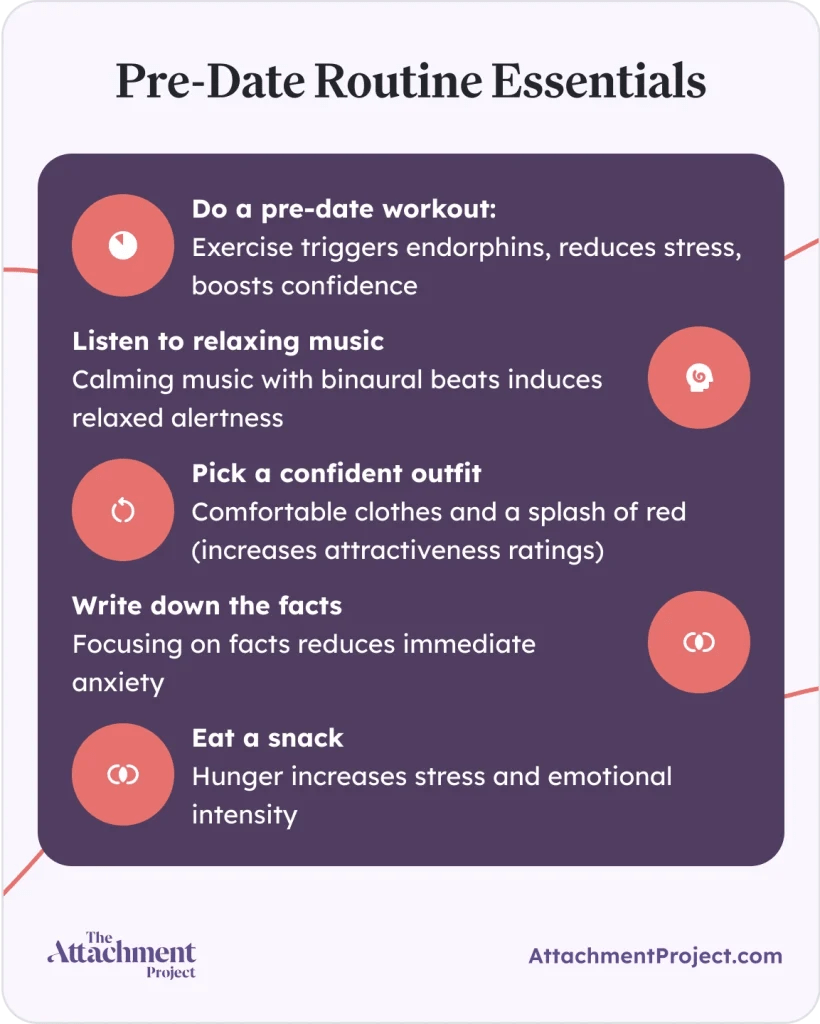
It should include things that make you feel good, ease your anxiety, and get you in the right mindset to meet someone new. If you need ideas, check out the list below:
Do a Pre-Date Workout
Exercise helps us to feel positive and relaxed as it triggers the release of endorphins, or “happy hormones” that reduce stress. Doing a quick workout will also make you feel more confident, but you have to time it wisely.
Ensure you still have time to get ready, including showering, picking out your outfit, and so on. A morning workout or a short, 15-minute workout before you get ready may work best.
Listen to Relaxing Music
Relaxing music can induce a state of relaxed alertness, which is perfect for feeling confident and ready for a first date. In one study, scientists could even see this in our brain waves after just 3 minutes of listening2. The relaxing music used in this study was described as “calming music with binaural beats (alpha brainwave range, 8–13 Hz)”.
Pick Out a Confident Outfit
Feeling uncomfortable in your clothes can be very distracting – pick something that makes you feel both comfortable and confident. Try adding a splash of red – studies have shown that both men and women rate the opposite sex as more attractive in red3, 4!

Write Down the Facts
It’s easy to get caught up in our nerves and the possibilities ahead of us, but studies show that focusing on the facts of a stressful situation can reduce your immediate anxiety5. Focus on what you already know to be true, rather than your feelings or the future.
Eat a Snack
When we’re hungry, we’re more prone to stress and emotional intensity6. Having a quick snack before your date can keep you sharp.
DISCOVER YOUR ATTACHMENT STYLE
Tip #2. Relax!
When we’re anxious, we sweat, tremble, and have a racing heart rate. We’re also more prone to thinking negatively and feeling uncomfortable emotions like shame, embarrassment, and self-consciousness.
Extreme anxiety before a date may, therefore, make it difficult for us to show our date the best version of us. It may also make us feel differently about our date, and if it doesn’t go well, it makes us more self-critical or down about it.
To avoid anxiety taking over, take the time to relax before your date. This doesn’t mean sitting on the couch or taking a nap – instead, use active relaxation strategies to ease your anxiety. Here are some ideas for relaxation activities to use:
- Progressive muscle relaxation
- Deep breathing
- Mindfulness
- Meditation
- Yoga
- Exercise
- Journaling
Adding one (or multiple!) of these to your pre-date routine can help both your brain and your body relax before and during your date. And remember, you are just meeting another person who is also probably feeling the same nerves about meeting you!
Tip #3. Work Out Your Boundaries
While boundaries may sound like a long-term relationship move, setting boundaries before a first date is also crucial. Boundaries help us to know what we want and don’t want, and will increase the likelihood of a positive outcome. Here are some boundary ideas to think about:
- How long do you want the date to go on for?
- Would you feel comfortable being alone with your date?
- What level of physical connection are you okay with?
- Do you want to drink alcohol? If so, how much?
- What time of day would you like to meet?
- Where would you like to meet up?
- Are you comfortable moving the date to your home, theirs, or neither?
Remember, you’re the expert on you – you know what you like, dislike, and find uncomfortable. Communicate your boundaries where needed and stick to them, and recognize if your date tries to push against them. Their response to healthy boundaries may help you decide whether you want to keep dating them.

Reflecting on Dates in the Aftermath
A lot of energy and thought goes into dating, so it’s important to take some time after each date to reflect on your experience and give yourself a little self-care. Below, we provide three essential steps to post-date reflection and self-care success. If you would like more information on these steps, our article Post Date Reflection and Self Care contains all you need.
The 3 steps to reflection and self-care after a date are:
- Reflecting on the date using the “Post-Date Eight.”
- Learning what you like from dates (and other people) by engaging in self-dating as a form of self-care.
- Understanding how to healthily communicate a lack of interest in pursuing the connection.
Final Words on How to Prepare for a First Date
Everyone who is in a relationship first met their partner somewhere, sometime. It may have been random, or it may have been a planned date. That’s the thing, you never know what is going to happen on a first date; they are filled with possibilities. That’s what makes it so exciting and brings on some of those nerves too.
Ultimately, you should know it is completely natural to worry about messing up a date, but you do not need to worry. You can take some simple steps to be better psychologically prepared for your first date.
With more experiences, dating gets easier. Have a think and see if establishing a solid pre-date routine, making time for relaxation and setting your own boundaries can help you on your next first date.
References
- Mongeau PA, Jacobsen J, Donnerstein C. Defining dates and first date goals: Generalizing from undergraduates to single adults. Communication research. 2007 Oct;34(5):526-47.
- Mahmood D, Nisar H, Yap VV, Tsai CY. The effect of music listening on EEG functional connectivity of brain: A short-duration and long-duration study. Mathematics. 2022 Jan 24;10(3):349.
- Elliot AJ, Niesta D. Romantic red: red enhances men’s attraction to women. Journal of personality and social psychology. 2008 Nov;95(5):1150.
- Elliot AJ, Niesta Kayser D, Greitemeyer T, Lichtenfeld S, Gramzow RH, Maier MA, Liu H. Red, rank, and romance in women viewing men. Journal of Experimental Psychology: General. 2010 Aug;139(3):399.
- Mendolia M, Kleck RE. Effects of talking about a stressful event on arousal: Does what we talk about make a difference?. Journal of personality and social psychology. 1993 Feb;64(2):283.
- Montagrin A, Martins-Klein B, Sander D, Mather M. Effects of hunger on emotional arousal responses and attention/memory biases. Emotion. 2021 Feb;21(1):148.
Related Articles

Avoidant Attachment Triggers and Tips for Healthy Self-Regulation
30 Jul 2021
Understanding how to self regulate your emotions is an essential skill. However, having avoidant attachment may impact your ability to do so.

Giving Up Ghosting: How to Avoid Ghosting Others
27 Jan 2023
In the age of technology, ghosting is becoming more frequent. But it is a painful and confusing experience for anyone on the receiving end. Find out how to avoid ghosting others.

Emotional Intelligence & Attachment
2 Jan 2023
Emotional intelligence is a useful tool for successfully navigating relationships. Discover how your attachment style impacts emotional intelligence.
 Get mental health tips straight to your inbox


