









Open Relationship Guide: How to Make It Work

We’ve all heard of open relationships – to some they may feel like a distant reality, something that doesn’t actually happen or work in real life. But what if open relationships weren’t so distant, and what if they worked?
The thing is, open relationships are not that distant, and they do work. While they still may be an uncommon relationship structure to find, we promise they’re not as hard as finding a unicorn. In this article, we hope to introduce you to the topic of open relationships and how, if you’d like to, make them work.
In this article, we’ll cover the following:
- What an open relationship is
- Open relationships and dating
- How open relationships work
- The rules of open relationships
- What an open marriage is
- Why open relationships don’t work
DISCOVER YOUR ATTACHMENT STYLE
What Is an Open Relationship?
While we have already introduced the topic of ethical non-monogamy (ENM) we haven’t yet delved into open relationships. Yet, before we do, let’s quickly recap what ENM means.
ENM, also referred to as consensual non-monogamy, encompasses relationships where partners are romantically and/or sexually involved with more than one person, and where each of the people involved are aware and agree to this arrangement.
ENM can take many forms, such as a triad or throuple, or a closed V in which only one person is involved with two others. Within ENM, another common term is the open relationship.
Open Relationship Meaning
An open relationship typically involves a dyad that can have sexual relationships with others outside of this dyad1, 2.
While some refer to the meaning of open relationships interchangeably with ENM, others specify open relationships as a dyad that is exclusively open to sexual relationships independent of one another3. The definition we are opting for is the latter.
How Do Open Relationships Work?
Open relationships, like any other relationship, require a strong foundation of mutual understanding and transparency3. With this understanding, partners can form a joint relationship design, where each person can tailor the relationship to their best interests and possibilities4.
This personal tailoring of the relationship structure is of the most important components in an open relationship. This process requires understanding ourselves first, what we want and need, as well as what kind of experiences we are open to.
While a highly personalized relationship design will naturally bring about different configurations, there are a couple of ground rules that make sense in open relationships in general. As one study suggests, the main pillars of a healthy open relationship are: communication, consent and comfort5. Taking these three pillars into consideration as the foundation of open relationship structures, the following sections will outline a few tips that we find most important.
Open Relationships and Dating
Navigating open relationship dating has two facets: one from the perspective of the people involved in a committed open relationship, and one from the perspective of those who date people in an open relationship. From each side, the following tips are helpful when exploring open relationships:
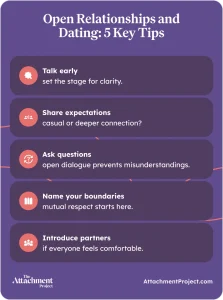
Have the conversation early
It can feel a little awkward, especially if we’re not exactly used to dating around open relationships. However, talking about the fact that you, or the person you are dating, is in an open relationship is important to set the stage for what could come.
Be open about expectations
As open relationships are idiosyncratic in their rules and setups, it’s important to be clear about what we want and need up front. From the position of the person who is dating someone in an open relationship, it is important to verbalize if they expect a deeper emotional involvement. Or, on the flip side, someone in an open relationship may want to clarify that they expect a more casual relationship.
Don’t be afraid to ask awkward questions
It can feel awkward to ask certain questions, especially when we’re dating someone we’ve just met. It can feel like oversharing, or intruding into the life of our dating partner. However, engaging in free and honest conversations can prevent unwanted scenarios, such as feeling lost in a new environment, or even misunderstanding expectations, desires and boundaries.
Be clear about boundaries
Being clear about our expectations comes hand in hand with what boundaries we need to set for ourselves, too. For example, some couples in open relationships prefer that their partner does not spend the night at a date’s place, or others may prefer that their partners do not see one person more than once or twice. While we cannot expect everyone to be a completely open book, boundary setting is essential to guarantee mutual respect and understanding.
Present the partner – if that feels right
In some situations, it may help to present, or be introduced to, the partner. For example, someone who is new at dating people in open relationships may feel unsure about what it means to be in one, or to date someone in one. Sometimes, it can help to introduce each other and have an open conversation with one another about the situation at hand. However, naturally, this is only helpful when everyone is comfortable with knowing one another.
Open Relationships and Sex
Open relationships inevitably lead to sexual openness because transparent communication is key2. For those of us who are not the most experienced or comfortable with talking about sex, dating someone in an open relationship can truly feel like unfamiliar territory. Below, we’ll outline a couple of tips for sex in open relationships.
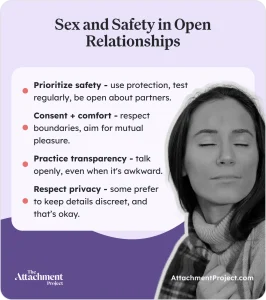
Safety is key
Depending on the goals and desires of the people involved, open relationships can give way to opportunities for sexual experiences. Within this context, it’s important to stay safe and be mindful and respectful of others’ safety too. Some people do this by regularly getting tested for sexually transmitted infections (STI), by wearing protection in every experience, and by being open about their sexual partners and habits.
Consent and comfort are non-negotiable
Also somewhat related to transparency and safety, consent and comfort are necessary. Consent is easy – ask what is okay and what might not be, and respect these boundaries. It may feel like it gets in the way of spontaneity, but it really doesn’t have to when it’s a natural part of the experience. Moreover, feeling comfortable with your experiences is highly important as well. After all, sexual experiences are about pleasure!
Transparency is essential
A component for safety, as well, is to be transparent about how we go about our sexual experiences – similar to hardballing, where clear communication is valued from the start. For example, STI’s are not uncommon in people who are sexually active, and they can happen to anyone.
However, when they do happen, it is essential to alert all of the people who could have been potentially affected.
Yes, it’s awkward and can feel embarrassing, but it’s crucial that people are aware of their partner’s sexual health so they can look out for their own.
Note: Discretion may also be important for some.
Some people prefer to keep their sexual experiences private. It’s not that they are necessarily ashamed of their experiences, but rather, that they prefer to maintain their privacy.
Open Marriage
Although we have spoken mostly about dating and partnerships in general, we will also briefly dive into non-monogamous marriages. When we talk about an open marriage, we are not referring to polygamy – where one person is married to several others6. An open marriage, for the purpose of this article, is one where the married couple engages in sexual relationships outside of their dyad.
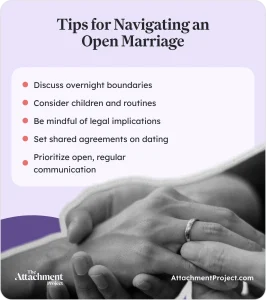
While every relationship is different in terms of commitment, marriage brings perhaps the deepest level of commitment of all. This is why an open marriage can have a different set of boundaries, rules or expectations. Below, we’ll go through a couple of considerations when thinking about an open marriage.
Living arrangements
Not wanting to generalize, married couples usually live together – they share a life. Yet, if a couple is in an open marriage, they likely go on dates and perhaps may want to spend the night with their dating partners. However, one of the spouses may not be okay with having dates spend the night, or having their spouse spend the night elsewhere. This is an important consideration and a conversation to have with your spouse.
Legal limitations
An unfortunate, yet important consideration are legal implications. For example, in a divorce, adultery can be enough to complicate the process. Adultery has a relatively vague definition in the USA, for instance, as it is considered in any case of extramarital sexual intercourse7. Naturally, in an open marriage, extradyadic sex was agreed to previously. However, if things were to get complicated, adultery could technically be used against one of the partners.
Family
Having a family can bring even further deliberation into certain boundaries and aspects of the relationship. For example, it may not be as easy to spend the night out with a date if you have children at home. Furthermore, it may also not be as easy to arrange dates and spend longer periods of time with dates because children or household responsibilities need to be taken into account.
While these considerations may sound alarming to some, they are not meant to be dissuasive from having an open marriage.
All of the above can be discussed and resolved with clear and honest communication with your partner.
Open Relationship Psychology
While open relationships can seem wildly different from monogamous relationships, they actually don’t differ that greatly. As stated above, open and non-monogamous relationships do not significantly differ in satisfaction1, 3, 4.
The main difference between monogamous and open relationships occurs when the open component of the relationship is one-sided, as one partner eventually feels left out or not given the care and attention they need4.
Naturally, there are some issues that will arise more easily in open relationships, such as matters of jealousy, possessiveness, time management, and trust, among others. Perhaps, the two most important components of an open relationship to work on that somewhat touches on all of these issues, are honesty and boundaries. In fact, according to research, honesty and boundaries are considered to be the most important components in satisfying open relationships8.
Researchers have reported that couples tend to be less honest with one another than with their friends8. This is especially true when speaking of infidelity, as what tends to ruin relationships is not necessarily the act of cheating, but the dishonesty that is inherent within it. In open relationships, honesty is essential to avoid the pitfalls that dishonesty ultimately brings.
Boundaries, as we’ve discussed in a previous section, are also essential in an open relationship. To reiterate, boundaries prevent people from getting hurt or being in situations they do not wish to be in.
Open Relationship and Your Attachment Style
As open relationships are not the typical relationship structure, they may not be for everyone. This is especially true when we consider attachment styles – you can read more on this in our ENM and Attachment Styles page. While, in this article, we will not dive too deeply into how each attachment style fits (or doesn’t) into an open relationship, we will give you a brief overview of the main aspects to consider:
Insecure Attachment
There’s a misconception that open relationships arise from unhappy relationships – this is a myth. So far, no studies show that insecure attachment is linked to open relationships.
However, there are some considerations we might need to be aware of to better understand how someone with each attachment style may feel within an open relationship.
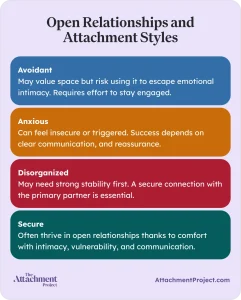
Those with an avoidant attachment may be a perfect fit for open relationships – if they respect the main pillars, that is. Within open relationships, avoidant attachers have the opportunity to create an escape for when they feel overwhelmed in their relationship – however, this can be problematic as it can indicate problems in the relationship.
Again, much like with anxious attachment, an open relationship has the potential to work for an avoidant attacher if there is purposeful and effortful work.
Disorganized attachers will likely need the extra stability from a committed primary relationship but may benefit from extradyadic experiences too if they are working on themselves and feel safe enough in their primary relationship to develop secure traits from new experiences.
Secure Attachment
Perhaps contrary to popular belief, open relationships are associated with secure attachment. Researchers have found that non-monogamous relationships provide benefits that are characteristic of secure attachers in healthy relationships. These are, in essence, reaped from the fact that secure attachers have a greater ease with intimacy and their own vulnerability than insecure attachers.
Overall, open relationships may prove to be a challenge for insecure attachers, but this may very well be why this type of relationship has the potential to positively impact them. By working together with their partner(s) to develop a secure base for a relationship, insecure attachers are capable of establishing healthy open relationships.
Take-Home Message: Open Relationship Pros and Cons
In this article, we introduced the topic of open relationships. To recap, an open relationship is a type of ENM relationship in which the partners are allowed to have sexual relationships with others.
Within every topic we discussed, there is one essential rule: for an open relationship to work, three pillars must stand tall and strong – communication, comfort, and consent. For this reason, these three pillars show up throughout the tips and considerations we outlined, as they are the cornerstone to a healthy open relationship.
We know that articles such as this can be an important source of information for those considering an open relationship. As such, we will leave you with a couple of pro’s and con’s of open relationships:
Pros
- New adventures – open relationships allow for opportunities to explore ourselves and our sexuality. If a safe space is created among people that are mindful of one another’s boundaries, this exploration can bring about fun new experiences that might have otherwise not come about.
- Working through attachment issues – this may seem surprising, but navigating an open relationship, especially for the first time, can be a great opportunity to work through attachment issues. With frequent and transparent communication about issues such as relationship expectations, certain topics naturally arise that may not have shown up in other contexts.
- Meeting new people – open relationships provide opportunities to get back into the dating world. Now, with dating apps, this is even easier, and will inevitably mean meeting new people outside of our usual circles.
Cons
- Jealousy – opening up a relationship can potentially lead to jealousy. It’s not easy for everyone to share their partner with others. However, there is also the possibility that instead of jealousy, partners experience compersion for one another. Compersion is essentially the opposite of jealousy and entails feeling joy for someone, even when it means their happiness doesn’t involve us or isn’t to our advantage.
- Uncharted territory – being a pioneer isn’t always easy. Sometimes, it can feel scary to dive into new experiences, especially when we’re new at this. Speaking openly about our fears and doubts is the best way to overcome this.
- Stigma – open relationships are on the rise, but they’re not quite common just yet. It’s easy to feel observed or judged by others who don’t fully understand or agree with open relationships. It’s important to stay true to ourselves and understand that not everyone will be on board with our decisions.
Curious to learn more about ethical non-monogamy? Take a look at other articles in this series:
References
- Séguin, L.J., Blais, M., Goyer, M-F., Adam, B.D., Lavoie, F., Rodrigue, C., Magnotier, C. (2017). Sexualities, 20(1-2), 86-104.
- Murphy, A.P., Joel, S., Muise, A. (2020). A Prospective Investigation of the Decision to Open Up a Romantic Relationship. Social Psychological and Personality Science, 12(2), 194-201.
- Fairbrother, N., Hart, T.A., Fairbrother, M. (2019). Open Relationship Prevalence, Characteristics, and Correlates in a Nationally Representative Sample of Canadian Adults. The Journal of Sex Research, 56(6), 695-704.
- McDaniel, R., Twist, M.L.C. (2016). Review: Designer relationships: a guide to happy monogamy, positive polyamory, and optimistic open relationships. Michaels, M.A., Johnson, P. (Eds.). Sexual and Relationship Therapy.
- Hangen, F., Crasta, D., Rogge, R.D. (2019). Delineating the Boundaries between Nonmonogamy and Infidelity: Bringing Consent Back Into Definitions of Consensual Nonmonogamy With Latent Profile Analysis. The Journal of Sex Research, 1.
- Zeitzen, M.K. (2018). Polygamy (Polygyny, Polyandry). The International Encyclopedia of Anthropology.
- Wex Definitions Team (2021). Adultery. Legal Information Institute: Cornell Law School.
- Zimmerman, Kevin J. (2012). Clients in Sexually Open Relationships: Considerations for Therapists. Journal of Feminist Family Therapy, 24(3), 272–289.
 Get mental health tips straight to your inbox