









The Father Wound: What Is It and How to Heal
The father wound and symptoms of the father wound can seriously impact our self-worth and relationships. Find out how it develops and what its signs are in sons and daughters.
The impact of absentee fathers is commonly used in the entertainment industry; films such as Star Wars, The Quiet Girl, and Interstellar, books and plays like Harry Potter and Hamlet–finding something on the subject is like searching for sand in the desert. While the impact of absent fathers is popularly known as “daddy issues”, the more technical term is the “father wound.” Father wound is what we call the emotional damage that occurs when a father is physically or emotionally absent from their child’s life.
If you feel unloved, unknown, or unwanted by your father from an early age, this can influence how you see yourself and what you expect other people to see in you. These lessons can stick with you into adulthood and change how you live your life. For example, you may think there’s something wrong with you, although this is far from true.
DISCOVER YOUR ATTACHMENT STYLE
Because of the pain and shame a father wound can trigger, it’s rarely talked about. As a result, many people find overcoming a father wound challenging. However, with guidance, knowledge, and an action plan, you can start to heal your father wound.
To answer all of your questions on what the father wound is, and ways of healing the father wound, this article will cover:
- What the father wound is and how it happens
- Signs and symptoms of the father wound
- What the father wound looks like in sons
- How daughters may experience the father wound
- How to overcome father wounds
What Is the Father Wound?
The father wound is an unresolved trauma between father and child that occurs when a person’s father is absent or abusive. It’s important to recognize that both a physical or emotional absence can cause a father wound. For example, a dad leaving when you were a young child can cause a father wound. Likewise, if your dad was abusive, manipulative, highly critical, or emotionally unavailable, this can also lead to a father wound.
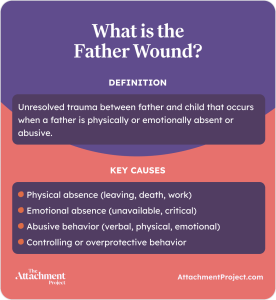
The father wound differs from the mother wound, and this distinction lies in the roles mothers and fathers typically play according to societal expectations. Women are expected to provide care and nurture for the child–if they’re unable to offer this emotional support, their child may develop a mother wound. However, the father wound relates more to absenteeism, either emotionally or physically, which reflects the father’s stereotypical role as the “protector” and “advice-giver.”
How Does the Father Wound Happen?
Father wounds always involve the emotional or physical absence of the father. However, the form this absence takes differs depending on the specific circumstances of each family. For example, you may develop a father wound if your dad:
- Was overprotective and controlling
- Was highly critical of you
- Suffered from a mental health condition
- Had experienced the father wound with his own father
- Verbally, physically, emotionally, or sexually abused you
- Abandoned you by leaving when you were a child
- Neglected your physical or emotional needs
- Suffered from substance abuse
- Left the family home as a result of divorce or separation
- Passed away when you were a child
This isn’t an exhaustive list; a father wound might occur if the father has been absent in any capacity. But regardless of the exact circumstances, the father wound can significantly impact your life, so it’s important to be able to recognize it–we can do this by considering the signs and symptoms.
Father Wound Signs and Symptoms
Father wound symptoms and signs differ from person to person and may look similar to other emotional difficulties in childhood. Because of this, it’s not always easy to identify–often leaving it unrecognized.
Nevertheless, people who experience a father wound tend to report similar feelings and experiences regarding their fathers. If you can relate to the items on the following list, this might indicate you experienced a father wound. Here are the signs that you may have a father wound:
- Your dad was abusive, either emotionally, physically, verbally, or sexually.
- Your dad gave you the “silent treatment,” or restricted food or love to punish you.
- No matter what you did, it felt like you could never please your dad.
- You didn’t feel “good enough” for your dad.
- Your dad was often critical of you, belittling your experiences or using harsh disciplinary methods.
- Your dad was physically absent during your childhood (this could include reasons such as leaving for long periods for work or because of parental separation).
- Your dad was often a source of fear. For example, if you were ever caught doing something you shouldn’t have been, you became preoccupied with the fear that your dad would find out.
DISCOVER YOUR ATTACHMENT STYLE
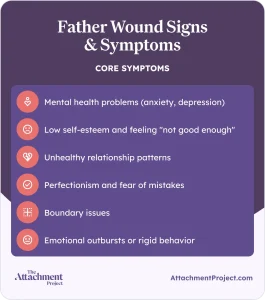
Experiencing the father wound can have a profound impact, not just in childhood, but in the way you feel about yourself and others throughout life. For example, those who have a father wound tend to show the following symptoms:
Mental health problems: Research repeatedly shows that the father wound and other forms of attachment trauma in childhood are associated with mental health problems (such as anxiety and depression) in adulthood.
Emotional outbursts: Those with a father wound often struggle to manage their emotions in later life and may use anger and aggression as coping mechanisms to shield the pain underneath.
Low self-esteem: A child forms their sense of self-worth based on the love and care they receive from their attachment figures. They may blame themself for their dad’s absence or internalize their anger or hurt, causing them to hold negative views about themselves.
Unhealthy relationships: People develop an understanding of how they should be treated based on their caregiver’s behaviors. Those with a father wound may be more likely to accept abusive, unhealthy behaviors from partners as this is what they were taught was acceptable in childhood.
Perfectionism: A child with an overly critical, belittling, or abusive father may be taught early on that mistakes lead to punishments or insults. As a result, they may fear making mistakes in adulthood, leading to perfectionism.
Boundary issues: Someone with a father wound may be more willing to compromise their boundaries due to their low self-esteem, as their lack of self-worth may make it difficult to say no to others and assert their needs.
Rigid behavior: The absence of a father can leave children feeling like they have no control. In adulthood, they may become controlling and demonstrate rigid behaviors, attempting to control as many details of their lives as they can, as this may ease their anxiety.
These signs and symptoms may be noticeable in both sons and daughters. However, research indicates that sons’ and daughters’ experiences of the father wound may also differ in certain ways.
Father Wounds in Sons
We may be more familiar with the impact of a father’s absence on a daughter’s life, as the term “daddy issues” is a well-known concept in entertainment media and social media. For example, there are over 297,000 posts with the hashtag “daddy issues” on Instagram alone. Yet, the father wound can also occur in the father-son relationship and it can have a significant impact on a son’s life3.
All we have to do is cast our minds to the story of Star Wars to understand the importance of a father-son bond. In Star Wars, Luke Skywalker experiences a father wound when his dad (Anakin Skywalker, later Darth Vader) is absent. Throughout the film, we see how this impacts his views of himself and his relationships. We also see how Anakin Skywalker’s turn to the dark side had much to do with his difficult relationship with his own father, Qui-Gon Jinn.
Unfortunately, unlike in the film, reconciliation and resolution aren’t always possible. In these instances, a father wound can continue to impact a son’s life from childhood to adult years6.
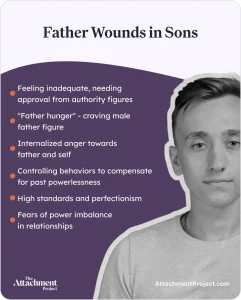
Often, sons who have a father wound feel lacking or “not good enough” in some way. They may struggle with difficult feelings of self-doubt, inadequacy, and the need for approval and validation, particularly from authority figures. These feelings can manifest in two ways:
- They may crave a male father figure, like Luke Skywalker did with Obi-Wan Kenobi. Experts call this “father hunger.” Father hunger refers to the longing that a boy may experience for his father, who is emotionally, physically, or psychologically distant.
- OR they may develop intense anger towards their father that may then become internalized, leading to negative self-views.
It’s important to note that it’s also possible for someone to experience both of these manifestations of feelings at the same time–they may not only occur in isolation.
Sons with a father wound may also seek to control many aspects of their lives to compensate for the lack of control they felt when they were younger. For example, they may want everything “just so” in their homes as adults or struggle with fears of power imbalance within relationships. As a result, they may show controlling or jealous tendencies in relationships to curb their anxieties about not being in control.
Many sons with father wounds also hold themselves to very high standards, particularly if their father was critical or abusive. They may live their life as if to prove their worth to themselves and their father, causing a fear of making mistakes and perfectionism.
Father Wounds in Daughters
Daughters who experience a father wound may grow up feeling like they’re not good enough. As a result, they may struggle with low self-esteem and lack of confidence5.
A father wound in daughters often tends to reveal itself in a pattern of unhealthy relationships: Daughters with father wounds typically crave the love they didn’t get from their father, making them more likely to accept unhealthy behaviors from romantic partners. Furthermore, our caregiver’s behaviors often form the basis of our expectations of relationships. So, if someone was taught to accept being abandoned, abused, or criticized as children, they may be more likely to accept this behavior in a romantic partner.
Although women with a father wound may, of course, have differing sexualities, the following patterns towards men are common.
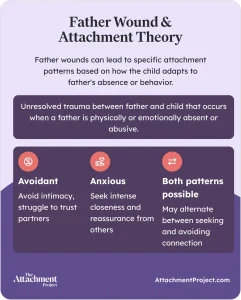
Women who experienced a father wound in childhood may grow up struggling to trust men. If they developed an avoidant attachment as a result of their father wound, they may avoid intimacy and a close connection with a romantic partner.
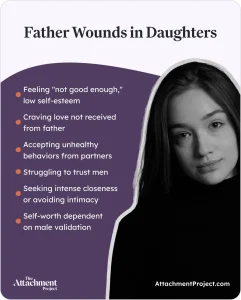
In contrast, if the father wound caused the daughter to develop an anxious attachment style, they may seek intense closeness and reassurance from men. Their sense of self-worth may hinge on this reassurance and validation, and when they don’t receive it, they may start to feel anxious, insecure, and lose confidence. If you’re wondering which attachment style you have, you can take our free quiz and receive a report.
Healing father wounds isn’t easy, but it is possible. If you experienced a father wound and want to heal, follow the practical strategies in the following section.
How to Overcome the Father Wound? Practical tips
Overcoming the father wound isn’t a straightforward endeavor, as it’s often muddled up with difficult and painful emotions. However, it is possible to heal from the father wound with the help of effective tips and strategies.
1. Recognize Your Father Wound
The fact that you’re reading this article gives a good indication that you already recognize your father wound. So, perhaps take comfort in the fact that you’re part of the way there already.
However, if you have an avoidant attachment style, you may be tempted to fall into patterns of avoidance, denial, or suppression around the pain, loss, and anger surrounding your father wound. This response is natural, as these emotions are difficult to feel and manage, particularly if you’re not sure what to do with them.
Furthermore, some families may normalize father wounds, making it seem that the hurt and pain you’re experiencing is normal. The inner belief that your experience is like everyone else’s can also make a father wound difficult to recognize.
Yet, by recognizing the attachment trauma you experienced as a child and the impact it has had on your adult life, you can begin to heal.
DISCOVER YOUR ATTACHMENT STYLE
2. Learn to Love Yourself
Many people with a father wound feel as if their dad didn’t love them, which often motivates them to go searching for that lost love in romantic relationships in adulthood. Unfortunately, this desperation to be loved can mean we accept unhealthy forms of love, which can repeat the patterns of abuse and emotional availability over time.
Therefore, if you experienced a father wound, it’s important to offer yourself the love that you want to find in others. You can love yourself in various ways, such as by:
- Keeping a gratitude journal, where you record the things about life you are grateful for each day.
- Treating yourself with kindness and compassion and adapting how you speak to yourself. For example, instead of thinking, “I’m such a failure,” when you get something wrong, reframe this to “I can’t do this yet, but I can learn.”
- Taking care of your physical health through exercise, adequate sleep, and a healthy diet
3. Seek Support From a Mental Health Professional
The father wound is a deep attachment trauma that can have a profound emotional impact on you, so it can feel difficult to tackle on your own. While it is possible to heal from a father wound on your own, it’s often easier with the support of a mental health professional.
A mental health professional, such as a counselor, psychologist, or psychiatrist, can provide a safe, non-judgmental space for you to process your thoughts and feelings relating to your father wound.
If you have never experienced a healthy relationship before, your therapist can also show you what this feels like, enabling you to make healthier decisions in romantic relationships and friendships in the future.

Healing the Father Wound for Sons and Daughters
Some strategies for healing the father wound are universal, helping both men and women. However, as this attachment trauma can manifest differently in men and women, there are also gender-specific strategies to consider when healing your father wound.
Strategy for Healing the Father Wound in Sons
Don’t Be Like Your Father
One way many men are reportedly healing from their father wounds is by choosing not to be like their dads when they become parents themselves4. Of course, this change may be easier said than done. However, it’s reassuring to see that research demonstrates an increasing number of men shaking off the traditional fathering practices they learned from their dads. For example, in the last 10 years, studies suggest many men are becoming more emotionally expressive and involved in their children’s lives.
Strategy for Healing the Father Wound in Daughters
Look for & Attract Secure Partners
Daughters with father wounds often seek out men who treat them in similar ways to their dad. So, once you have taken the time to love yourself so you don’t feel the need to seek love and approval from a romantic partner, it’s important to look for and attract secure partners who are emotionally available and who will respect you.
A secure partner will be honest, open, trusting, and will show emotional vulnerability. They will also consistently show support and warmth, rather than blowing hot or cold, seeming interested one minute and uninterested the next. Secure partners will also have healthy boundaries and will respect the limits that you put in place.
To find out more about what to look for in a partner, check out our article on Attracting a Partner With a Secure Attachment Style.
Final Word on the Father Wound
The bond with both of our caregivers is important, but we often rely on our dads to keep us safe, protect us, and offer us advice. So, when we don’t have this figure to rely on, we develop a father wound.
Father wounds can significantly impact how we see ourselves and others: We may see ourselves as “not good enough” and have a low sense of self-worth. We also might struggle to trust others or, alternatively, throw ourselves into their arms to try to make up for the love we didn’t receive from our dads, causing a pattern of unhealthy relationships.
While it can be difficult to recognize and heal from the father wound, it’s reassuring to know that it is completely possible. By learning to love yourself, seeking the support of a trained and licensed professional, and learning from the unhealthy patterns of the past, you can overcome your father wound.
References
- Enright, R. (2021, March 5). How to Heal from a “Father-Wound.” Psychology Today.
- Foy, C. (2021, October 16). How to Heal from a ‘Father Wound’ and Family Trauma. FHE Health.
- Miller, E. D. (2012). Why the Father Wound Matters: Consequences for Male Mental Health and the Father-Son Relationship. Child Abuse Review, 22(3), 194–208.
- Pease, B. (2000). Beyond The Father Wound: Memory-Work And The Deconstruction Of The Father-son Relationship. Australian and New Zealand Journal of Family Therapy, 21(1), 9–15.
- Schwartz, S. E. (2020). The Absent Father Effect on Daughters: Father Desire, Father Wounds. United Kingdom: Taylor & Francis.
- Vogt, G. M. (2013). Like Son, Like Father: Healing the Father-Son Wound in Men’s Lives. Germany: Springer US.
 Get mental health tips straight to your inbox