









The Ideal Parent Figure Protocol: What Is It and How It Works

If you have attachment wounds that stem from your parents, the path to healing them can feel uncertain – you can’t reach into the past to change what happened, so how do you soothe your inner child?
The Ideal Parent Figure Protocol attempts to clear the way forward. The Ideal Parent Figure Protocol, or IPFP, is a guided visualization tool designed to help you to heal childhood attachment disruptions.
Key takeaways:
- The Ideal Parent Figure Protocol is a guided visualization to vividly imagine a caregiver who is caring and attentive to your needs.
- This helps people with childhood attachment wounds and insecure adult attachment styles by restructuring their internal working model.
- The IPFP is best used with a therapist for guidance, but it’s possible to use self-guided recordings.
In this article, we’ll explain what the IPFP is, how it works, and how you can use it to work towards a more secure attachment.
DISCOVER YOUR ATTACHMENT STYLE
What Is the Ideal Parent Figure Protocol?
The Ideal Parent Figure Protocol is a therapeutic technique which aims to help those with insecure attachment styles transition towards more secure attachment. It was created by a team of psychologists as part of a “Three Pillar” model of attachment treatment, where it featured alongside building skills in self-awareness and collaboration1. The IPFP is also used in the first stage of treatment for Complex Post-Traumatic Stress Disorder, but our article will focus on its use in attachment theory2.
The Ideal Parent Figure Protocol uses guided visualization to create a mental image of caregivers who were consistently supportive, attuned, and responsive. Instead of picturing your actual caregiver, you picture a whole new person who meets all of your childhood attachment needs to build a new internal working model (which is like your mental map of the world) of security. This might sound far-fetched, but research has found it to be an effective tool for self-soothing and healing attachment wounds1, 2.
How Does the Ideal Parent Figure Protocol Work?
A neuroimaging study at University College London found that the brain processes things we experience and things we vividly imagine in very similar ways. In theory, the IPFP might work because vividly imagining a secure, attentive caregiver can give your brain the real experience.
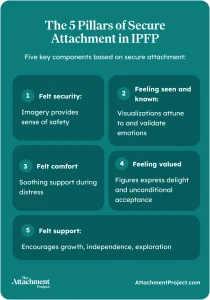
There are five key components to the Ideal Parent Figure Protocol which are based on the five pillars of secure attachment. These are:
- Felt security: The imagery should provide a sense of safety.
- Feeling seen and known: Visualizations should attune to and validate emotions.
- Felt comfort: The technique should feel soothing and provide support during times of distress.
- Feeling valued: The visualization should include figures which express delight and unconditional acceptance of the individual.
- Felt support: The imagery should encourage self-development through encouraging growth, independence, and exploration.
By focusing on these five components, the Ideal Parent Figure Protocol fosters healthier self-compassion and emotional regulation, which can in turn lead to better relationships with the self and others.
How the Ideal Parent Figure Protocol Addresses Attachment Difficulties
Restructuring your internal working model into one that sees the world as safe and others as loving and caring builds the secure base you need to form secure attachments.

For example, if your caregiver wasn’t around often then you might have built an internal working model of attachment figures as typically absent and not there for you when you need them. By vividly imagining your ideal parent figure as someone who is there for you whenever you need them, your internal working model can shift towards a view of attachment figures as reliable and present.
Using the Ideal Parent Figure Protocol
The Ideal Parent Figure Protocol is ideally used in a therapy setting, where a trained therapist or counsellor can help you to co-create new experiences. Their guidance helps you to imagine your ideal caregiver giving you everything you need and keeps you on the right track if your visualization starts to blend with real memories.
It’s possible to use recorded versions of the IPFP for your own self-guided visualization, but you may wish to try a few different options from qualified mental health professionals to see which resonates the most with you.
Important: Remember that the IPFP is supposed to be self-soothing – if you find anxiety, fear, or other negative feelings coming up during visualization, you may wish to stop and try again with the support of a mental health professional.
Who Can Benefit from the Ideal Parent Figure Protocol?
The IPFP can be particularly helpful for people who:
- Have experienced emotionally immature parents or caregivers
- Struggle with anxious attachment patterns in relationships
- Experience avoidant attachment and difficulty with emotional intimacy
- Have fearful-avoidant attachment characterized by push-pull relationship dynamics
- Are working towards earned secure attachment
- Have experienced abandonment issues or childhood neglect
The protocol can be used alongside other therapeutic approaches such as attachment-based therapy to create a comprehensive healing approach.
START YOUR ATTACHMENT HEALING JOURNEY
Limitations and Considerations
While the IPFP shows promise as a therapeutic tool, it’s important to understand its limitations:
- It may not be suitable for everyone, particularly those with severe attachment trauma
- Professional guidance is recommended, especially for those with complex trauma histories
- The technique requires consistent practice over time to see meaningful changes
- Some people may find visualization challenging or triggering initially
If you’re considering using the IPFP, discuss it with a qualified mental health professional who can assess whether it’s appropriate for your specific situation and needs.
Conclusion
The Ideal Parent Figure Protocol is a therapeutic technique which uses vivid imagination to create “memories” in which we have ideal parent figures who meet our unmet attachment needs. By doing this, we can restructure our internal working model to one where attachment figures are safe, reliable, and loving.
Although it is possible to practice the Ideal Parent Figure Protocol through self-directed approaches, exploring the IPFP with a therapist gives you more support and guidance.
If you’re not sure if you already have a secure attachment style, take our free attachment quiz.
FAQs About the Ideal Parent Figure Protocol
How long does it take to see results from the IPFP?
Results vary by individual, but many people report feeling some benefits after several weeks of consistent practice. Significant changes to attachment patterns typically take months of regular use.
Can I practice the IPFP if I had loving parents?
Yes, even people with generally good childhoods may have unmet attachment needs or specific areas where they didn’t receive optimal caregiving. The IPFP can help strengthen secure attachment patterns.
Is the IPFP safe to practice alone?
While self-guided practice is possible, it’s recommended to work with a therapist initially, especially if you have trauma history or find the visualization distressing.
How often should I practice the IPFP?
Most practitioners recommend daily sessions of 10-20 minutes for optimal results, though frequency can be adjusted based on individual needs and therapeutic guidance.
What if I can’t visualize clearly during the IPFP?
Not everyone is a strong visual imager. The protocol can be adapted to focus more on feelings, sensations, or even just conceptual understanding of having an ideal caregiver present.
Can the IPFP help with relationship problems?
Yes, by healing attachment wounds and creating more secure internal working models, the IPFP can contribute to healthier relationship patterns and improved emotional regulation in partnerships.
References
- Brown DP, Elliott DS. Attachment disturbances in adults: Treatment for comprehensive repair. WW Norton & Co; 2016.
- Parra F, George C, Kalalou K, Januel D. Ideal Parent Figure method in the treatment of complex posttraumatic stress disorder related to childhood trauma: a pilot study. European Journal of Psychotraumatology. 2017 Jan 1;8(1):1400879.
 Get mental health tips straight to your inbox