









Self-Sabotage in Relationships: Why We Destroy What We Want Most

Everything’s going well in your relationship until, for seemingly no reason, one of you self-sabotages – leaving both of you wondering, “why did this happen?”. Self-sabotage in relationships isn’t always obvious, so it can happen more often than you might think.
Self-sabotaging a relationship is a destructive behavior meant to undermine the relationship’s success, but it’s often an unconscious process reflective of the sabotager’s inner thoughts and feelings. There are lots of different behaviors that can come under this scope, but researchers have been able to pick them apart and define exactly what relationship self-sabotage is and why we do it.
In this article, you’ll learn about the psychology behind relationship self-sabotage, how self-sabotage relates to attachment theory and your attachment style, and how to stop self-sabotaging in relationships.
What is Self-Sabotage?
Self-sabotage is any behavior that ultimately ruins something that was positive for us. Psychologists researching self-sabotage in relationships have described it as “a cognitive strategy employed with the overall aim of self-protection, and it primarily serves the function of self-esteem and self-image safeguard” – in other words, self-sabotage is an attempt to keep our pre-existing ideas of ourselves intact1.
DISCOVER YOUR ATTACHMENT STYLE
In relationships, self-sabotage is often an unconscious behavior. Rather than intentionally deciding to ruin something, our thoughts and feelings about ourselves and our relationships might produce an urge to behave a certain way. If we don’t spend time understanding how our thoughts and feelings lead to behaviors, we’re prone to acting in ways we struggle to explain even to ourselves.
9 self-sabotaging behaviors
In one study, psychologists were asked about their experiences with therapy clients who self-sabotaged in relationships1.
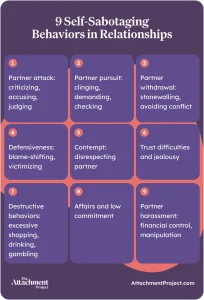
Their responses were coded to identify repeating patterns, resulting in 9 identified self-sabotaging behaviors:
- Partner attack: criticizing, accusing, “revenge”, judging.
- Partner pursuit: clinging, demanding, partner checking, protesting.
- Partner withdrawal: stonewalling, ignoring the partner or relationship, avoiding conflict, hiding emotions.
- Defensiveness: seeking or shifting blame, victimizing, externalizing.
- Contempt: disrespecting the partner.
- Difficulties trusting and jealousy: lack of trust in the partner and relationship, jealous behavior.
- Destructive behaviors: excessive shopping, drinking, or eating, self-medicating, gambling.
- Affairs: low commitment, history of affairs.
- Partner harassment and abuse: financial control, preventing partner from leaving, manipulation.
We don’t enter relationships with the intention of acting in these ways – so what are the psychological mechanisms that drive our self-sabotaging behaviors?
Why Do People Self-Sabotage? 6 Psychological Reasons Behind Self-Destructive Patterns
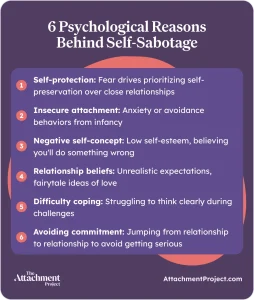
In the same study, psychologists explored the reasons why people self-sabotage in relationships1. They came up with 6 reasons, each with some overlap:
Self-protection: The psychologists agreed that in cases of self-sabotage, the underlying cause is usually fear. When our need to protect ourselves is stronger than our need for a close relationship, we can act in ways that prioritize self-preservation and lead to patterns of difficult relationships.
Insecure attachment: All psychologists interviewed also agreed that insecure attachment behaviors could lead to the end of romantic relationships. Insecure attachment styles are marked by anxiety or avoidance in relationships, or both, and stem from our caregiver attachments in infancy. Self-sabotaging can occur when people with an insecure attachment style hold “avoidance goals” – which could relate to attachment anxiety or avoidance, depending on the goal (more on this in the box below).
START YOUR HEALTHY DATING JOURNEY
Negative self-concept: When people have low self-esteem, they may self-sabotage because they already believe they will do something wrong, or because they blame their partner for their difficult feelings. People who have a negative self-view may also be more likely to take their partners’ behaviors as negative, even if they were not intended to be.
Relationship beliefs: Psychologists identified that some of their self-sabotaging clients held unrealistic expectations about relationships. Some believed that their partners should know what they’re thinking, and some were influenced by “fairytale” ideas of love. Those who believed that love was pre-destined might be less likely to take accountability for the outcome of their relationships. Some were simply so rigid in their relationship beliefs, in any sense, that they weren’t able to compromise.
Difficulty coping with relationship challenges: People who self-sabotage tend to find it more difficult to think clearly and self-regulate when relationship difficulties arise. Linking to relationship beliefs, they might find it difficult to accept that healthy conflict is a normal part of relationships.
Avoiding commitment: The psychologists noted that people tended to self-protect by jumping from one relationship to another, and that modern online dating made this easier than ever.
Avoidance Goals
“Avoidance goals” are internal desires to avoid, instead of approach, certain relationship dynamics2. They’re represented by the examples in the right-hand column.
| Approach | Avoid | |
|---|---|---|
| Closeness | Expressing warmth and connection. | Not opening up too much, trying not to get too close. |
| Distance | Appearing detached and uninvolved. | Trying not to feel distant or rejected, avoiding withdrawal. |
| Submission | Express willingness to meet expectations. | Avoiding weakness, avoiding being told what to do. |
| Assertion | Suggest ideas and opinions and expect them to be respected. | Withdrawing or not expressing views to avoid conflict or avoid appearing difficult. |
Both attachment avoidance and anxiety have been linked to a tendency to focus on goal avoidance rather than approach. Researchers aren’t sure whether attachment experiences lead to different motivational systems or vice versa, or whether shared brain systems lead the two to overlap.
How Your Attachment Style Creates Self-Sabotage Patterns
In the study above, psychologists identified that insecure attachment styles were associated with self-sabotage through avoidance behaviors – but attachment insecurity can also lead to self-protection, negative self-concept, difficulty coping with relationship challenges, maladaptive relationship beliefs, and commitment avoidance; all the factors that played into relationship self-sabotage.
Attachment theory states that our early experiences with caregivers lead us to develop an internal working model, or inner mental-map, of our place in the world and how we relate to others. If our caregivers meet our emotional needs in infancy, we develop secure attachments low in anxiety and avoidance. If our caregivers are generally inconsistent, we develop attachment anxiety, and if they are generally absent, we develop attachment avoidance.
Our attachment styles can change throughout our lives, and some of us go on to develop both anxiety and avoidance at the same time (the fearful-avoidant attachment style). However, the internal working models we develop as infants are the foundations of our future interactions.
If, as infants, we develop an internal working model that says others cannot be trusted, we might carry that forward and self-sabotage our relationships as a way to self-preserve.
What Triggers Self-Sabotage? Recognizing Your Activation Points
What triggers self-sabotage will be different for different people – we all have our own unique experiences of relationships and difficulties with particular behaviors or circumstances. Learning to recognize when self-sabotaging tendencies have been “triggered” is the first step to being able to stop the urge to self-sabotage from turning into action.
Some people find it helpful to keep a “trigger diary” – when you feel the urge to do something destructive to your relationship, note down what the action urge was, the emotions and physical sensations you felt at the time, and the thoughts you had. If you know the trigger, write it down. You may not be able to recognize the trigger straight away, in which case, write down all the things that happened or that you noticed around the time you felt triggered. In time, you may be able to look for patterns in triggering events and put plans into place so that you can be more prepared to avoid or cope with the triggers in the future.
Examples of Attachment Triggers That Activate Self-Sabotage
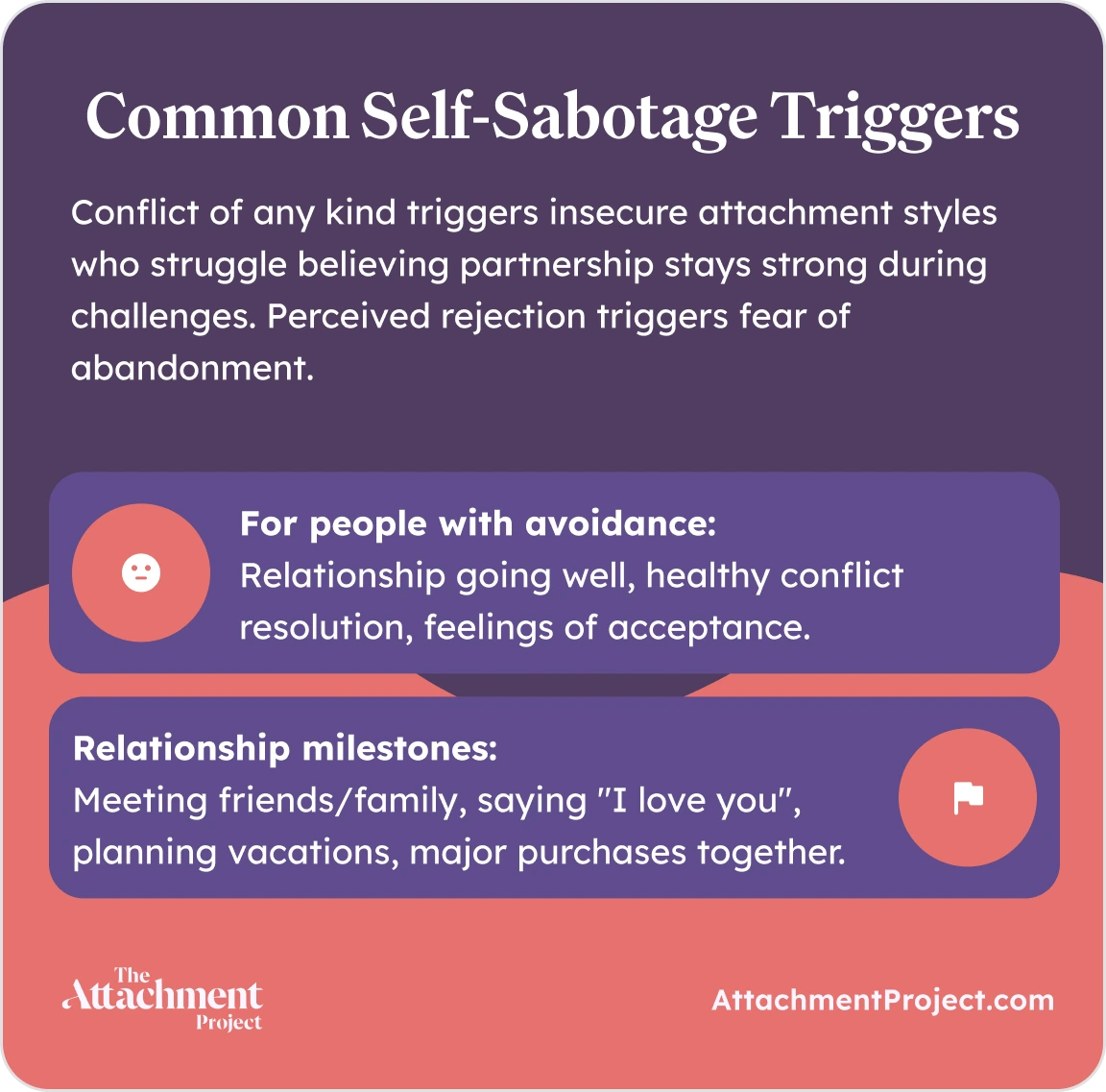
Conflict of any kind can trigger self-sabotage for people with insecure attachment styles, who can find it difficult to believe that their partnership will still be strong during or after normal challenges occur. Perceived rejection can also trigger a fear of abandonment, which may lead people with insecure attachment styles to self-sabotage so that they can be first to leave or find an easy place to put the blame.
People with attachment avoidance can be triggered when the relationship is going well – healthy conflict resolution and feelings of acceptance, for example, could lead people high in attachment avoidance to self-sabotage in order to make reality match their expectation that relationships are unreliable.
Relationship Milestones That Commonly Trigger Self-Protection
For the same reasons, relationship milestones can also trigger self-sabotage in people with high attachment avoidance. These milestones could be big or small, from meeting each other’s friends and family to the first time you say “I love you”. Activities that involve planning for the future together, such as planning vacations or making major purchases together can also be difficult milestones for people with attachment avoidance to manage.
Am I Self-Sabotaging? Signs of Self-Sabotage in Relationships
Taking what they learned from practicing psychologists about the behaviors and motivations behind self-sabotage, and combining it with lived experience from the general public, the same researchers compiled and tested a Relationship Self-Sabotage Scale3.
Defensiveness, trust difficulty, and lack of relationship skills came out as distinct constructs, meaning they were significant enough to be used in the development of the psychological scale. This scale was created to try to measure self-sabotaging tendencies scientifically.
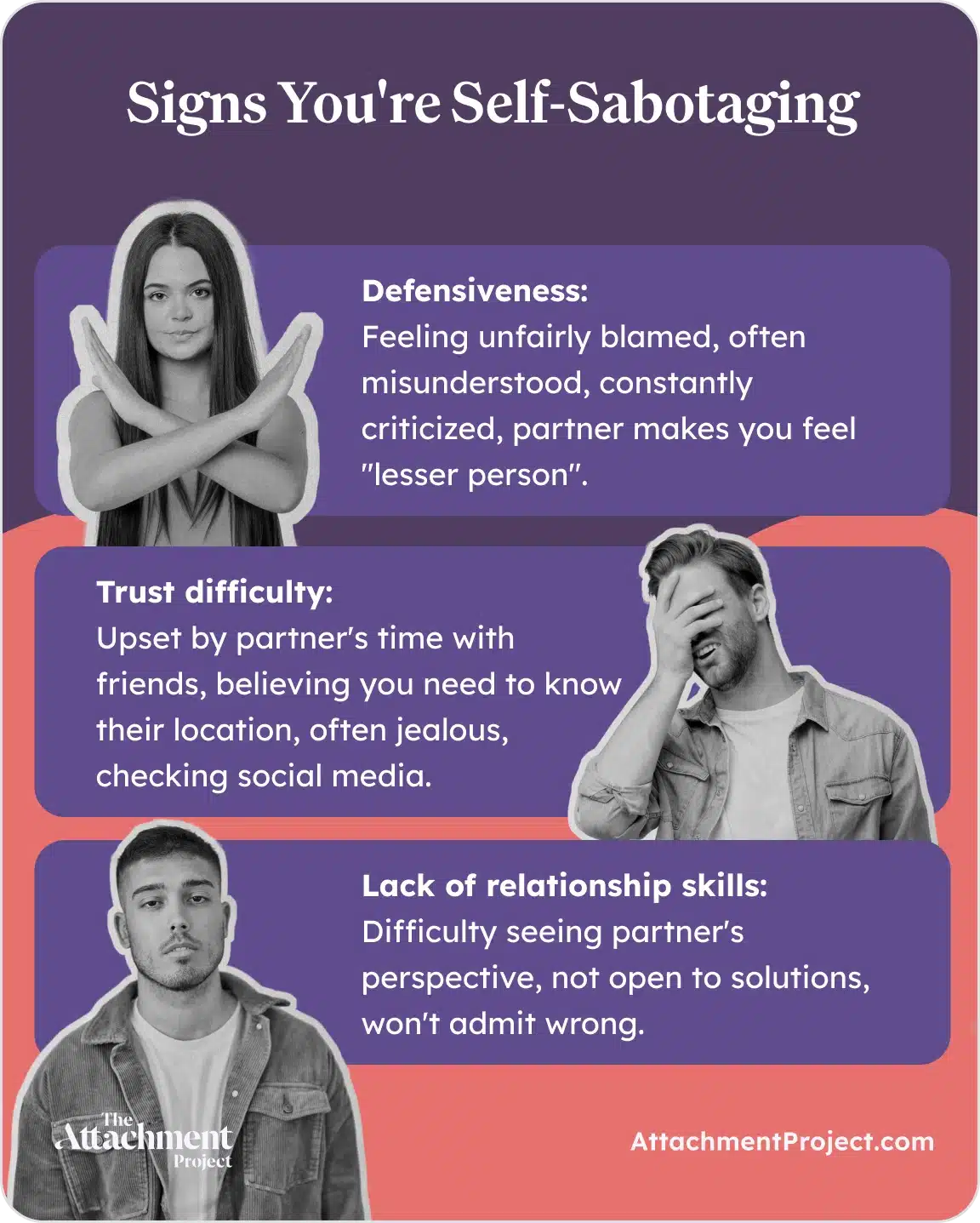
Signs of defensiveness are: feeling unfairly blamed for relationship issues, often feeling misunderstood by your partner, constantly feeling criticized by your partner, and feeling that your partner makes you feel like a “lesser person”.
Trust difficulty is indicated by: feeling upset by how much time your partner spends with their friends, believing that you need to know where your partner is to keep them safe, often feeling jealous of your partner, and checking your partner’s social media profiles.
Under lack of relationships skills, researchers found that participants at risk of self-sabotage find it difficult to put themselves in their partner’s shoes when their partner is upset, are not open to finding solutions to relationship issues, will not admit to being wrong, and are not open to their partner suggesting things they could do to improve the relationship.
If any of these sound familiar, you might be at a particularly high risk of self-sabotaging your relationships.
These Self-Sabotage Examples Might Sound Familiar…
Emotional self-sabotage: Creating distance between you and your partner, or demanding closeness. Feeling contempt or resentment towards your partner.
Behavioral self-sabotage: Crossing boundaries within your relationship or acting in ways that you know will elicit a negative reaction.
Communication self-sabotage: Feeling unable to discuss relationship challenges, lying, or keeping secrets that will harm your relationship.
How Different Attachment Styles Self-Sabotage
Both avoidance and anxiety have been associated with relationship self-sabotage, and both might be related to a lack of relationship skills – but how might self-sabotage look different for different attachment styles?
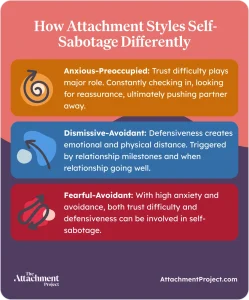
Anxious Attachment Self-Sabotage Patterns
People with higher relationship anxiety (anxious-preoccupied and fearful-avoidant attachment styles) have been found to have stronger approach-avoidance goals, which might make them more likely to experience internal conflicts and create confusion in their relationships2.
Based on what we know about anxious attachment styles, we might find that trust difficulty plays a major role in self-sabotage for people with high relationship anxiety. This could lead you to do things that ultimately push your partner away, like constantly checking in or looking for reassurance.
Avoidant Attachment Self-Sabotage Patterns
We’ve already discussed the significance of relationship milestones in self-sabotage triggers for people high in attachment avoidance (dismissive-avoidant and fearful-avoidant attachment styles). Using what we know about avoidant attachment styles, defensiveness could be a likely culprit in your experience of self-sabotage, leading you to create emotional and physical distance between you and your partner.
How to Stop Self-Sabotaging Your Relationships
If you think that you’re self-sabotaging in your own relationships, first try to gain a deeper awareness of your self-sabotaging behaviors – are defensiveness, trust issues, and communication difficulties at the root of them?
Learning and practicing emotional intelligence – which is a skill, rather than a trait – can help you to recognize the feelings and triggers that lead to self-sabotage. Mindfulness practice is one way emotional intelligence can be strengthened, as this can help us learn to recognize and sit with our own thoughts and feelings.
It’s also important to learn good communication skills with your partner. This can resolve relationship conflicts quicker, or even before they arise. Practice an open-minded and curious approach to your partner’s perspective, and recognize that some conversations naturally bring up difficult feelings that you can learn to be comfortable with.
When to Seek Professional Help for Self-Sabotage
If your self-sabotaging behaviors are getting in the way of daily life or causing harm to yourself or someone else, you might wish to consider professional support from a mental health practitioner. This could take any shape or form that would be helpful to you – some kinds of therapy involve lots of talking and reflecting, and others are focused on psychoeducation and skill building. Spend some time “shopping around” for a good match for you.
START YOUR ATTACHMENT HEALING JOURNEY
Conclusion
Self-sabotage can be difficult for both partners to understand, as it often unconsciously stems from difficult feelings, communication struggles, and unrealistic expectations. Your attachment style may play into your tendency to self-sabotage, with different triggers and methods of self-sabotage likely to trigger different attachment styles.
Defensiveness, trust difficulty, and lack of relationship skills are common culprits, but practicing emotional regulation and open communication can help you and your partner to better manage self-sabotaging behaviors. If self-sabotage is causing harm or significant disruption to your daily life, consider seeking support from a mental health practitioner.
Frequently Asked Questions
Q: Why do I self-sabotage when things are going well in my relationship?
If you have high attachment avoidance, you may tend to self-sabotage when relationships are going well because they find it difficult to trust that the relationship will continue in this direction. It may feel safer and more comfortable for you to maintain distance.
Q: Is self-sabotage always unconscious or can it be intentional?
Self-sabotage is often an unconscious cognitive process stemming from insecurity or poor relationship skills. However, it can sometimes be more intentional.
Q: How do I know if I’m self-sabotaging or just incompatible with someone?
To find out if you’re self-sabotaging or just incompatible, it could be helpful to examine where the feelings behind your behaviors are coming from. Do you feel insecure in the relationship and find it difficult to cope with its challenges, or are you just not enjoying it?
Q: Is self-sabotage more common in people with certain attachment styles?
Research has found that self-sabotage is more common in people with insecure attachment styles, as they feel a greater need to self-protect.
Q: Can childhood trauma cause relationship self-sabotage?
Childhood trauma is associated with insecure attachment styles and difficulty with emotional regulation, which are both associated with self-sabotage in relationships.
Q: How can I help a partner who self-sabotages our relationship?
If your partner is self-sabotaging, it’s important for them to understand their own difficulties. The support they find helpful will be unique to their own processes, but looking after yourself first can ensure that you have the emotional capacity to help them too. It can be helpful to both of you to make sure your own needs are met by prioritizing self-care and relationships with friends and family.
Q: How do I know if someone is self-sabotaging?
If someone shows signs of defensiveness, difficulty trusting, and a lack of relationship skills, their relationship-damaging behaviors could be self-sabotage.
References
- Peel R, Caltabiano N, Buckby B, McBain K. Defining romantic self-sabotage: A thematic analysis of interviews with practising psychologists. Journal of Relationships Research. 2019 Jan;10:e16.
- Locke KD. Attachment styles and interpersonal approach and avoidance goals in everyday couple interactions. Personal Relationships. 2008 Sep;15(3):359-74.
- Peel R, Caltabiano N. The relationship sabotage scale: an evaluation of factor analyses and constructive validity. BMC psychology. 2021 Sep 19;9(1):146.
 Get mental health tips straight to your inbox