








Attachment at Work Study
Your attachment style influences how you feel about yourself, as well as your relationships with others – so it makes sense that your attachment style might influence your experiences in the workplace. This area of attachment is relatively understudied, so we set out to explore exactly how your attachment style relates to work.
Our large-scale study saw a total of 64,240 people across a variety of tests answer questions on attachment, emotional wellbeing, and workplace experiences. We performed in-depth statistical analyses on each section, resulting in exciting new insights.
In this article, we’re outlining our research on Attachment at Work, our key findings, and what they could mean for you. When you find out your own workplace attachment style, you can use the information here and in your Attachment at Work report to gain a deeper understanding of your experiences in the workplace and build towards a more positive relationship with work.
What is Attachment?
Briefly, attachment theory is a psychological framework explaining how we relate to others and ourselves. Your attachment style starts to develop as soon as you’re born in response to how your caregivers respond to your emotional needs, and continues to be shaped by your experiences throughout life.

There are lots of different ways to measure your attachment style. One of the most popular, and the scale we base our free attachment quiz on, measures your attachment to your mother, father, romantic partners, and others in general separately1. You can have different attachments to different people – for instance, you might be generally secure overall, but have an avoidant attachment to your mother and an anxious attachment to your father.
This way of measuring attachment scores attachment avoidance and attachment anxiety on a spectrum. This enables us to see patterns in greater detail – rather than categorizing results as attachment styles alone, we can see how high or low we score on both domains.
TAKE OUR FREE ATTACHMENT AT WORK TEST
We wanted to know whether this way of measuring attachment could be adapted to understand your Attachment at Work, so we developed and tested our own test.
Attachment at Work
Attachment in the workplace is an under-researched subject, but a few studies have begun to explore it.
A 2024 paper summarized existing research, supporting the idea that workplace attachment styles can impact other aspects of work2. For instance, if you have an anxious attachment style at work, you might be more prone to fears of rejection and hypersensitivity to feedback – but also better at detecting risks and personal areas for improvement.
If you have an avoidant workplace attachment style, you might be less likely to engage with your team and seek support from others, but better at working independently and focusing on goals.
Fearful-avoidant attachment styles have characteristics of both attachment anxiety and avoidance, so the pros and cons of both can be present if you have this workplace attachment style.
If you have a secure workplace attachment style, you’re the most likely to form strong bonds at work, enjoy high job satisfaction, and experience greater trust in leadership.
Workplace Attachment Anxiety
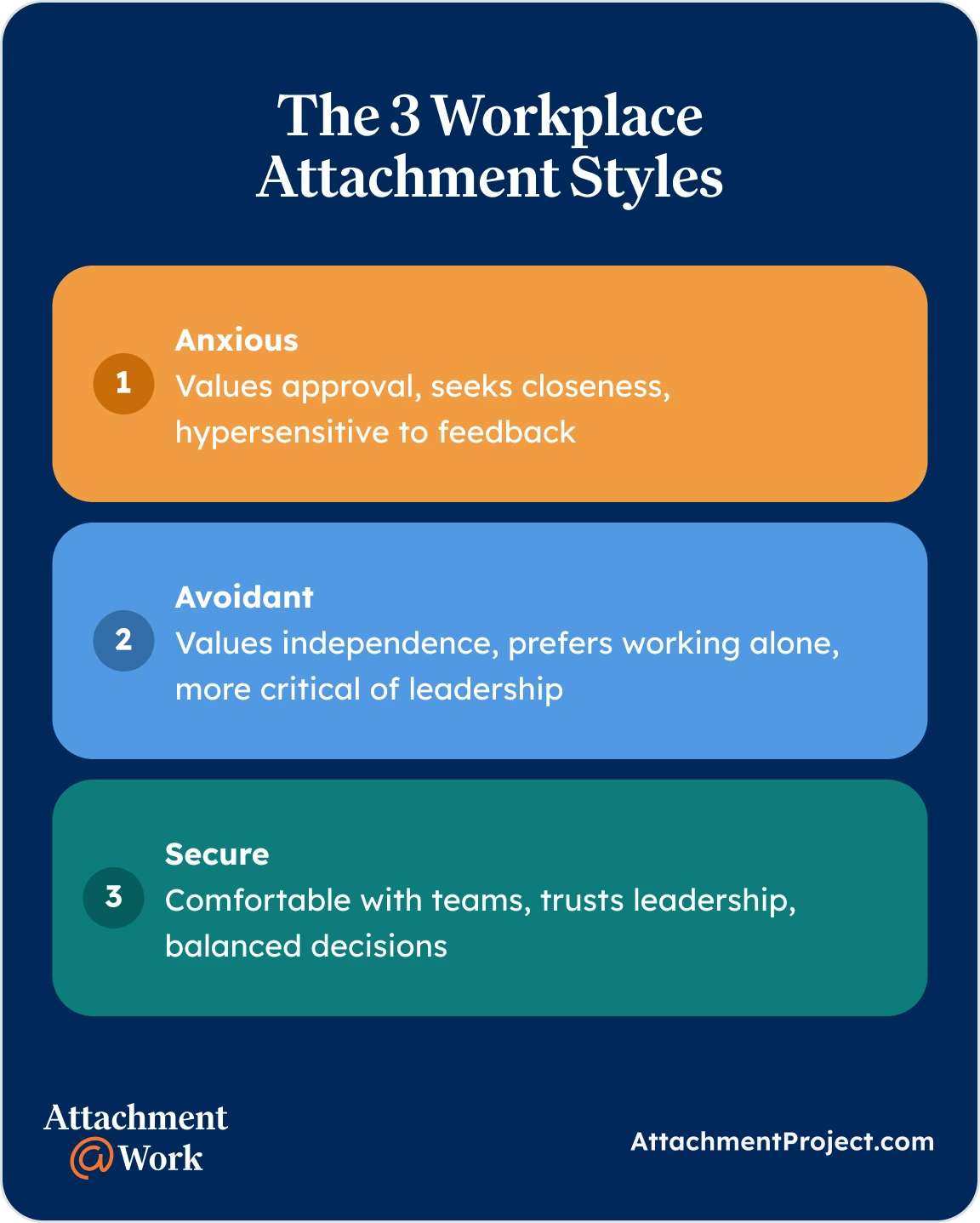
If you have high workplace attachment anxiety, you strongly value connection, approval, and reassurance from your colleagues. You might seek closeness with colleagues and supervisors, look for signs of acceptance, and experience discomfort when working independently or without feedback.
This can manifest as hypersensitivity to criticism and a tendency to conform to group expectations, even if it comes at a personal or professional cost. Attachment anxiety is generally related to low self-esteem and a strong fear of rejection, which can lead you to become more invested in your relationships – including in the workplace.
However, attachment anxiety does come with unique strengths at work. Hypervigilance helps you to detect risks, inconsistencies, and potential problems quicker than others, and your desire to be a valued member of the team drives you to perform well and contribute to workplace cohesion.
Workplace Attachment Avoidance
If you have high workplace attachment avoidance, you strongly value independence, autonomy, and emotional distance at work. You might prefer to avoid group tasks and rely on yourself rather than seeking support from colleagues or leaders.
Attachment avoidance is typically associated with downplaying close relationships and distrusting others. In the workplace, you might seem emotionally reserved to others, critical of leadership, and resistant to new ideas – especially when they challenge your existing views. This can sometimes lead to social isolation or friction within teams.
However, there are advantages to workplace attachment avoidance. Because you prefer to work alone, you can be more focused on completing tasks, able to make quick decisions, and maintain emotional steadiness in high-pressure situations. Your distance from group dynamics helps you to drive positive results without distraction.
Workplace Attachment Security
If you have both low workplace attachment anxiety and low workplace attachment avoidance, then you have workplace attachment security. This is characterized by a comfort with closeness within teams that is driven by your own internal sense of self-worth and ability to contribute, rather than a fear of rejection and dependence on others.
Attachment security is typically associated with trusting relationships, healthy boundaries, and high self-esteem. In the workplace, this can help you to make balanced decisions and be more resilient with access to both high self-worth and good quality social support.
Our Study
Our Attachment at Work measure was statistically tested to make sure it worked as intended, with positive results – Attachment at Work was found to be its own type of attachment! This meant we could use our own Attachment at Work scale to investigate the relationships between Attachment at Work and other psychological measures, all tested using scientifically validated measures.
We compared workplace attachment anxiety and workplace attachment avoidance with 11 different measures of wellbeing and workplace experiences, each with varying but large numbers of responses. Some were surprising – take a look below:
Attachment and Workplace Experiences
First, we looked at how your workplace attachment pattern, or Attachment at Work, is related to your other experiences at work – your organizational citizenship behavior, career sustainability, psychological safety, and job satisfaction.
Organizational Citizenship Behavior and Attachment at Work
Organizational citizenship behavior, or OCB, measures how likely you are to voluntarily contribute to your company, support your co-workers, and go above and beyond what’s expected in your role. Higher scores indicate a higher likelihood of behaving altruistically towards your company.
We used the Organizational Citizenship Behavior Checklist, developed by Fox & Spector in 20093. This scale splits OCB into citizenship behavior that benefits the organization (OCBO) and fellow employees (OCBP), and asks respondents to say how often they have done things like:
- “Volunteered for extra work assignments.” (OCBO)
- “Said good things about your employer in front of others.” (OCBO)
- “Covered a co-worker’s mistake.” (OCBP)
- “Changed vacation schedule, work days, or shifts to accommodate co-worker’s needs.” (OCBP)
We found that people with higher organizational citizenship behavior scores of both kinds, indicating a higher likelihood of going above and beyond to help their company and their teammates, tended to have lower workplace avoidance, but higher workplace anxiety.
This might reflect the tendency for people with anxious attachments to focus on others’ needs – sometimes slipping into people pleasing – to maintain a sense of connection. On the other hand, people with attachment avoidance tend to steer clear of this dynamic and focus on their own goals.
Career Sustainability and Attachment at Work
Career sustainability was measured on 3 domains: health, happiness, and productivity, using a measure developed in 2011 by Milić & Hedrih4. Participants answered 15 questions, 5 in each domain, which were combined to give an overall career sustainability score.
A higher career sustainability score indicates a higher likelihood that employees will be able to continue in their role and its progression for a long time. Items on the scale included:
- “The work I do endangers my health.” (Health; reverse coded)
- “Success I achieve in my career makes me fulfilled.” (Happiness)
- “I get praised for my work.” (Productivity)
Better career sustainability overall was associated with more secure workplace attachment. This aligns with what we would expect: people with greater workplace attachment security are more likely to feel positive about work and able to maintain their career trajectory.
Although high scores in all domains were associated with lower workplace attachment anxiety and workplace attachment avoidance, good health (in relation to career sustainability) was 1.88x more strongly associated with low anxiety compared with avoidance, and happiness and productivity were 3.66x and 2x more strongly associated with low avoidance than anxiety, respectively.
Psychological Safety and Attachment at Work
Psychological safety describes how safe you feel to express your views, feelings, and concerns at work without fear of punishment, embarrassment, or negative consequences. Teams and individuals who score high in psychological safety are more able to raise problems and admit mistakes, which allows more efficient and effective problem solving.
We used a validated scale of psychological safety developed in 2004 by Edmondson and colleagues at Harvard Business School5. Items on this scale included:
- “If you make a mistake on this team, it is often held against you.” (Reverse coded)
- “It is safe to take a risk in this team.”
- “No one on this team would deliberately act in a way that undermines my efforts.”
In our study, people who reported higher psychological safety also reported more secure workplace attachment – particularly lower workplace attachment avoidance, which was 1.66x more strongly associated with psychological safety than workplace attachment anxiety.
This makes sense: attachment avoidance is typically associated with a discomfort with vulnerability and develops when you already feel unsafe, making it more difficult to put yourself on the line to point out or admit something wrong. Meanwhile, attachment anxiety can make it feel scary and unsafe to risk being perceived negatively by others. When you have a secure attachment style, you are more self-affirmed, so taking these risks poses less of a threat to your sense of self.
Job Satisfaction and Attachment at Work
The job satisfaction scale comprised 9 different domains: coworker relations, job enjoyment, meaning and purpose, organizational communication, pay and benefits, promotion and recognition, supervisor relations, work environment, and workload.
The scale used in the research was developed by organizational psychologist Paul Spector in 19856, and has been cited almost 5,000 times. Participants were asked how strongly they agreed or disagreed with statements like:
- “I feel I am being paid a fair amount for the work I do.”
- “I like the people I work with.”
- “I am satisfied with my chances for promotion.”
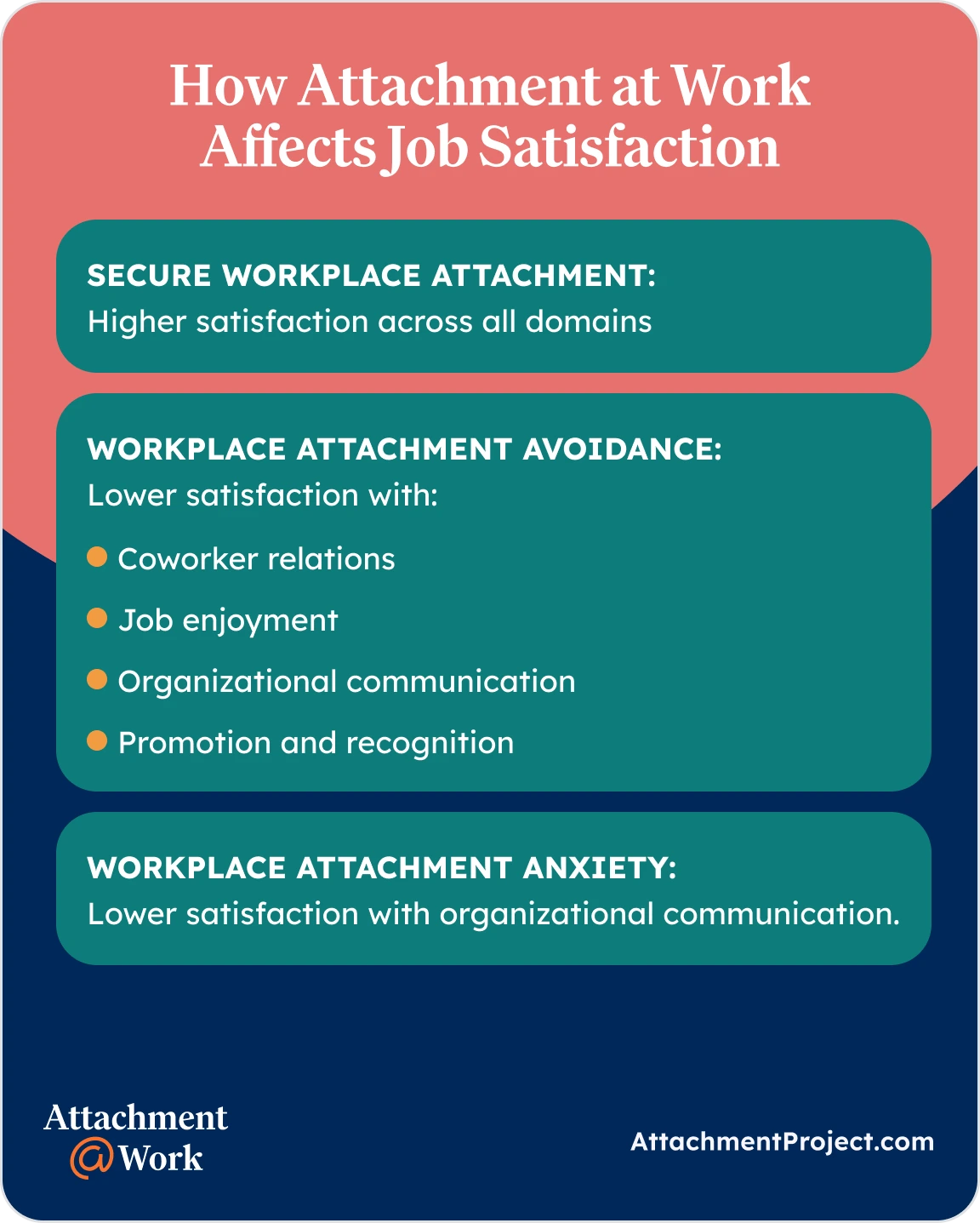
Overall, higher job satisfaction was associated with higher workplace attachment security. Higher workplace avoidance was most strongly associated with lower satisfaction with coworker relations, job enjoyment, organizational communication, and promotion and recognition.
TAKE OUR FREE ATTACHMENT AT WORK TEST
Meanwhile, higher workplace anxiety was more strongly associated with lower satisfaction with organizational communication compared with the other job satisfaction domains. This might indicate a higher need for people with workplace anxiety to feel informed about what’s going on in their company, or to feel that this conversation goes two ways.
Attachment and Self at Work
Next, we investigated how your Attachment at Work relates to how you feel about yourself – your emotional regulation, self-esteem, burnout risk, and resilience.
Emotion Regulation and Attachment at Work
To measure emotional regulation, we used the psychologically validated Difficulties in Emotion Regulation Scale (DERS-16), developed by Gratz and Roemer in 20047. The DERS was developed on the basis that emotional regulation involves:
- Awareness and understanding of your own emotions.
- Acceptance of your emotions.
- The ability to engage in goal-directed behavior and control the urge to act on impulse when emotions are negative.
- Access to effective emotional regulation strategies.
Because the DERS measures difficulties in emotion regulation, lower scores reflect higher emotion regulation skills. This scale measures your overall emotion regulation, meaning it’s not specific to the workplace.
Overall, less secure Attachment at Work was associated with higher DERS scores, indicating more difficulties with emotion regulation and mirroring what we know about emotion regulation and romantic attachment styles: greater attachment security is associated with better emotion regulation.
The relationship between emotion regulation and workplace attachment anxiety was almost 2x higher than with workplace attachment avoidance. All dimensions of the DERS had a stronger relationship with workplace attachment anxiety than with workplace attachment avoidance.
Both high attachment anxiety and attachment avoidance are typically related to poorer emotion regulation, so it’s no surprise that we found the same pattern in workplace attachment security.
Attachment anxiety is particularly associated with high emotional intensity, which can make it more difficult for us to think clearly – this may be why all DERS domains were more strongly associated with workplace attachment anxiety than workplace attachment avoidance.
Self-Esteem and Attachment at Work
We used the Rosenberg Self-Esteem Scale (RSE), developed in 1965 and still often used to measure self-esteem using two dimensions: self-liking and self-confidence (or self-competence)8. Higher scores on the RSE indicate higher self-esteem.
Self-liking measures your fundamental feelings of self-worth, without factoring in your achievements or acceptance from others. For example, “I take a positive attitude toward myself.”
Self-confidence, on the other hand, reflects your perceived ability to succeed and achieve your goals. For example, “I am able to do things as well as most other people.”
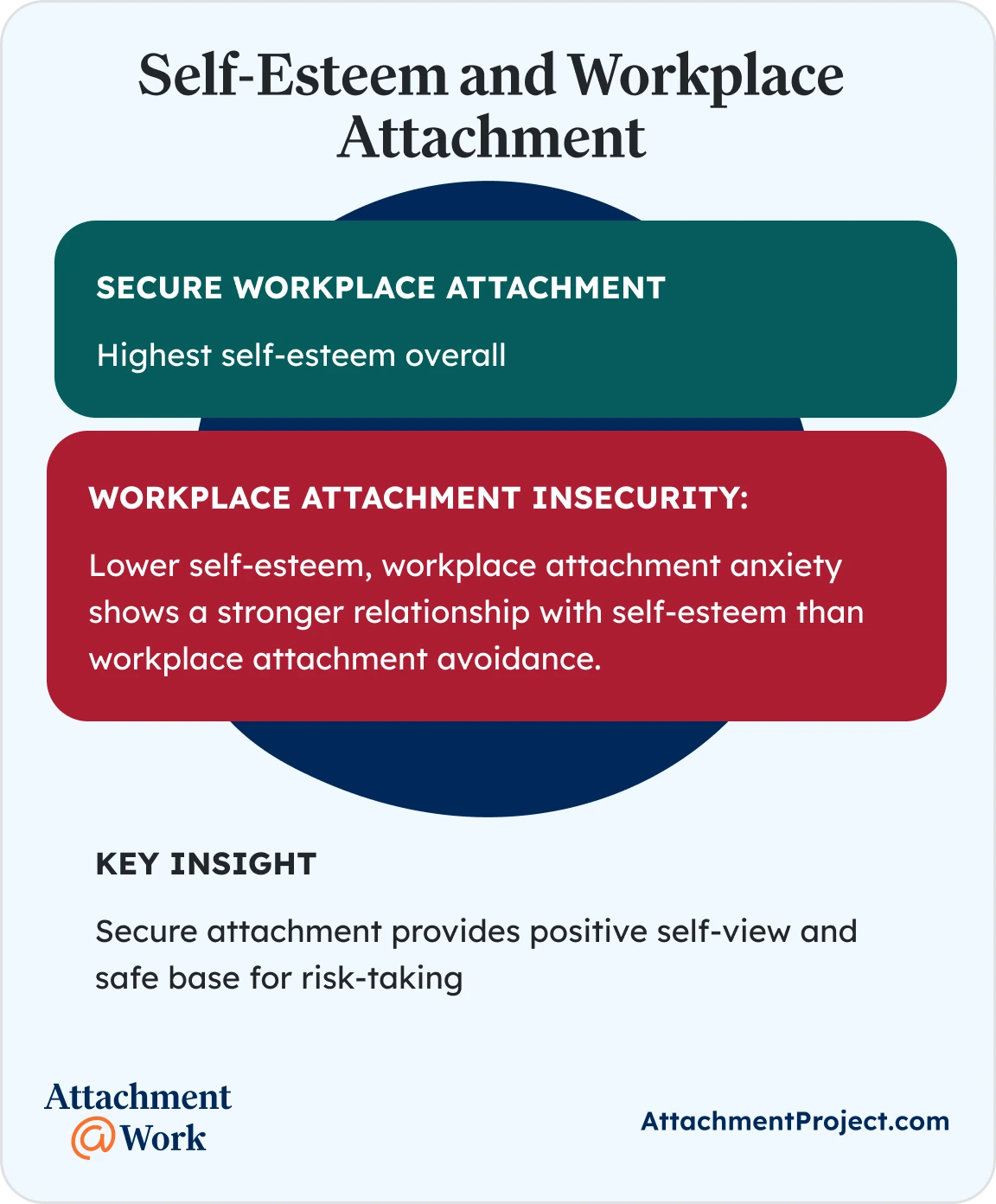
As in romantic attachment, more secure Attachment at Work patterns were associated with higher self-esteem. The relationship between self-esteem and attachment was 1.5x stronger in anxiety than avoidance, which matches what we’d expect; anxious attachment styles typically have a higher view of others but lower self-view, while avoidant attachment styles have a lower view of others but higher self-view.
However, secure attachment styles have the highest self-esteem because they have a positive internal working model of themselves and a felt “safe base” to take risks from.
Burnout and Attachment at Work
Burnout describes a state of work-related exhaustion, which can lead to severe mental health difficulties. The American Psychological Association describes burnout as:
“Physical, emotional, or mental exhaustion accompanied by decreased motivation, lowered performance, and negative attitudes toward oneself and others. It results from performing at a high level until stress and tension, especially from extreme and prolonged physical or mental exertion or an overburdening workload, take their toll.”
To measure burnout risk, we used a measure developed by Schaufeli, Bakker, & Salanova in 20069. This scale measured burnout on 4 dimensions:
- Exhaustion – “After a day at work, I find it hard to recover my energy.”
- Mental distance – “I struggle to find any enthusiasm for my work.”
- Cognitive impairment – “When I’m working, I have trouble concentrating.”
- Emotional impairment – “At work I may overreact unintentionally.”
Higher scores on these domains indicate a higher risk of experiencing burnout.
Our study found that individuals reporting greater risk of burnout tend to have less secure workplace attachment. This, again, makes sense: attachment security gives us a greater ability to cope with challenges and bond with our teams.
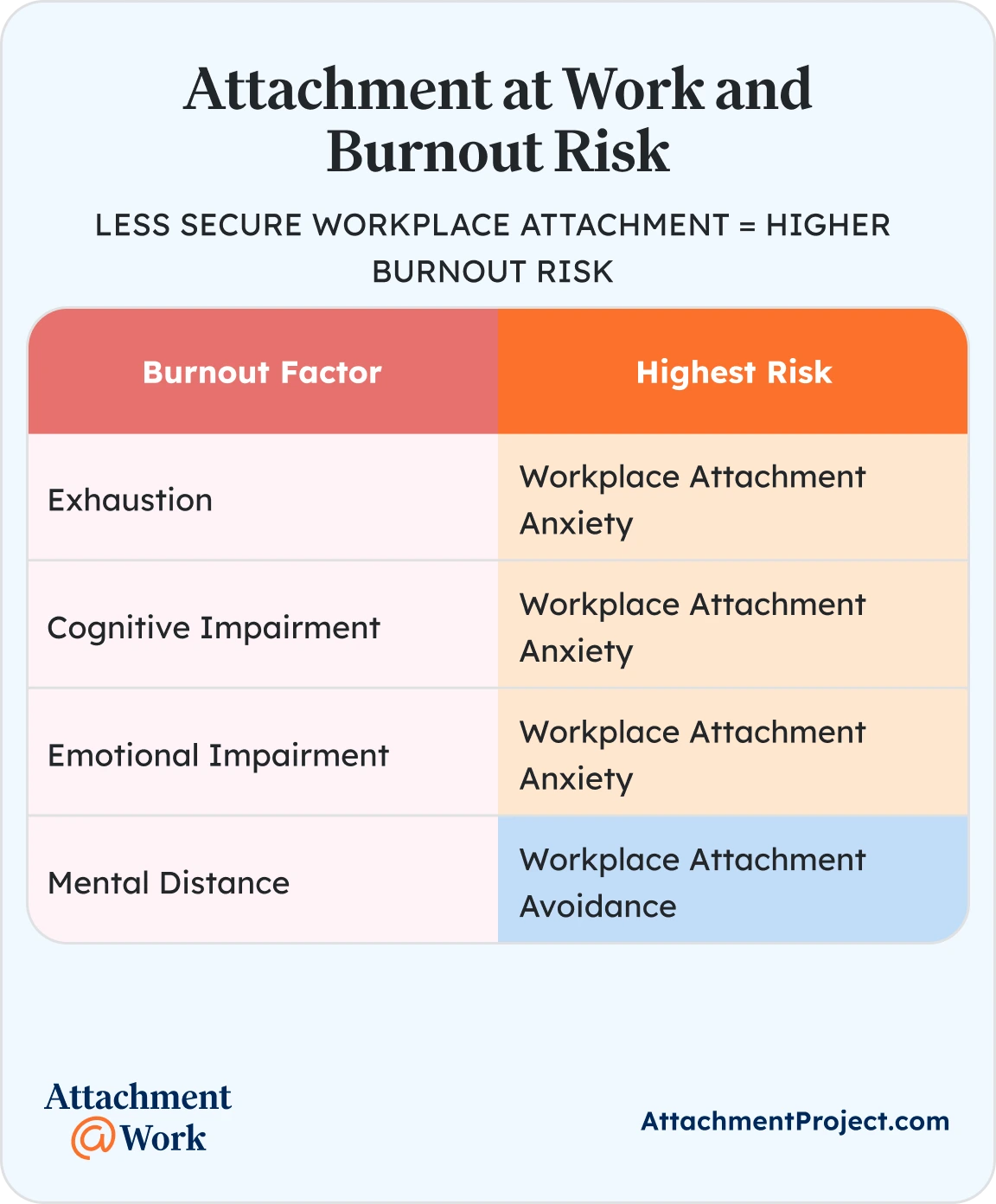
Three of the burnout dimensions were more strongly associated with workplace attachment anxiety than avoidance: exhaustion by 1.72x, cognitive impairment by 2.2x, and emotional impairment by 5.6x. This might indicate that, overall, workplace attachment anxiety poses a greater risk of burnout than workplace attachment avoidance. It’s worth noting that these relationships were fairly weak, which is why the differences between them can seem large.
Mental distance was the only burnout factor which was associated more strongly with avoidance than with anxiety, but the difference was small – mental distance was 1.26x more strongly associated with avoidance than anxiety. Using distance to manage emotions is a cornerstone of attachment avoidance, so it also isn’t surprising that mental distance has a stronger relationship with workplace attachment avoidance than anxiety.
TAKE OUR FREE ATTACHMENT AT WORK TEST
Resilience and Attachment at Work
Resilience is the ability to quickly bounce back from stress. The Brief Resilience Scale, developed by Bruce Smith and colleagues from the University of New Mexico in 200810, measures how well someone might be able to recover from challenges or setbacks. Higher scores indicate stronger resilience. The scale includes questions like:
- “I tend to bounce back quickly after hard times.”
- “It is hard for me to snap back when something bad happens.” (Reverse coded)
- “I usually come through difficult times with little trouble.”
In line with what we expected, we found that more resilient people tended to report higher workplace attachment security. Again, this makes sense because attachment security is linked with stronger self-esteem and social support.
The relationship between workplace attachment and resilience was particularly strong when it comes to anxiety – the relationship between resilience and workplace attachment anxiety was 92% stronger than the relationship between resilience and workplace attachment avoidance.
This could be connected to the emotional intensity and dependence on others associated with attachment anxiety, but it’s also possible that people with attachment avoidance report higher resilience because they are less likely to identify or connect with memories of hard times.
Attachment and Demographics at Work
Remote Work and Attachment at Work
Working remotely has soared in popularity in the last several years: according to the US Bureau of Labor Statistics, remote work increased by over 30 percentage points in some industries post-pandemic. To explore the connection between Attachment at Work and remoteness, we asked our test respondents whether they were full-time office based, remote, or a mix of both (hybrid).
We found that remote workers had slightly higher workplace attachment avoidance than office and hybrid workers, but the lowest workplace attachment anxiety. For example, 59% of office and hybrid workers scored below the group average in avoidance, showing less avoidance, compared with 55% of remote workers.
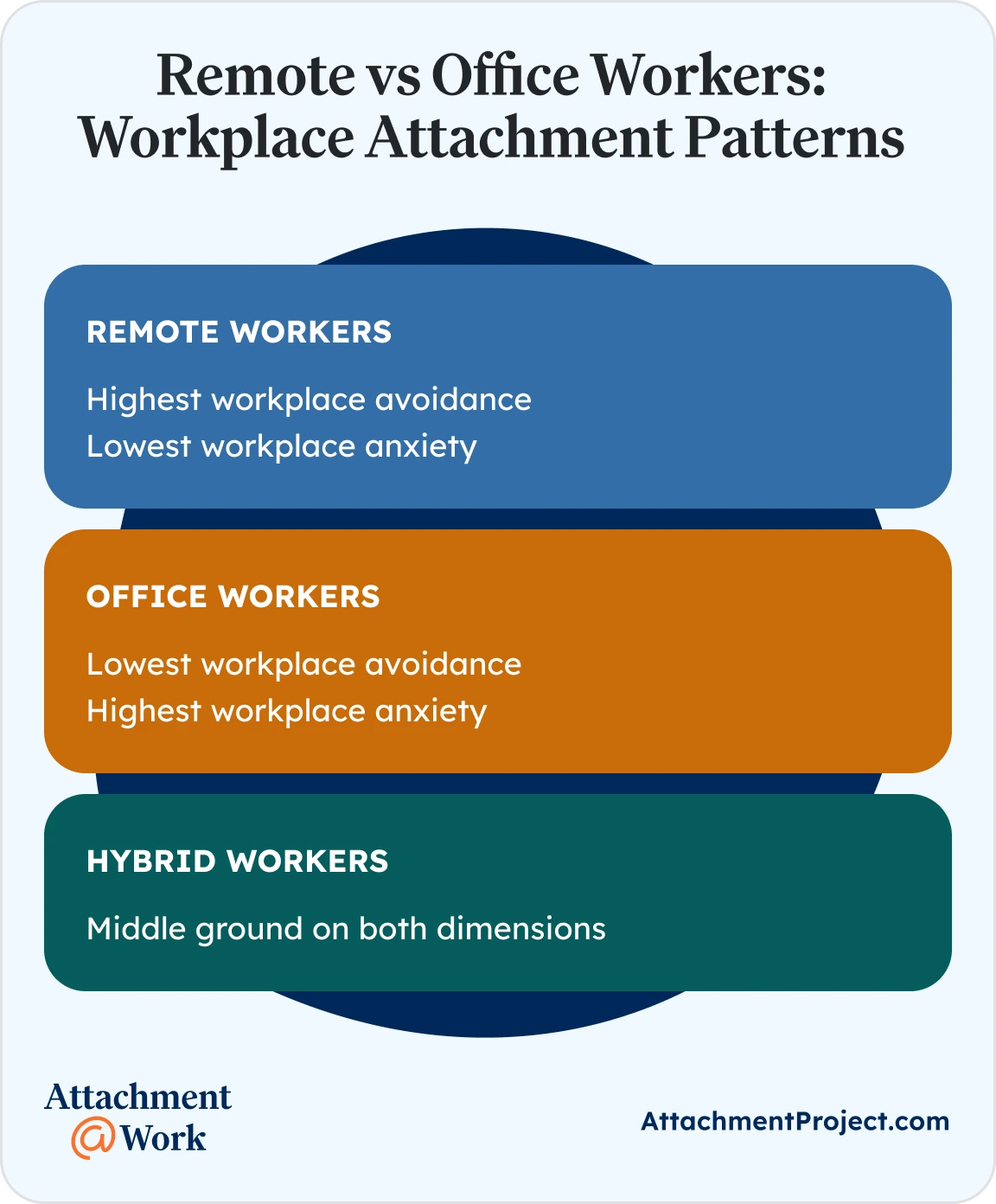
In terms of workplace attachment anxiety, 62% of remote workers scored below the group average, showing the least anxiety, compared with 60% of hybrid workers and 57% of office workers.
Professional Status and Attachment at Work
We also wanted to know whether your Attachment at Work could be related to your professional status. Participants were asked to choose the most fitting professional status: business owner, contractor, employed manager, employed non-manager, or unemployed.
Business owners and employed managers had the lowest workplace avoidance, while the unemployed group had the highest. Unemployed respondents also had the highest workplace anxiety, while contractors had the lowest.
58% of employed managers scored below average on avoidance, followed by 56% of business owners, 53% of employed non-managers, 50% of contractors, and only 38% of unemployed respondents.
54% of contractors scored below average on anxiety, compared with 53% of both business owners and employed managers, 51% of employed non-managers, and 43% of the unemployed group.
Gender and Attachment at Work
Reflecting trends on romantic attachment, men showed slightly more workplace attachment avoidance than women, and women showed slightly more workplace attachment anxiety. However, the differences are so small that they could be considered negligible, with no real difference in workplace attachment between men and women. A small number of participants selected “other” in the gender category, but there were too few “other” responses to draw meaningful conclusions.
Conclusions on Attachment at Work
Our Attachment at Work report is one of the largest scale studies ever undertaken on the subject, investigating the relationships between Attachment at Work and your feelings and experiences at work.
Our findings are correlational, meaning they can’t be used to imply the direction of cause and effect. For example, people with higher self-esteem have more secure Attachment at Work, but this doesn’t necessarily mean that they have higher self-esteem because they have more secure workplace attachment, or vice versa.
The relationships we investigated are likely complex and influenced by many different factors, but our crucial finding is that Attachment at Work does relate to the factors we investigated independently of relationship-based attachment styles.
Are you ready to find out more about you or your team’s Attachment at Work? Take our free Attachment at Work quiz to find out more about your workplace attachment style and team dynamics.
About Our Workplace Attachment Measure
We validated our measure of Attachment at Work against pre-existing psychometrically validated measures of attachment. Following rigorous item development and five rounds of trialling, our final instrument’s psychometric properties are as follows:
| Instrument | CFI (>0.9) | RMSEA (<0.08) | SRMR (<0.08) | Dimension | AVE (>0.5) | Alpha (>0.7) | Omega (>0.7) | Internal Quality |
|---|---|---|---|---|---|---|---|---|
| Work-related attachment | 0.906 | 0.104 | 0.054 | Avoidance | 0.449 | 0.829 | 0.830 | Good, except RMSEA |
| Anxiety | 0.541 | 0.724 | 0.756 | |||||
| Work-related attachment with residual covariances (items 1&4, 5&6) | 0.977 | 0.054 | 0.040 | Avoidance | 0.425 | 0.829 | 0.778 | Excellent |
| Anxiety | 0.540 | 0.724 | 0.758 |
The workplace attachment measure has good confirmatory factor model fit indicators, except RMSEA. This is similar to all the other attachment measures, which also have a high RMSEA.
When residual covariances between items 1 and 4 and items 5 and 6 are introduced, this disappears and fit indicators become perfect. This indicates that high RMSEA is due to specific correlations between some items that is not accounted for by attachment avoidance and anxiety.
Internal consistency is acceptable. AVE for avoidance is a bit lower than 0.5, but not by much. Overall, internal psychometric properties of the workplace attachment measure are good.
There are moderate correlations with corresponding measures from the general attachment measure (avoidance with avoidance and anxiety with anxiety) which are both above 0.5.
Correlations with other, specific measures of attachment are much lower, although the correlation with the corresponding dimension is always higher than with the non-corresponding one.
TAKE OUR FREE ATTACHMENT AT WORK TEST
What We Do at The Attachment Project
Our mission is not only to bring you the latest research in attachment and relationships, but to do our part to contribute to attachment research around the world. The Attachment Project’s Attachment at Work study is a groundbreaking insight into attachment in the workplace. Over 64,240 of you took part, producing a massive dataset and incredible results on attachment, burnout, work satisfaction, remote working, and more. Join our mailing list to stay up to date as we share our most fascinating findings under our Attachment at Work series.
References
- Fraley RC, Heffernan ME, Vicary AM, Brumbaugh CC. The experiences in close relationships—Relationship Structures Questionnaire: A method for assessing attachment orientations across relationships. Psychological assessment. 2011 Sep;23(3):615.
- Warnock KN, Ju CS, Katz IM. A Meta-analysis of Attachment at Work. Journal of Business and Psychology. 2024 Dec;39(6):1239-57.
- Spector PE, Fox S. Organizational citizenship behavior checklist (OCB-C). 2009.
- Milić K, Hedrih V. A three-factor model of a sustainable career and the Sustainable Career scale. Unpublished materials. 2011.
- Edmondson AC, Kramer RM, Cook KS. Psychological safety, trust, and learning in organizations: A group-level lens. Trust and distrust in organizations: Dilemmas and approaches. 2004 Apr 29;12(2004):239-72.
- Spector PE. Measurement of human service staff satisfaction: Development of the Job Satisfaction Survey. American journal of community psychology. 1985 Dec 1;13(6):693.
- Gratz KL, Roemer L. Multidimensional assessment of emotion regulation and dysregulation: Development, factor structure, and initial validation of the difficulties in emotion regulation scale. Journal of psychopathology and behavioral assessment. 2004 Mar;26(1):41-54.
- Rosenberg M. Rosenberg self-esteem scale. Journal of Religion and Health. 1965 Jan 1.
- Schaufeli WB, Bakker AB, Salanova M. The measurement of work engagement with a short questionnaire: A cross-national study. Educational and psychological measurement. 2006 Aug;66(4):701-16.
- Smith BW, Dalen J, Wiggins K, Tooley E, Christopher P, Bernard J. The brief resilience scale: assessing the ability to bounce back. International journal of behavioral medicine. 2008 Sep;15(3):194-200.
 Get mental health tips straight to your inbox