









Avoidant Discard: Why Do People Suddenly End Great Relationships?

Published on June 19, 2025 Updated on February 17, 2026
Everything seemed to be heading in the right direction – your relationship was blossoming, you started to share more of your lives with each other, and you were even making future plans. Suddenly, out of nowhere, they pulled away and ended things without any apparent reason. This might have been a case of what the Internet is calling the “avoidant discard”.
Avoidant discard is when relationships end because somebody with an avoidant attachment style decides to end a relationship while it’s going well, often leaving their partner very confused. They usually give very little explanation, and sometimes they gradually disengage with no explanation at all.
When someone has an avoidant attachment style, they typically aren’t comfortable with trusting others and intimate relationships; this might cause them to pull away when things are good. Studies find that around 25% of us have an avoidant attachment style1.
DISCOVER YOUR ATTACHMENT STYLE
In this article, we’ll talk more about what causes avoidant discard, the patterns you might use to recognize it, how to develop healthy healing strategies when you’re on the receiving end of it, and what to consider if reconciliation might be on the cards.
What Exactly Is Avoidant Discard? The Psychology Behind Sudden Breakups
Avoidant discard isn’t like any other breakup: it’s an attachment-driven pattern in which one partner with relationship avoidance distances from the relationship. Often, breakups are the result of building issues over time and a breakdown in communication, gradually driving partners apart. When a breakup is driven by an avoidant attachment style, it can feel like it comes completely out of the blue – sometimes even when things are going better than they’ve ever been, or after a significant milestone.
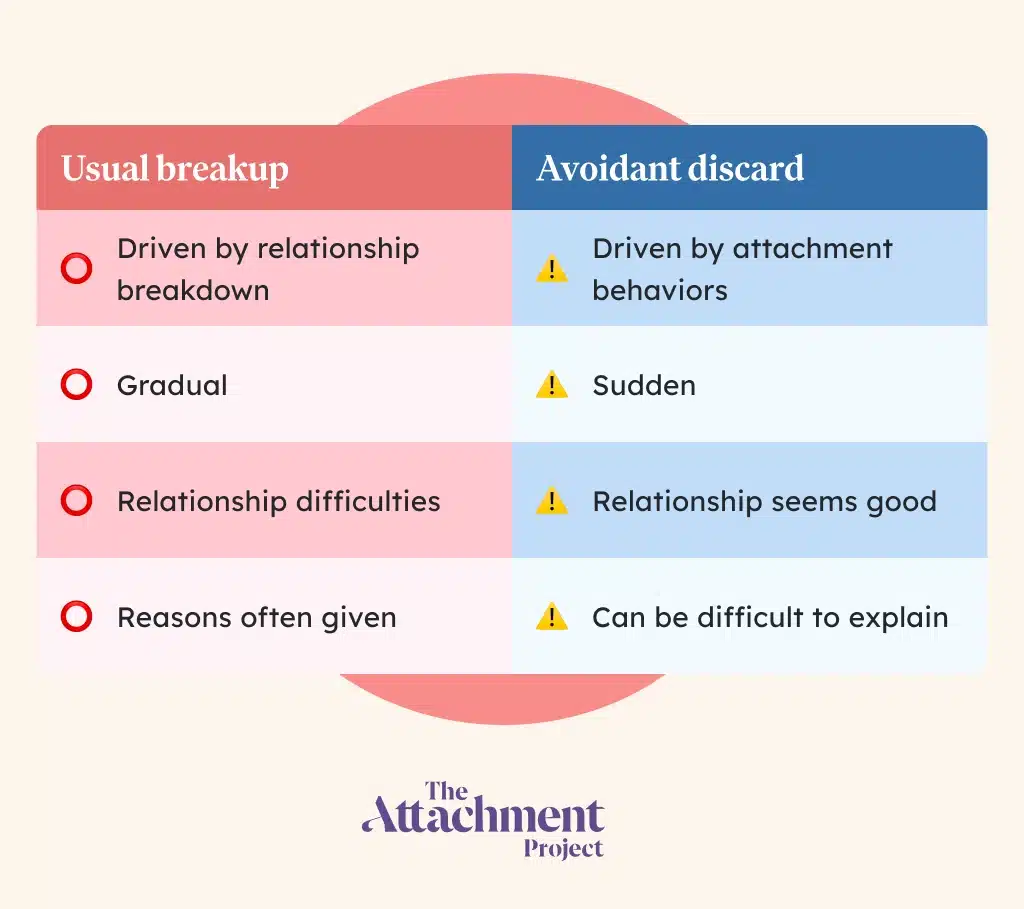
This is because relationship avoidance leads people to fear close connection, dependence, and emotional intimacy. When things are going well in a relationship, their attachment style might sound alarm bells and cause them to feel afraid and overwhelmed. This can lead them to distancing themselves from their partner or initiating a breakup for reasons they can’t explain, leaving you to feel hurt and extremely confused.
Two attachment styles are high in avoidance: dismissive-avoidant and fearful-avoidant. The difference is that people who are fearful-avoidant are also high on relationship anxiety, whereas people who are dismissive-avoidant aren’t. We’ll take a closer look at the difference in avoidant discards when someone is dismissive-avoidant versus fearful-avoidant in the next section.
How to Spot an Avoidant Discard Coming: Warning Signs and Real Examples
People who have been subject to avoidant discard have shared their experiences and the early warning signs. Here are the real life examples they say to look out for:
- Stops using pet names like “babe”.
- Withdraws from physical affection.
- Loss of interest or noticeable lack of emotional involvement in sexual intimacy.
- Hesitant to commit to plans, especially in the more distant future.
- Attempts to start arguments, “picking a fight”.
- Decreased digital communication.
People who are avoidant discarding might not be completely aware of the attachment patterns driving their feelings. They might be equally confused and unable to understand why they feel the need to pull away, perhaps experiencing the ick, which can lead them to give vague reasons for breaking up or distancing from you. They might say things like: “I don’t think we’re compatible”, “you deserve better”, and “it’s not you, it’s me”. They aren’t necessarily doing this to purposely mislead you, rather, an avoidant attachment style can leave them looking for reasons why they suddenly feel emotionally withdrawn and unable to verbalize it.
Dismissive Avoidant vs. Fearful Avoidant Discard Patterns
Although both avoidant attachment styles might engage in avoidant discarding, they have distinctly different ways of navigating relationships and breakups.
People with a dismissive-avoidant attachment style have low relationship anxiety, so they tend to be more comfortable with independence. Dismissive-avoidant driven discards are often a clean break, direct, and emotionally detached. The separation might feel more sudden and complete, and the dismissive-avoidant partner might feel very sure and logical about their decision.
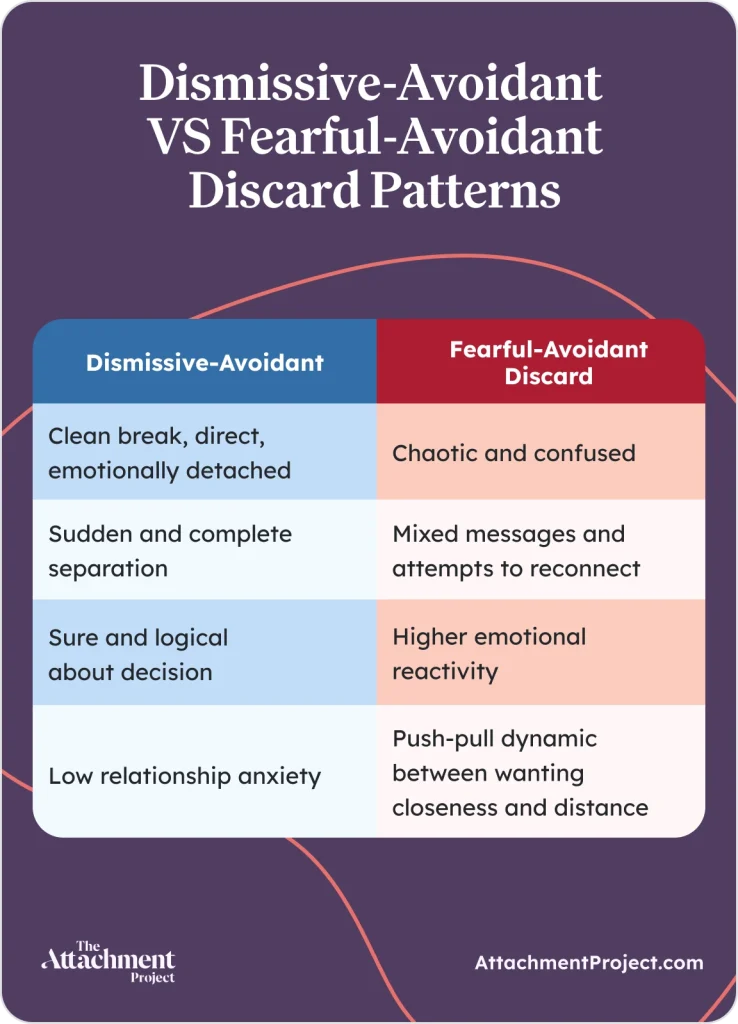
On the other hand, people with a fearful-avoidant attachment style have high relationship anxiety, so they fear being alone and feel more comfortable being dependent on another person. Avoidant discards driven by a fearful-avoidant attachment style might feel more chaotic and confused. People with the fearful-avoidant attachment style might give mixed messages, attempt to reconnect soon after the discard, and show higher emotional reactivity throughout. These breakups can feel like they’re conflicted between their own drive to push and pull.
The Psychological Mechanism Behind Avoidant Discard
Attachment styles begin in infancy. Avoidant attachment styles in children develop when a caregiver is consistently unavailable to meet their needs – the child learns not to depend on others, and instead to preserve their relationship to the caregiver by ignoring their own needs. The infant develops an internal working model, or inner framework, of relationships as unreliable and unsafe. They develop core beliefs that relationships are not trustworthy. When this persists into adulthood, they can continue to value independence above connection with others and ignore their own emotions.
It’s a common misconception that fearful avoidant attachment styles are the result of trauma. Fear of the caregiver does result in disorganized attachment styles in children, but disorganized attachment doesn’t appear to link to the fearful-avoidant style – in fact, it’s possible to have both a disorganized attachment system and another primary attachment style2, 3. Findings do show that adverse childhood experiences are related to both higher relationship anxiety and avoidance, which may be where this misconception comes from, but trauma is not a necessary precursor to a fearful-avoidant attachment style4. Instead, fearful-avoidance could arise from later negative relationship experiences compounding on an already insecure attachment style.
In both cases, the avoidant attachment system uses attachment deactivation to protect itself when it feels overwhelmed by intimacy with another person. When an attachment system deactivates, the person emotionally withdraws from their relationship. Attachment deactivation can be triggered by high emotional intensity (whether positive or negative), relationship milestones, or expectations of deeper commitment or intimacy.
Avoidance In The Brain
We can actually see avoidant attachment in the brain: studies have found deactivation in brain areas associated with social processing in people with avoidant attachment styles, such as the inferior frontal gyrus and striatal regions5.
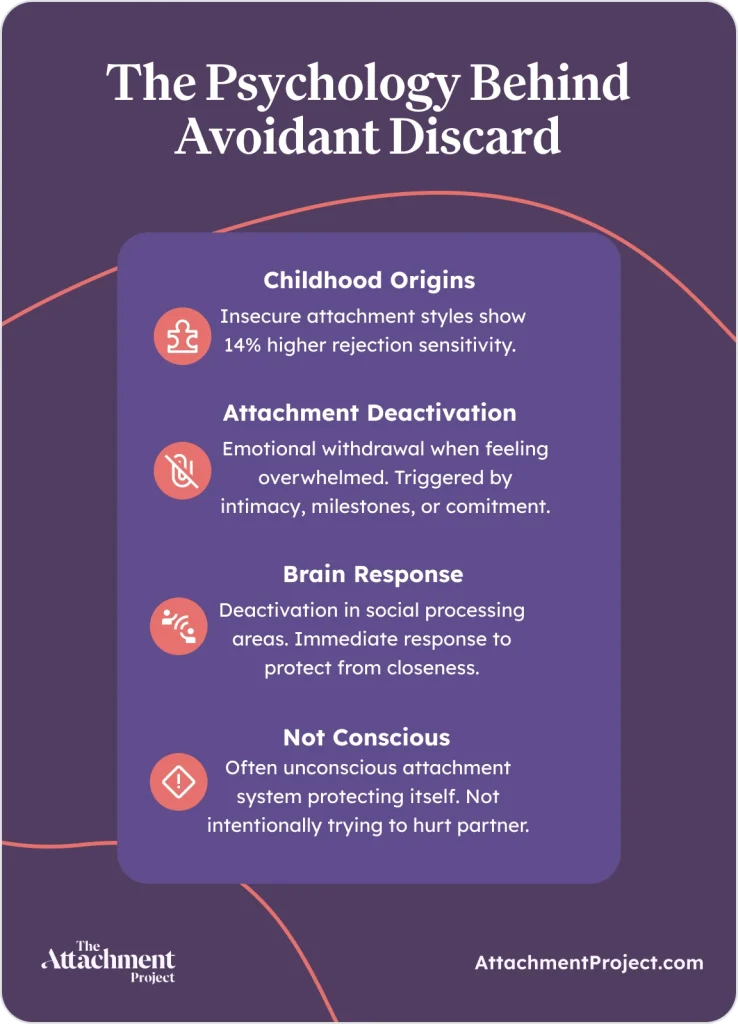
One brain study found that in fearful avoidant attachment styles, the brain’s immediate response to attachment triggers is closer to a dismissive avoidant attachment style than an anxious attachment style (even though the fearful avoidant style usually has characteristics of both)6. This might explain why people with a fearful avoidant attachment style could engage in an avoidant discard first, only to then feel confused and uncertain about their decision. The separation could trigger their relationship anxiety, leading them to make emotional attempts at reconciliation that characterize the “push and pull” approach.
The fact that we can see these processes in the brain should remind us that the avoidant discard isn’t necessarily a conscious process. These actions are often labelled as cruel and senseless, and while this might make us feel better, they are often the result of a person’s deeply ingrained attachment system trying to protect itself – not an attempt to hurt somebody they care about.
Why Do Avoidants Discard When Things Are Going Well?
Avoidant discards can happen when you least expect it to. This process may seem counterintuitive – why would avoidants discard when things are going well?
It’s precisely this relationship success that drives someone with an avoidant attachment style away. Their internal working model says that others can’t be trusted and emotions should be suppressed, so feeling dependent on another person can trigger their attachment system to pull away.
Real life examples of attachment triggers might be milestones like moving in together, deciding to be exclusive, or meeting friends and family. While people low on avoidance might feel greater security and intimacy after these events, people high on avoidance might feel nervous and afraid.
START HEALING AVOIDANT ATTACHMENT
People with high avoidance might also experience the approach-avoidance dilemma: it’s not necessarily that they don’t want a relationship with you, and they might still make efforts to maintain it, but at the same time their attachment system is telling them it’s time to back away. Unfortunately, this can make it all the more confusing – their attempts to maintain the relationship can come across as false, or, if they seem to be genuine, then their withdrawal can be even more unpredictable and baffling.
Can an Avoidant Fight the Discard Impulse?
It can be difficult to recognize attachment processes if you’re not aware of them. However, if someone with an avoidant attachment style learns about attachment processes and understands more about what drives their urge to discard, then they might be able to find other ways of coping with their needs.
This might look like developing a way to communicate that they need space when they feel overwhelmed by the relationship, or finding a way to focus on another area of their life for a time without sacrificing their relationship too. Communication and boundaries are important for both of you here – while you want them to move at a pace they’re comfortable with, you shouldn’t feel you have to suffer to accommodate their needs. It’s important to find a solution that works for both of you.
In general, any work towards becoming more secure could help to lessen the intensity of discard urges. This tends to happen naturally with time and positive relationship experiences, but learning more about attachment and developing healthy relationships could help to speed up the process7.
“Why Does This Hurt So Much?” The Emotional Impact of Being Discarded
All breakups have the potential to be highly distressing, but being on the receiving end of avoidant discard can be especially distressing because of the intense confusion. People who’ve been through an avoidant discard say that they’re so devastated that they find it hard to recognize themselves, with one forum user commenting: “I went from an energetic person too [sic] a complete emotional wreck.”
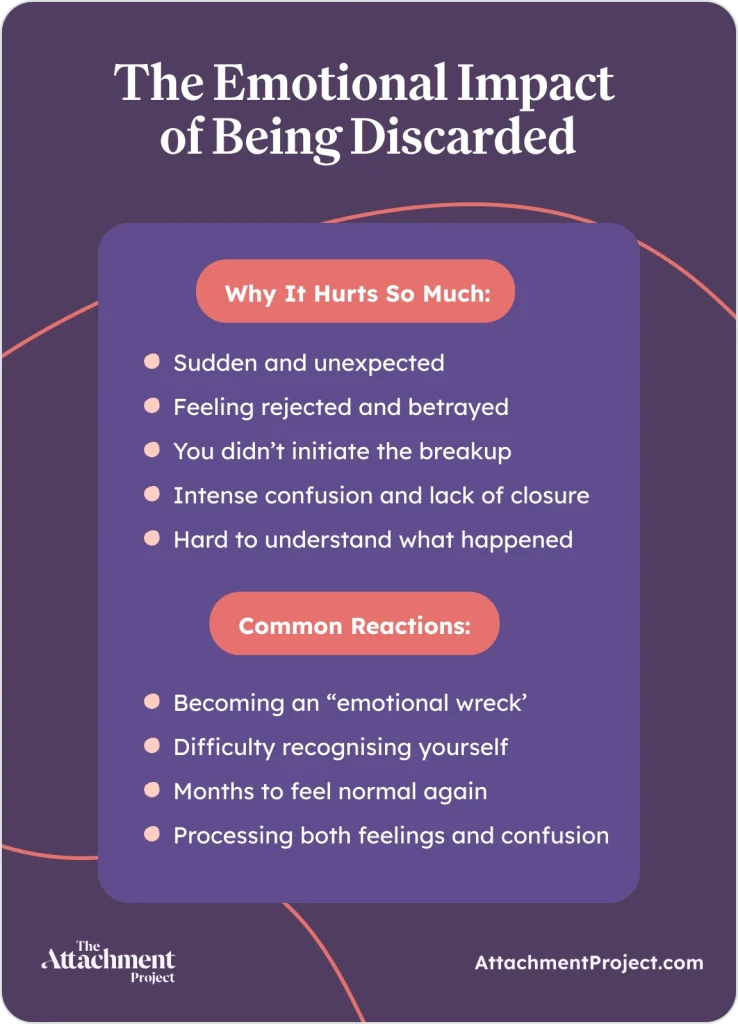
While somebody in the midst of an avoidant discard might be feeling extreme emotions, this is a normal response to a very distressing event. Studies show that the highest distress following a breakup happens when it’s sudden, when we feel rejected and betrayed, and when we didn’t initiate the breakup – all of which are likely to be true in an avoidant discard8.
The confusion and lack of closure in an avoidant discard breakup complicates our emotional reaction – as well as processing our feelings, we can have a hard time understanding what happened and why it happened in the first place.
How to Heal from Avoidant Discard
Healing from a painful and confusing breakup can take a long time – everybody’s different, but many people report that it takes months to feel themselves again. You’re already learning more about attachment theory and what might have been behind your breakup, and this is a great start to understanding what might have happened.
START YOUR HEALTHY DATING JOURNEY
You might need to consider boundaries around contact with this person, especially if they’re displaying the push-pull behavior associated with a fearful-avoidant attachment style. To improve your emotional regulation and practice self care while healing from avoidant discard, there are a few things you can try:
- Mindfulness – yes, mindfulness really does help with emotional regulation9. Start with small and manageable tutorials – a little practice is better than none at all.
- Journaling about your emotions – one study found that journaling about your feelings helps you to focus on the positive sides of a painful experience10.
- Cognitive reframing – if you’re struggling with rumination or intrusive thoughts, a cognitive reframing therapy such as CBT could help you to change your thoughts and feelings about what happened11.
Even though it might feel like an impossible hill to climb, with time and self-compassion, healing is possible. It’s normal for this process to take longer than you might expect, and it doesn’t necessarily happen in a linear fashion – some days will be worse than the day before, and that’s okay.

Should You Give an Avoidant Who Discarded You Another Chance?
If your ex avoidant partner comes back to you after an avoidant discard, it’s important to make the right decision for you. It might feel exciting, relieving, or upsetting, but try not to let your emotions do the decision-making.
Consider whether things could reasonably be different this time – have you both learned more about yourself and what happened, and have you both learned from the experience? Do you both feel ready to be vulnerable and intimate again, or do you need more time to heal and learn more about your attachment behaviors?
Rushing back into a relationship, showing unwillingness to learn, and a lack of awareness around what happened might be red flags that you’re not ready to resume the relationship. However, if you both are willing to learn, set boundaries, and communicate, there’s no reason why you couldn’t heal from the avoidant discard together.
Whether or not you choose to reconcile, growth and healing from avoidant discard is possible – it just takes time and understanding.
Conclusion
Avoidant discard is a painful and confusing experience – unlike a normal breakup, it can come suddenly and when you least expect it. It can seem cruel and unfair, but it’s not necessarily intentional – it’s driven by avoidant attachment behaviors, which the person discarding might not be aware of. They likely feel confused too, but they may have emotionally withdrawn from the relationship already.
Even though it hurts now, healing from this experience can lead to growth and more fulfilling relationships in the future. Healing starts with emotional balance and understanding – start your journey with our Emotional & Self Growth Course.
START YOUR ATTACHMENT HEALING JOURNEY
FAQs About Avoidant Discard
Why does it seem so easy for avoidants to walk away from relationships?
When an avoidant attachment system shuts down, they emotionally withdraw from the relationship. This can make it seem like they don’t care, even if they really do.
Is my ex consciously trying to hurt me with avoidant discard, or is it unconscious?
Avoidant discard isn’t necessarily intentionally hurtful – it’s an attachment-driven process that compels someone to back away from relationships that feel too close for comfort.
Why is avoidant discard so painful?
Avoidant discards can be the most painful types of breakup, because they’re sudden and can make us feel rejected or betrayed. The additional element of confusion can make them difficult to understand, adding an extra layer of complication to the healing process.
How can I tell if this was a normal breakup or an avoidant discard?
While a normal breakup is usually a gradual build up of conflict and communication difficulties, avoidant discards can seem like they come out of nowhere. They often happen after an attachment trigger like a commitment or milestone, like moving in together.
Can avoidants ever change their pattern of discarding partners?
By learning more about their attachment style and what drives their behaviors, people with avoidant attachment styles can change their pattern of discarding partners.
References
- Mickelson KD, Kessler RC, Shaver PR. Adult attachment in a nationally representative sample. Journal of personality and social psychology. 1997 Nov;73(5):1092.
- Paetzold RL, Rholes WS, Kohn JL. Disorganized attachment in adulthood: Theory, measurement, and implications for romantic relationships. Review of General Psychology. 2015 Jun;19(2):146-56.
- Simpson JA, Rholes WS. Fearful-avoidance, disorganization, and multiple working models: Some directions for future theory and research. Attachment & Human Development. 2002 Sep 1;4(2):223-9.
- Chambers JE, Perkins SM, Mosesso KM, Ahdoot A, Arnaudo CL, Chambers RA. Adverse childhood experiences, insecure attachment, and appointment compliance in an outpatient addiction psychiatry treatment population. The American Journal on Addictions. 2025 May;34(3):334-41.
- Perlini C, Bellani M, Rossetti MG, Zovetti N, Rossin G, Bressi C, Brambilla P. Disentangle the neural correlates of attachment style in healthy individuals. Epidemiology and psychiatric sciences. 2019 Aug;28(4):371-5.
- Dan O, Zreik G, Raz S. The relationship between individuals with fearful-avoidant adult attachment orientation and early neural responses to emotional content: An event-related potentials (ERPs) study. Neuropsychology. 2020 Feb;34(2):155.
- Hudson NW, Fraley RC. Moving toward greater security: The effects of repeatedly priming attachment security and anxiety. Journal of Research in Personality. 2018 Jun 1;74:147-57.
- Field T, Diego M, Pelaez M, Deeds O, Delgado J. Breakup distress in university students. Adolescence. 2009 Dec 1;44(176).
- Roemer L, Williston SK, Rollins LG. Mindfulness and emotion regulation. Current Opinion in Psychology. 2015 Jun 1;3:52-7.
- Ullrich PM, Lutgendorf SK. Journaling about stressful events: Effects of cognitive processing and emotional expression. Annals of behavioral medicine. 2002 Aug;24(3):244-50.
- Krisnamurthi PB, Hanum L. The effectiveness of online group cognitive and behavioral therapy on self-esteem and forgiveness in young adult women after romantic relationship break up. InInternational Conference on Psychological Studies (ICPSYCHE 2020) 2021 Apr 24 (pp. 38-45). Atlantis Press.
Related Articles

Tips for Managing ADHD for Insecure Attachers
13 May 2022
Discover a number of powerful strategies to manage ADHD symptoms efficiently. Our tips in this blog post are designed specifically for people with insecure attachment.

What Is Anxious Ambivalent Attachment and What Causes It?
25 May 2021
Anxious ambivalent attachment typically develops in children whose caregiver may have acted nurturing and responsive one minute and unavailable or insensitive the next.

Adoption and Attachment: Forming a Secure Bond With Your Adopted Child
12 Nov 2022
Adoption gives children a second chance. Find out how adoption impacts attachment and what adoptive caregivers can do to help their child forge a secure bond.
 Get mental health tips straight to your inbox


