









Fearful Avoidant vs Dismissive Avoidant: Key Differences and Similarities

Published on August 19, 2025 Updated on March 2, 2026
The more you learn about attachment styles, the more confusing they can seem – particularly when we introduce lots of different names like “fearful avoidant” and “dismissive avoidant”. Fearful avoidant and dismissive avoidant are two distinct attachment styles, but they do share similar traits. If you know you have avoidant traits but aren’t sure which of these attachment styles makes the most sense for you, this article will help you to learn which is which.
Understanding whether your avoidance is fearful or dismissive can help you to learn about your behavior in relationships and move closer to a secure attachment style – but first, you need to know the difference!
To help clear up any confusion between dismissive avoidant vs fearful avoidant attachment, this article discusses the key characteristics of each, including how they’re similar and different.
DISCOVER YOUR ATTACHMENT STYLE
Key Characteristics of Dismissive Avoidant Attachment
The dismissive avoidant attachment style is an adult attachment style aligned with the avoidant attachment style in childhood – this is why you might see them used interchangeably1.
When caregivers consistently fail to meet an infant’s needs, the child learns that they can’t rely on others. They develop an internal working model, which works like a template, that says self-sufficiency is necessary and shutting down their attachment system is the best way to maintain relationships.

As adults, people with the dismissive avoidant attachment style in relationships can retain this internal working model. When this happens, they tend to be uncomfortable with emotional intimacy and withdraw from other peoples’ attempts at closeness.
There is a misconception that people with dismissive avoidant attachment don’t want love; they do. However, they’re also deeply fearful of being rejected and hurt, so they often create impassable boundaries for others.
The following are the key characteristics of dismissive avoidant attachment.
Characteristics of Dismissive Avoidant Attachment
People with a dismissive avoidant attachment style score highly on relationship avoidance, but low on relationships anxiety. This can manifest as:
- Intense fear of rejection by loved ones.
- Innate distrust of other people.
- Strong desire for independence and self-reliance.
- Difficulties turning to others for support during times of need.
- High self-view but low view of others.
- Avoidance of emotional closeness, intimacy, and conflict.
- Denial of, or dissociation from, uncomfortable emotions.
- High sensitivity to criticism – even constructive.
- Emotional dysregulation issues when triggered, such as avoidance, denial of emotions, and withdrawal.
- Dismissing of emotional displays from others – regardless of whether these displays are positive or negative in nature.
- Preference for short-term over long-term relationships.
- Surface-level disclosures of information – even in mature relationships.
Key Characteristics of Fearful Avoidant Attachment
Adults with the fearful avoidant attachment style score highly on both relationship avoidance and relationship anxiety. They might use both attachment strategies, engaging in a “push-pull” when it comes to relationships.
One school of thought says that fearful avoidant attachment styles arise from disorganized childhood attachment styles, which are characterized by fear of the caregiver. However, it’s a common misconception that this theory is a known fact; social psychologists actually argue strongly against it2. While fearful avoidance has been linked to parental neglect, disorganization in attachment styles can also be thought of as its own construct.

Disorganized vs Fearful Avoidant Attachment Style
In the development of disorganized attachment styles, caregivers are perceived as a source of fear. This leads infants to react to their presence in confused and unpredictable ways, as the person they rely on is also a danger3.
Rather than existing as its own attachment style, disorganized infants tend to exhibit one of the organized attachment styles except when in their caregiver’s presence. As adults, disorganization in childhood attachment can manifest as confused, interrupted, or nonsensical speech when recounting difficult childhood experiences3.
Therefore, it’s argued that disorganization can exist alongside the organized attachment styles. Having a disorganized attachment system doesn’t necessarily mean you also have a fearful avoidant attachment style, even though they both correlate with adverse parental relationships.
Characteristics of Fearful Avoidant Attachment
When someone scores highly on both avoidance and anxiety in relationships, it can manifest in the following ways:
- Inconsistent, push-pull patterns of behaviors in relationships.
- Simultaneously desiring and intensely fearing emotional closeness and intimacy with others.
- Extreme difficulties trusting others.
- Significant fears of abandonment.
- Negative view of self and others.
- Emotional regulation difficulties, including extreme outbursts of emotions.
- Alternating between over-disclosures of emotional information and withdrawal.
Fearful Avoidant vs. Dismissive Avoidant: A Direct Comparison
Both fearful avoidant and dismissive avoidant are forms of insecure attachment. Although they share some common traits, let’s take a closer look at fearful vs dismissive avoidance.
Similarities Between Fearful Avoidant and Dismissive Avoidant Attachment Styles
First up, fearful avoidant and dismissive avoidant attachment styles are similar because they are both insecure avoidant forms of attachment. Both are associated with difficulty trusting others and processing emotions, and both are linked with difficulties maintaining healthy relationships.
Neural studies have found that the brain’s responses to emotional cues are similar between fearful avoidance and dismissive avoidant attachment styles, but not anxious attachment styles – suggesting that avoidance dominates the initial emotional response in fearful avoidant attachment4. For a deeper look at how these styles differ, see our comparison of anxious vs avoidant attachment.
The following table demonstrates the similarities between fearful avoidant and dismissive avoidant attachment:
- Struggle with emotional closeness and intimacy
- Avoid vulnerability
- Find emotional dependence difficult
- Distrust others
- Experience emotional dysregulation
- Engage in self-protective behaviors to avoid getting hurt
- Fear commitment
- Struggle to maintain stable relationships
- Avoid conflict
Now that we’ve covered the similarities, it’s important to discuss how the fearful avoidant and dismissive avoidant attachment styles differ as this awareness can enhance understanding of how to approach healing from attachment trauma.
Differences Between Fearful Avoidant and Dismissive Avoidant Attachment Styles
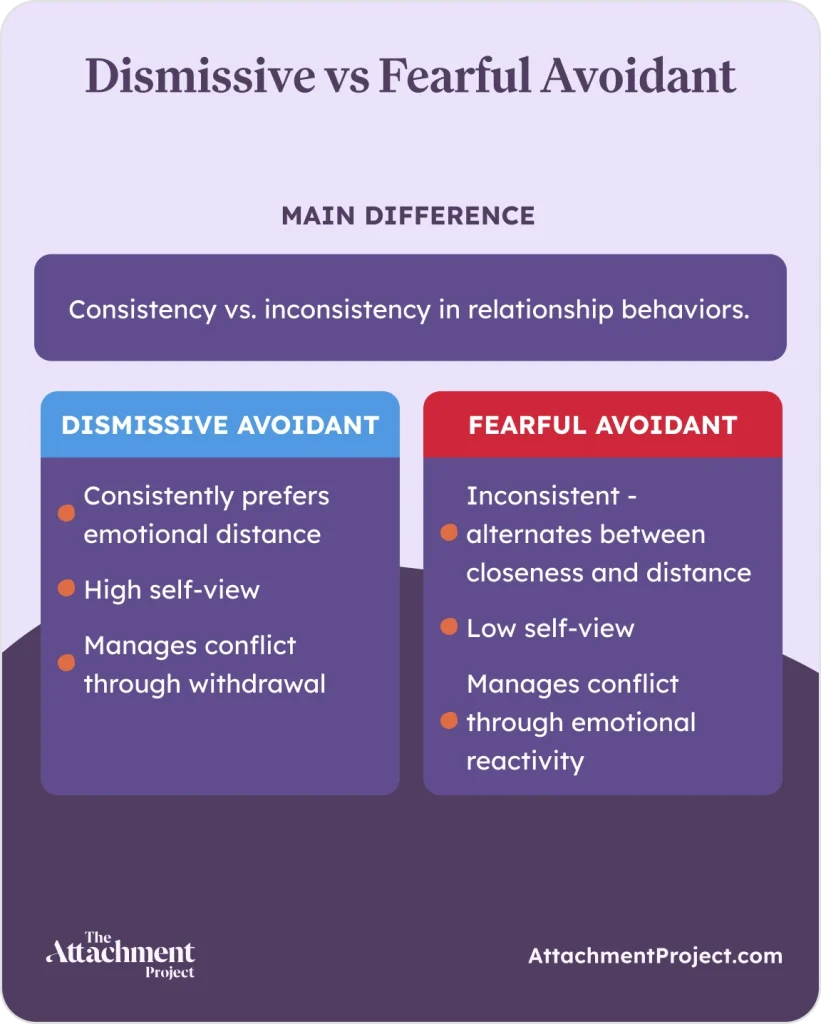
The following table covers the differences between fearful avoidant vs dismissive avoidant attachment.
| Fearful Avoidant Attachment… | Dismissive Avoidant Attachment… |
|---|---|
| May develop from confusion and fear around the caregiver | Develops from unmet needs in infancy |
| Has a core fear of both intimacy and rejection | Has a core fear of dependence and vulnerability |
| Craves closeness, but fear being hurt | Prefers to maintain emotional distance |
| Has low self-esteem and self-worth | Has a high view of the self |
| Includes inconsistent behaviors in relationships, pushing for both intimacy and detachment | Consistently prefers emotional detachment and self-reliance |
| Has emotion dysregulation in the form of outbursts or volatility | Has emotional dysregulation in the form of withdrawal (but may have outbursts when coping systems are overwhelmed) |
| Manages conflict through emotional reactivity | Manages conflict through detachment and withdrawal |
In a nutshell, the main defining difference between fearful avoidant vs dismissive attachment is consistency. People with dismissive attachment tend to be consistently emotionally detached, self-reliant, and independent. In contrast, the fearful avoidant attachment style is marked by inconsistency, shifting between avoidance and anxiety in relationships.
It’s important to know these differences when considering how to cope with your attachment style, as approaches designed to manage the dismissive avoidant attachment style may trigger the fearful avoidant style – and vice versa.
DISCOVER YOUR ATTACHMENT STYLE
Can a Fearful Avoidant and Dismissive Avoidant Be Together?
The only thing preventing a fearful avoidant and dismissive avoidant relationship from being successful is each persons’ willingness to accept the other’s boundaries, evolve in personal awareness, and accept love.
Like in any relationship, there can be challenges – they just might be more likely to look a certain way in a fearful avoidant and dismissive avoidant relationship. One major setback may come from how each style handles communication and conflict: the dismissive avoidant attachment style is associated with perceiving conflict as a form of criticism, so people with this style tend to react poorly and withdraw from potential conflict. This withdrawal could trigger anxiety in the fearful avoidant attachment style, leading them to display strong emotions and struggle to give the dismissive avoidant partner space.
Let’s discuss more potential challenges in fearful avoidant and dismissive avoidant relationships.
Challenges in Fearful Avoidant and Dismissive Avoidant Relationships
As mentioned, it is possible to successfully manage a fearful avoidant and dismissive avoidant relationship, especially if both partners understand where the other is coming from in terms of needs for validation and space.
However, as with any insecure-insecure attachment relationship, a fearful avoidant and dismissive avoidant combination may present certain challenges. Having an awareness of these challenges can help people in such relationships to make sense of the dynamics and work together for better outcomes.
To begin with, the clash between fearful avoidant inconsistency and dismissive avoidant consistency can be demanding. Fearful avoidant attachment styles can alternate between pushing for closeness and withdrawing, potentially creating confusion and emotional exhaustion for the dismissive avoidant partner.
In contrast, dismissive avoidant attachment styles tend to require emotional space. This could result in emotionally dysregulated responses from a fearful avoidant partner as they require validation that they’re loved and supported. Therefore, each style could become triggered by the other.
Both individuals within such a relationship dynamic may struggle with communication issues. A fearful avoidant partner might send mixed messages, fitting with their conflicting needs for space and closeness. Yet a dismissive avoidant partner typically struggles to identify and express their emotional needs, so may not communicate them at all.
Another major issue in the relationship could be how both fearful avoidant and dismissive avoidant partners struggle to trust others. Both likely experienced ruptures to their attachment bonds when young, so were taught that the people closest to them would let them down.
How to Manage Fearful Avoidant and Dismissive Avoidant Relationships
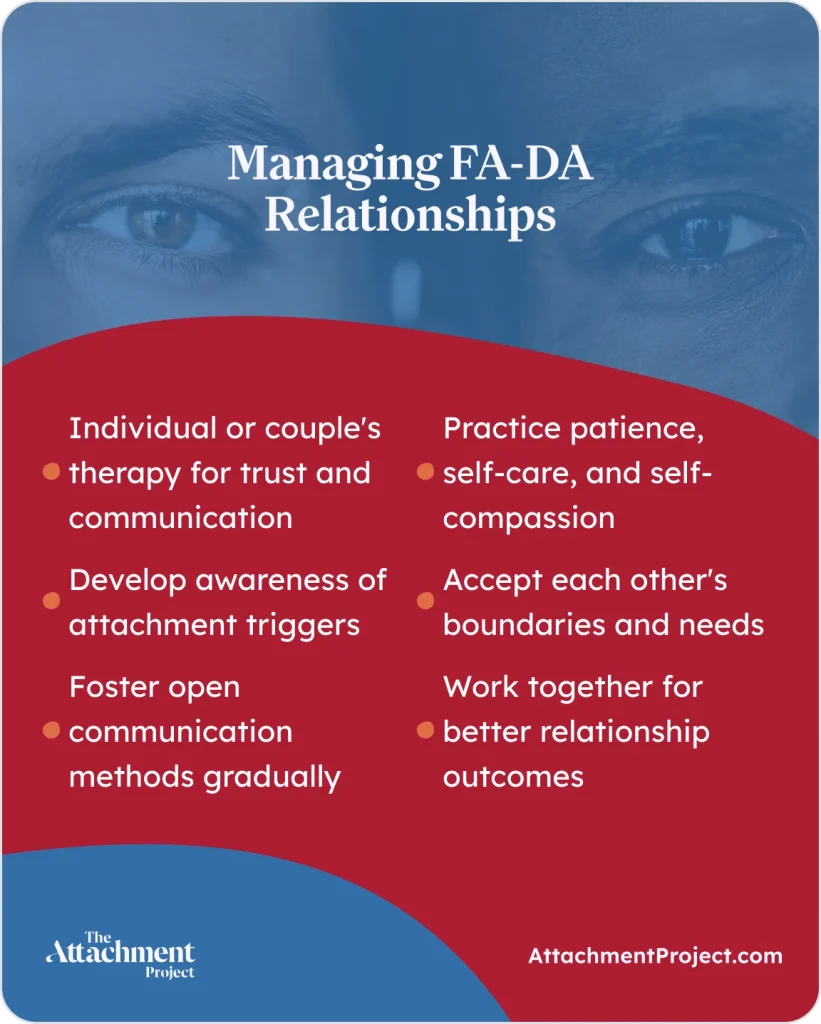
To support a long-term, stable, and fulfilling relationship, it’s important that the issues discussed are resolved in ways that suit both partners. This might include:
- Individual or couple’s therapy to learn how to trust, get needs met in healthy ways, and repair self-concepts.
- Developing further awareness of attachment styles, including how they develop and their triggers.
- Fostering more open methods of communication – perhaps building up to more in-depth disclosures over time.
- Patience, self-care, and self-compassion.
Understanding Your Own Avoidant Type
Recognizing whether you lean more toward fearful or dismissive avoidance can be crucial for your personal growth and relationship success. Here are some key questions to consider:
Self-Assessment Questions
- Consistency vs. Inconsistency: Do you consistently prefer distance in relationships, or do you fluctuate between wanting closeness and pulling away?
- Self-View: Do you generally think highly of yourself but lowly of others (dismissive), or do you have a negative view of both yourself and others (fearful)?
- Emotional Expression: Do you typically withdraw when emotions run high, or do you sometimes have emotional outbursts followed by withdrawal?
- Relationship Anxiety: Do you worry about being abandoned or rejected, or do you mainly focus on maintaining your independence?
- Intimacy Desires: Do you generally prefer to keep relationships surface-level, or do you sometimes crave deep connection despite your fears?
Why It Matters
Understanding your specific avoidant type is important because:
- Treatment approaches differ: Fearful avoidants may benefit from anxiety management techniques, while dismissive avoidants might need to focus on emotional awareness
- Relationship strategies vary: Partners need different approaches to support fearful vs. dismissive avoidant individuals
- Self-compassion requires accuracy: Understanding your patterns helps you respond to yourself with appropriate kindness rather than judgment
- Growth paths are unique: Your journey toward security will look different depending on your starting point
Moving Toward Security
Regardless of whether you identify as fearful or dismissive avoidant, movement toward earned security is possible. Here are some general strategies:
For Fearful Avoidants
- Practice emotional regulation: Learn techniques to manage intense emotions without pushing others away
- Work on self-worth: Address negative self-concepts that fuel the push-pull dynamic
- Communicate your needs: Practice expressing your need for both closeness and space clearly
- Challenge catastrophic thinking: Question assumptions about inevitable rejection or abandonment
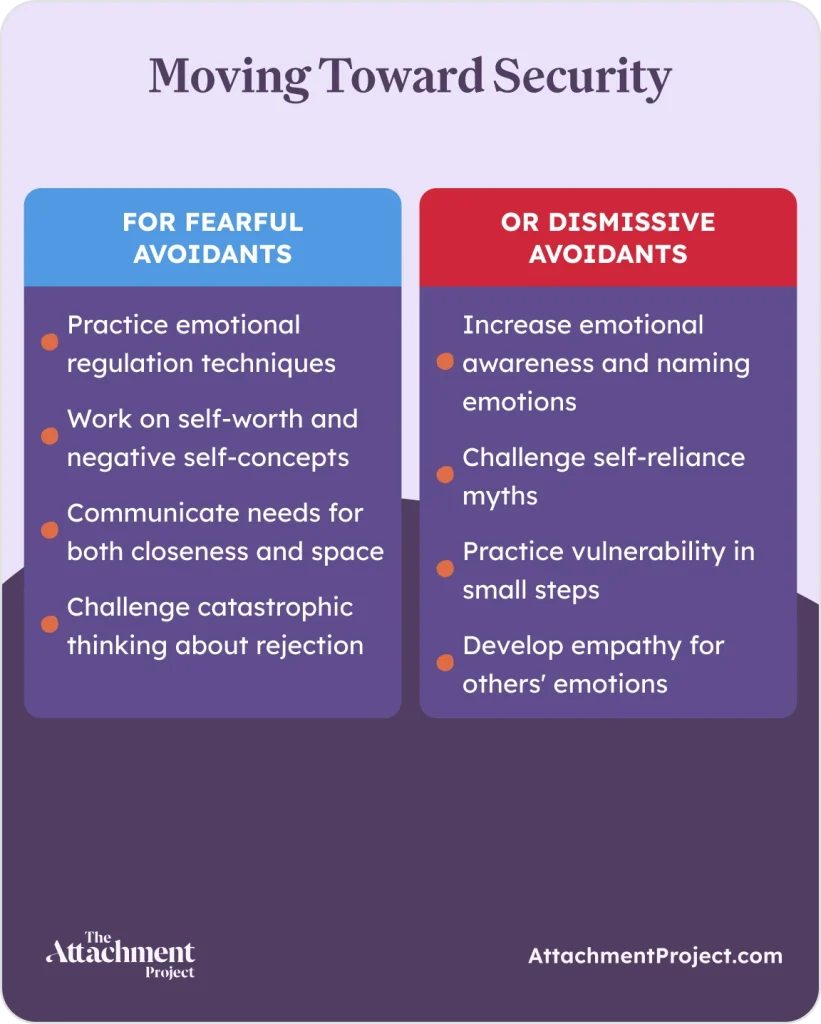
For Dismissive Avoidants
- Increase emotional awareness: Practice identifying and naming your emotions
- Challenge self-reliance myths: Explore the benefits of healthy interdependence
- Practice vulnerability in small steps: Gradually increase emotional openness with trusted individuals
- Develop empathy: Work on understanding and validating others’ emotional experiences
TAKE A LOOK AT THE AVOIDANT ATTACHMENT WORKBOOK
Final Words on Fearful Avoidant vs Dismissive Avoidant Attachment
Both fearful avoidant and dismissive avoidant attachment are high on the spectrum of avoidance, therefore, they share similar traits. However, their differing experiences of relationship anxiety result in different manifestations in relationships.
Namely, the fearful avoidant style is associated with inconsistent behaviors, alternating between searching for closeness and pulling away, while the avoidant dismissive style is consistently associated with withdrawal from intimacy.
The distinct differences between how both of these styles express their needs can lead to challenges in fearful avoidant-dismissive avoidant relationships. However, both individuals could also relate to the other’s need for emotional space. With an understanding of each others’ needs, traits, and willingness to work towards a stable relationship, there’s no reason why a fearful avoidant-dismissive relationship shouldn’t work.
Understanding these differences isn’t just academic—it’s practical information that can transform how you approach relationships, self-care, and personal growth. Whether you’re working to understand yourself better or trying to support a partner with an avoidant attachment style, recognizing the nuances between fearful and dismissive avoidance is a crucial step toward building healthier, more secure relationships.
Frequently Asked Questions About Fearful vs Dismissive Avoidant Attachment
Can someone have both fearful and dismissive avoidant traits?
While attachment styles exist on a spectrum, most people lean more heavily toward one style. However, you might recognize some traits from both styles, especially during different life phases or stress levels. The key is identifying which pattern is more dominant in your relationships.
How do I know if I’m fearful avoidant or just anxious attachment?
The key difference is in avoidance behaviors. Anxious attachment typically involves pursuing connection despite fears, while fearful avoidant involves both pursuing and avoiding connection. If you find yourself pulling away when relationships get too close, you may be fearful avoidant rather than purely anxious.
Can dismissive avoidants become fearful avoidant after trauma?
Attachment styles can shift due to significant life experiences, including trauma or highly negative relationship experiences. A dismissive avoidant might develop more anxiety around relationships, potentially moving toward a more fearful avoidant pattern, though this typically requires professional support to address.
Do fearful avoidants and dismissive avoidants attract each other?
These pairings can occur because both styles may initially feel comfortable with the emotional distance the other provides. However, over time, the fearful avoidant’s need for closeness may clash with the dismissive avoidant’s consistent need for space, creating relationship challenges.
Which avoidant style is more likely to seek therapy?
Fearful avoidants may be more likely to seek therapy due to their higher relationship anxiety and the distress caused by their push-pull patterns. Dismissive avoidants might be less likely to seek help unless external pressures (like relationship ultimatums) motivate them to change.
How long does it take to move from avoidant to secure attachment?
The timeline varies greatly depending on individual factors, including trauma history, current support systems, and commitment to change. With consistent effort and often professional support, people can begin seeing changes within months, though developing earned security is typically a years-long process.
Can medication help with avoidant attachment styles?
While there’s no medication specifically for attachment styles, some people may benefit from medication for co-occurring conditions like anxiety or depression. However, therapy and relationship work are typically the primary treatments for developing more secure attachment patterns.
References
- Wardecker BM, Chopik WJ, Moors AC, Edelstein RS. Avoidant attachment style. InEncyclopedia of personality and individual differences 2020 Apr 22 (pp. 345-351). Springer International Publishing.
- Paetzold RL, Rholes WS, Kohn JL. Disorganized attachment in adulthood: Theory, measurement, and implications for romantic relationships. Review of General Psychology. 2015 Jun;19(2):146-56.
- Simpson JA, Rholes WS. Fearful-avoidance, disorganization, and multiple working models: Some directions for future theory and research. Attachment & Human Development. 2002 Sep 1;4(2):223-9.
- Dan O, Zreik G, Raz S. The relationship between individuals with fearful-avoidant adult attachment orientation and early neural responses to emotional content: An event-related potentials (ERPs) study. Neuropsychology. 2020 Feb;34(2):155.
- Mizrahi D, Laufer I, Zuckerman I. Attachment Style, Task Difficulty, and Feedback Type: Effects on Cognitive Load. Behavioral Sciences. 2025 Mar 27;15(4):427.
Related Articles
Giving Up Ghosting: How to Avoid Ghosting Others
27 Jan 2023
In the age of technology, ghosting is becoming more frequent. But it is a painful and confusing experience for anyone on the receiving end. Find out how to avoid ghosting others.

Jealousy in Relationships: Do Attachment Styles Matter?
12 Dec 2021
We explore how attachment styles are related to the experience and expression of jealousy in relationships.

Valentine's Day Anxiety: Don't Let Love Get You Down
11 Feb 2022
This year, don't let expectations, comparisons, and self-doubt get you down. Follow these simple tips to prevent getting stressed out, worried, or lonely.
 Get mental health tips straight to your inbox


