









Post Date 8: Questions You Should Ask Yourself After a Date
Published on October 17, 2025 Updated on December 9, 2025
When first dates go well, it’s easy to get caught up in the rush of excitement about this new person’s potential role in our lives – so much so that we often ignore our gut feelings or bypass red flags. Today, we’re exploring what to do after a first date to deeply understand and evaluate your experience.
The Post Date 8 is a checklist of after-date questions designed by dating expert and behavioral scientist Logan Ury. The Post Date 8 helps you to self-reflect and become more aware of your emotions, physical feelings, and genuine interest after a first date. Combined with understanding which attachment style you have, this can be a great way to select and understand potential partners going forward.
START YOUR HEALTHY DATING JOURNEY
What to do After a First Date?
The most important initial step after a first date is to check-in with yourself. It may be tempting to get caught up in the spark, or brood about the lack of, but remember that your attachment style can influence how you interpret a date and how you feel in the aftermath.
The Attachment Project’s Dating Toolkit is an excellent tool for reflecting after your first dates, as well as for preparing yourself for future dates based on your attachment style. If you want a comprehensive workbook that could enhance your dating skills, this is it.
So, you’re wondering what to do after a first date, and how to tune into how you’re feeling straight afterward. Ask yourself questions like:
- How am I feeling at this moment?
- How does my body feel?
- Are there any areas of tension in my body?
- Do I feel relieved that it’s over or excited about how it went?
A good way to answer these is by free-writing or journaling about your feelings, meaning that you allow your emotions to guide your words rather than overthinking them.
Post Date 8 Questions
Ury’s Post Date 8 helps you to evaluate your honest feelings after a date. This can be helpful if you’re prone to getting head over heels too fast, or if you tend to focus on compatibility “on paper” over connection. This can be things like appearance, income, and education level.

Sometimes these dating strategies do work well, but if you’re running into problems because of them, the Post Date 8 can help you to consider what you and your date bring out of each other. These variables include how the other person makes you feel, the character traits they bring out in you, and whether they share the same goals and values as you.
Without further ado, here are the 8 questions to ask yourself after a date:
Q1. What Side of Me Did They Bring Out?
We all have different facets to our personalities that tend to show in varying amounts depending on the unique situation at hand. Studies have proven that our personality traits fluctuate based on our situation and environment, and sometimes we act in ways that complement or adapt to the behavior of the people around us1, 2. You’ve probably noticed this before in situations where certain people make you feel extra bubbly, focused, or contemplative.
After your date, think about the side of yourself that showed most often and how this person helped to draw it out. For example, did their sense of humor help to bring out the fun side of your personality? Or, alternatively, did their introversion bring out the more serious side of you?
Most importantly, did you like the side of you that they brought out? Did they bring out traits that you enjoy and encourage in yourself, or did they bring out a side of you that you’d prefer to work on?
Q2. How Did My Body Feel During the Date?
Whether it’s from excitement, nerves, or self-doubt, it can be tough to accurately pinpoint what we’re feeling after a date. One helpful way of determining how you feel is to ask yourself how your body felt during the date.
Try to think back to whether you felt tense or relaxed. A little tension at first is to be expected, but did you ease up once you felt comfortable, or did you feel tense all the way through? Did you develop any other signs of tension like a headache or a stomach ache, or anything else you might experience when you feel stressed?
How does your body feel when you remember the date?
These physical sensations can give us clues to our emotions or intuitive feelings about our date. If we feel tense around somebody often, they may be doing or saying things that make us feel uncomfortable. Although situational factors like a crowded venue or illness can sometimes be behind a stressful first date, ideally we want to feel relaxed and safe in our date’s presence.
Q3. Do I Feel More Energized or Deenergized Than I Did Before the Date?
Consider whether this person made you feel more energized or whether they made you feel drained. The reason this question is important is because factors that make us feel energized are more likely to feel authentic to us, help us perform optimally, and bring out our personal strengths.
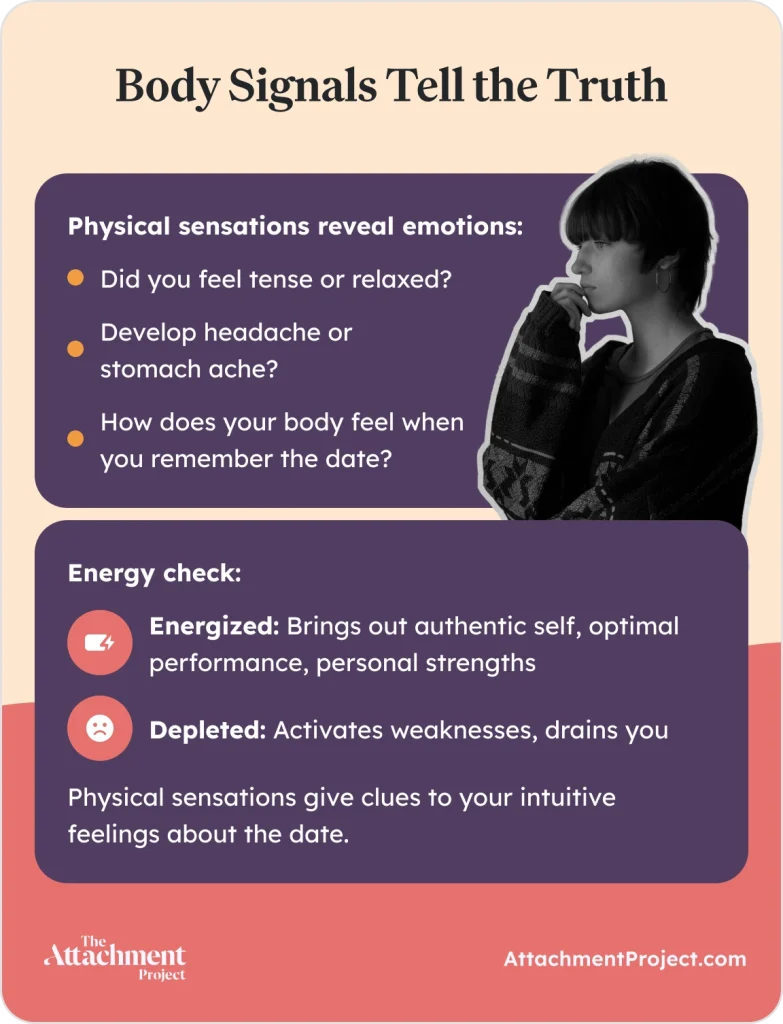
This question ties in to question one; what side of you did this person bring out? According to Linley’s theory of strengths, if this person helps to draw out your more positive features, you feel more energized3. However, if they bring out your weaknesses, they can make you feel depleted.
If you feel energized, it may be worth pursuing another date. However, if you feel depleted, it may be worth considering putting a full stop on the connection. It also might be worth considering your attachment style and how you presented yourself conversationally during the date; if you feel depleted, is it possible that your self-concept was driving you to spend energy questioning yourself and your dates intentions?
Untangling these factors can be difficult, but, again, your date should ideally make you feel secure, comfortable, and energized.
Q4. Is There Something About Them I’m Curious About?
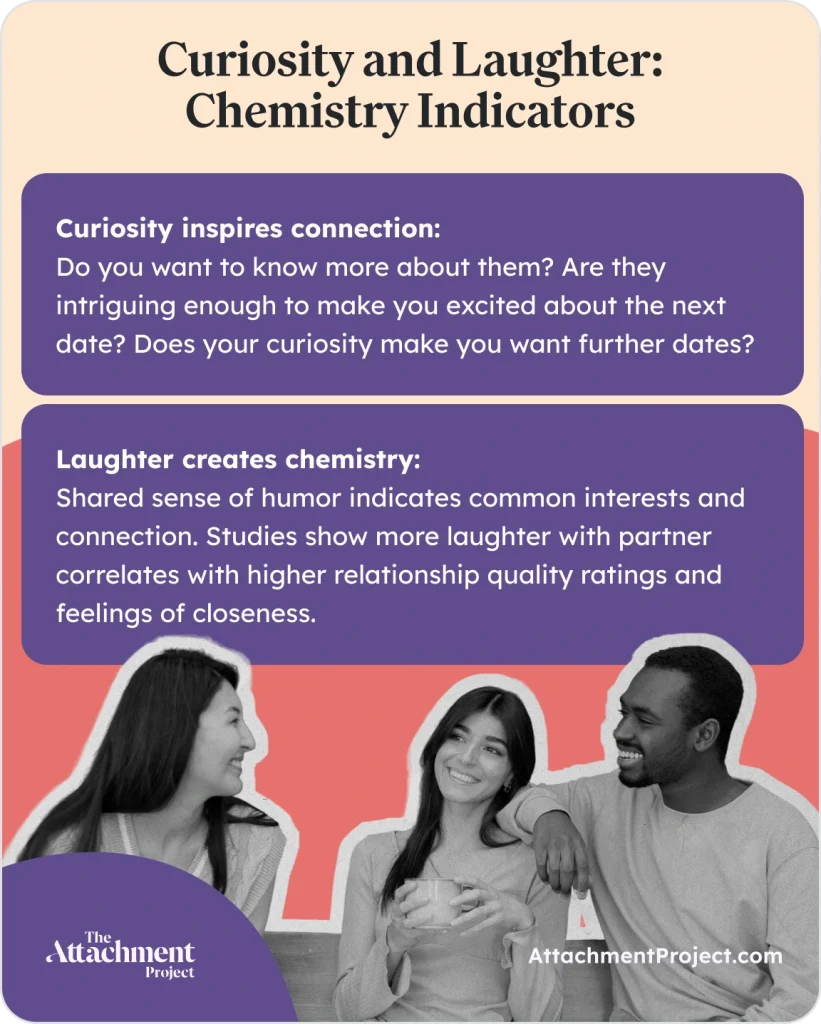
Curiosity inspires connection and compatibility. If we’re not curious about the other person, we won’t feel inspired to ask questions, and the chemistry is unlikely to kick in beyond surface level attraction.
In the aftermath of the date, ask yourself:
- Do I want to know more about this person?
- Are they intriguing enough to make me feel excited about the next date?
- Does my curiosity about them make me want to go on further dates?
Considering whether you feel a desire to know more about this person can let you know whether you have enough genuine interest in them to fuel a longer connection.
Q5. Did They Make Me Laugh?
Humor creates chemistry: a shared sense of humor indicates common interests, connection, and shared interests. What’s more, studies have found that the more we laugh with our partner, the higher we rate our relationship quality and feelings of closeness4.
It’s important that we spend our time with people we share lots of laughs with, and the first date can be an early indicator of this kind of compatibility.
Think about how often you laughed (including whether it was genuine laughter), what it was you laughed at, and whether this indicates that you were relaxed and comfortable in this person’s presence.
START YOUR HEALTHY DATING JOURNEY
Q6. Did I Feel Heard?
As much as it’s important to listen to your date, it’s equally (or potentially more) important to feel heard. Feeling heard means that you perceived that your ideas, opinions, and interests were received and acknowledged by your date.
Not feeling heard could potentially be a major red flag. Although nerves always have to be accounted for, if the other person dominated the conversation to the extent that you felt like background noise, there may not be any reason to continue the connection.
Consider whether the other person gave you the space to speak without interrupting. Did they seem interested when you were talking? Did you get the sense that they were trying to think of their own stories to tell in response to what you were saying instead of actively listening? Did they ask you questions about yourself and your opinions?
A truly successful conversation requires a balance between talking and listening. If your date didn’t show curiosity about you, then they may not be ready to pursue a deeper connection.
Q7. Did I Feel Attractive in Their Presence?
Feeling attractive isn’t always about appearance – it goes much deeper. Clearly, your own self-concept can come into play here, but if you feel attractive in your date’s presence, it is indicative of how they make you feel in general and whether there’s chemistry between you both.
When asking yourself if you felt attractive in their presence, take into account your sense of self-esteem in general. Self-esteem is how much we value, trust, and believe in ourselves. This level of belief in ourselves not only affects our decision-making abilities, mental health, and overall well-being, but also how we feel and act both during dates and afterward.
So, think about how confident you felt before the date; did your outfit make you feel confident? Did you trust in the fact that your date clearly finds you attractive enough to go out with in the first place? If the answer to questions such as these is “no,” then your own internal processes might be contributing to whether you felt attractive in their presence.
However, if your self-concept is typically balanced but you still didn’t feel attractive in your date’s presence, it may be the case that you’re not compatible with each other as they don’t make you feel relaxed and confident.
Q8. Did I Feel Captivated, Bored, or Something in Between?
Most first dates come with their fair share of ups and downs. There will inevitably be the odd awkward moment, there will be moments when you both click (hopefully), and there might be times when the conversation stumbles. But, on the whole, if you felt at least somewhat captivated by the other person, then there’s hope for a further connection.
If you’re interested in them, this is a good sign of chemistry. If you’re bored or disinterested, it goes without saying that there’s likely not much hope for future dates. Boredom suggests a lack of compatibility, but it’s also important to self reflect on how you feel. How was your mood before the date? Was a lack of interest due to internal processes or genuinely due to how well you and your date clicked?
Why Do Attachment Styles Affect How We Date?
An insecure attachment style often results from childhoods in which our emotional needs aren’t met. Many of us are aware of how this form of childhood can create a working model for relationships in adulthood, but it can also influence how we date – and how we reflect on dates in hindsight.
DISCOVER YOUR ATTACHMENT STYLE
A person with an insecure attachment style enters into the dating world with just that: insecurity. So, if you have an insecure attachment style, you may have doubts about yourself, your place in the world, and other people. This can impact your actions and how you evaluate a date – even if you’re unaware of it.
People with an insecure attachment style have higher sensitivity to being rejected, abandoned, or mistreated. This increased sensitivity may mean that you misinterpret the other person’s actions after a date, or project your own self-concept onto their intentions.

Having an insecure attachment style isn’t your fault, but what is within your control is how you reflect on your own thoughts, feelings, and actions, so that you can form a more accurate interpretation of how a date went.
Final Words on Reflecting on Dates in the Aftermath
As Aristotle said, “Knowing yourself is the beginning of all wisdom.” This quote applies to most of life’s circumstances, and it is perfectly fitting to your attitudes towards how well a date went. Being attuned to our wants, needs, and emotions is one of the most important factors in our search for suitable partners. So, asking yourself the questions in the Post Date 8 is a great way to attune to these factors.
At the end of the day, it may take more than one date to truly assess how you genuinely feel about another person – this is both normal and okay! First dates carry a lot of pressure for both parties, so it may take time for you both to relax enough into acting like yourselves. After each date, just remember to check in with yourself using the Post Date 8, answer the questions honestly, and act in ways that are respectful to yourself and the other person.
References
- Andresen PK, Schuurman NK, Hamaker EL. How to measure and model personality traits in everyday life: A qualitative analysis of 300 big five personality items. Journal of Research in Personality. 2024 Oct 1;112:104528.
- Alshamsi A, Pianesi F, Lepri B, Pentland A, Rahwan I. Beyond contagion: Reality mining reveals complex patterns of social influence. PloS one. 2015 Aug 27;10(8):e0135740.
- Linley PA, Woolston L, Biswas-Diener R. Strengths coaching with leaders. International Coaching Psychology Review. 2009 Mar 1;4(1).
- Kurtz LE, Algoe SB. Putting laughter in context: Shared laughter as behavioral indicator of relationship well‐being. Personal Relationships. 2015 Dec;22(4):573-90.
Related Articles

Avoidant Discard: Why Do People Suddenly End Great Relationships?
19 Jun 2025
Everything seemed to be heading in the right direction – your relationship was blossoming, you started to share more of your lives with each other, and you were even making future plans. Suddenly, out of nowhere, they pulled away and ended things without any apparent reason. This might have been a case of what the […]
6 Myths About Non-Monogamous Relationships
12 Apr 2022
Despite the rise in popularity, ENM relationships are still stigmatized and widely misunderstood. Read our article to discover more!

Insecure Attachment & Emotional Dysregulation in Relationships
18 Apr 2022
Discover how emotional dysregulation relates to insecure attachment and how it might affect your romantic relationships.
 Get mental health tips straight to your inbox


