









Roaching and Hardballing: Deception vs. Honesty in Modern Dating

You’ve been seeing each other for a few months now, and it’s going really well – you’ve deleted the apps, introduced them to your friends, and started talking about them with your family. You’re ready to commit to this person and you’re excited for the next step. Just when you think you’re ready, you find out something devastating: they’re still seeing other people, and they’ve been hiding it from you.
You’ve been roached.
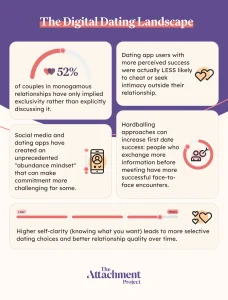
A recent study found that 52% of us in monogamous relationships have only implied exclusivity1. This leaves room for misunderstandings like the example above, where partners might be on two different pages about what is and isn’t okay. This is bound to happen when intentions and expectations are not clear, but a key component of roaching is the roacher’s intentional deception to keep you from finding out.
The gray areas in the beginning of a relationship are the perfect environment for confusion and miscommunication like this. This is why radical honesty in early dating stages, dubbed “hardballing” by dating coach and behavioral scientist Logan Ury, is rising in popularity.
These concepts may not be new, but their names arise as the digital world makes it easier to observe and discuss these common behaviors.
Keep reading to find out more about the meaning and signs of roaching (including how it differs from cheating, micro-cheating, ethical non-monogamy, or just casual dating), why people roach, and all about hardballing in dating.
START YOUR HEALTHY DATING JOURNEY
What is Roaching and How to Recognize It
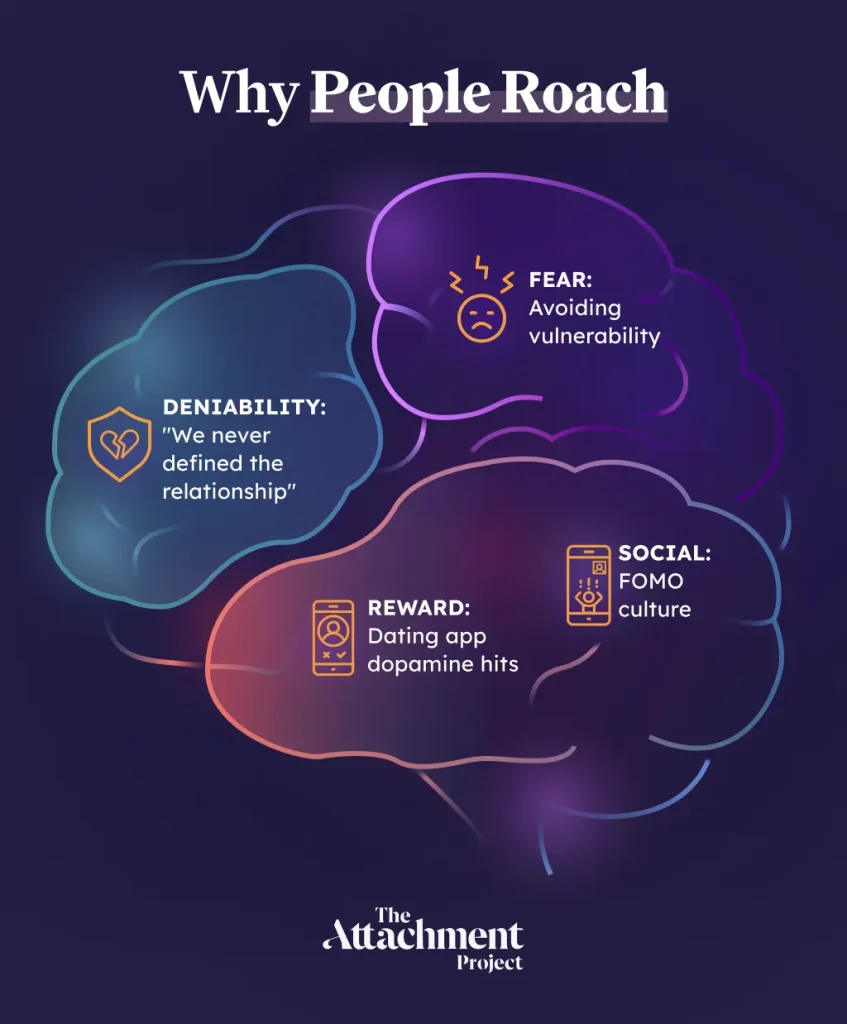
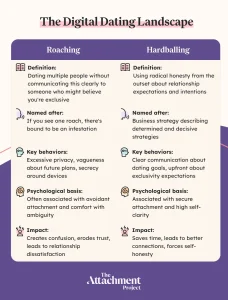
“Roaching” is the act of dating multiple people without communicating this clearly to someone who might believe that you’re in an exclusive relationship. Its name comes from the common saying that if you see one roach, there’s bound to be an infestation – implying that if you find your partner dating one other person, they may well be dating many more.
Where cheating involves the outright crossing of boundaries, roaching occurs when exclusivity may be more vague or undefined. It’s also different to casual dating; it’s normal to date around in the early days, but someone who’s roaching may be taking extra steps to hide their other potential partners from you.
One partner’s deception in relationships has been associated with their belief that the other person is also deceiving them, an attempt to avoid the consequences of their actions, and their attachment needs – we’ll dive deeper into why people roach soon2.
Deception in relationships through behaviours like infidelity, ghosting, and breadcrumbing has been associated with high scores on the Dark Triad personality traits: grandiose and vulnerable narcissism, Machiavellianism, and primary and secondary psychopathy3, 4, 5. These characteristics are often misunderstood, so it’s important to familiarize yourself with what we mean by them:
Narcissism describes the need for external validation and a sense of entitlement. In grandiose narcissism, these needs come from a belief that you are superior to others. In vulnerable narcissism, they reflect feelings of insecurity and inadequacy.
Machiavellianism refers to a highly-driven motivation toward goals without regard for others, including a tendency to manipulate. Machiavellian views see all of humanity as inherently untrustworthy.
Psychopathy describes low empathy, impulsivity, and aggression toward others. Primary psychopathy involves manipulation and charm, while secondary psychopathy encompasses impulsivity and boredom.
These are not diagnoses, but traits that exist on a scale we all score differently on.
While a person who roaches may score highly on these traits, it’s important to understand that these traits are associated with the tendency to deceive – not with the desire for non-monogamous relationships6.
The Difference Between Ethical Non-Monogamy and Roaching
People who roach in dating might be using the vagueness in your relationship status to their advantage. This is very different to ethical non-monogamy, where boundaries are clear and communication is key.
Ethical non-monogamy, also known as consensual non-monogamy, describes relationships in which both partners have agreed to a non-monogamous dynamic. This may include polyamory, opening the relationship, or swinging – in any case, the clarity and unambiguity is a defining feature of ethical non-monogamy.
Where roaching is concerned, the person doing the roaching will be hiding their multiple partners.
Signs Someone May Be Hiding Multiple Dating Partners
If this is starting to sound all too familiar and you’re worried your partner may be roaching, here are a few of the warning signs as described by dating coaches and roaching victims:
- Excessive privacy – it’s normal to keep some things to yourself, but privacy around certain common details like where they work or live, or who their friends are, might be an indication that they’re hiding something.
- Flaking and changing plans – if your partner routinely changes plans last minute and there’s no other explanation, like a job where they might be on-call, they might be making plans with other people.
- Unable to answer unexpected calls or messages – again, certain jobs or lifestyles can make this more likely to happen for completely understandable reasons, but if there’s no explanation for their absence, it could be that they’re with someone else.
- Vagueness about future plans – if your partner is seeing other people, they may find it difficult to lock in future dates or talk about long term plans. They may turn down opportunities to see you without suggesting an alternative.
- Avoiding the next step – if you’ve talked about where your relationship is going and they never seem to be ready for the next step, it could be a sign that they’re still dating around.
- Secrecy around devices – if they make sure their phone is always facing down or on do not disturb, or they act secretive around what they’re doing on it, it could be that they’re still using dating apps or talking to other potential partners.
- Seeming distant – a partner who seems like they’re pulling away or avoiding you, or seems suddenly more “cold”, might be seeing other people.
- A gut feeling – we know it’s not always easy to listen to, but many roaching victims say that their gut feeling told them all they needed to know.
Checking off one or two of these items doesn’t necessarily mean anything shady is going on, but if you’re worried, the best way to find out if your partner is still seeing other people is to ask them outright.
Why Deception Occurs in Early Dating Stages
While roaching is nothing new, we might be noticing it more and more since dating apps became part of our everyday lives. Digital dating makes it easier than ever to find potential other partners and maintain connections with them, even if they aren’t very deep or meaningful.
Furthermore, dating apps create an illusion of limitless options, leading users to develop a sense of FOMO (fear of missing out)7. This can make it difficult for someone to commit to just one person, as they may have a constant feeling that someone better could be just a swipe away.
However, and surprisingly, one study found that the more successful people were on dating apps, the less likely they were to be interested in intimacy with someone who wasn’t their partner8. They theorized that when someone receives positive feedback from a dating app and their options really do seem limitless, they become overwhelmed and disappointed with the actual experience.
Even when we’re not actively looking, an abundance of overly-polished social media profiles seeming to show potential alternatives has been shown to lead to decreased relationship satisfaction and time and emotional investment9.
It’s clear that modern life makes it difficult for some of us to settle, and it can be hard to know where you stand in early relationships. This might be why another new term, hardballing, has come into our collective awareness.
Hardballing: The Transparent Alternative
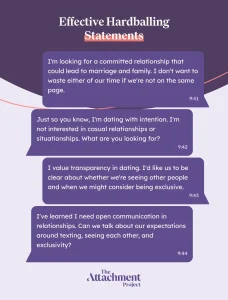
Hardballing describes using radical honesty from the outset during dating. It’s cutting to the chase about your expectations and intentions in a relationship. Looking for long-term, marriage, family? Or hoping for just a casual hook up? Either way, let them know on the first date – maybe even before the first date. That’s hardballing.
The term comes from its common use in business, describing an intense goal-oriented strategy designed to win at any cost. Hardballing in dating doesn’t have to be about winning, but it accurately describes the focus and set direction of someone’s dating goals. It’s not about demanding something from a potential partner, but explicitly stating what you’re both looking for in the hopes that you’ll be looking for the same thing.
Hardballing seems to have gained popularity in response to our fatigue with dating apps. It’s hard to ignore the impact of lockdowns during the COVID-19 pandemic, where for many of us, dating online was the only way to make new connections. The problem is that dating apps are designed to keep us hooked, leaving us feeling overwhelmed and exhausted by something that should be fun and exciting.
After years of swiping, first dates, and falling victim to dating games like breadcrumbing and benching, it’s no surprise people are looking for straightforward experiences that make the best use of their time. And it seems to work: people who look for more information from their online dating partner and/or have more information about their date have more successful first face-to-face meetings10.
The Benefits of Clear Communication from the Start
So, communicating clearly from the start not only saves your time and energy, but it seems to lead to better connections.
Being open and clear about what you’re looking for also has another key function: it forces you to be honest with yourself. When you decide to communicate what you want with your future date, you have to really know what that is. Studies have found that this kind of high self-clarity leads people to be more selective and better judges of character when dating11. Higher self-clarity is also associated with better relationship quality and commitment12.
Hardballing can be scary, and a lot of daters worry that being so upfront and honest might scare someone off – but this is what it’s for. Narrowing down your options might seem counterintuitive at first, but really, it’s like looking for a needle in the sewing drawer instead of the haystack.
How Attachment Styles Drive Roaching and Hardballing Behaviors
Insecurely Attached Partners Might Be More Likely to Roach
Attachment might play a role in roaching. One study found that partners who scored higher in anxiety and discomfort in intimacy, even if they didn’t have an avoidant attachment style, were more likely to use deception with romantic partners2. This may be because deception keeps their partner at arms length – even if the lie goes undiscovered, they may have created a sense of distance that keeps them within their comfort zone.
Looking more closely at roaching, interestingly, attachment also plays a role in what we count as cheating. Because roaching exists in a gray area for boundaries, it can be hard to say how significant the betrayal really is – and how we judge this partially depends on our scores on anxiety and avoidance13.
For example, a study in 2013 found that people who scored higher on attachment anxiety were more likely to consider sleeping in the same bed cheating, while people scoring higher on attachment avoidance were likely to find sleeping in the same bed a non-issue. The same pattern was found for kissing on the cheek and taking road trips out of state – in general, if you’re high in attachment anxiety, you’re more likely to consider behaviors cheating that people with attachment avoidance might see no problem with.
We could theorize from this that if your partner is high in attachment avoidance and you’re high in attachment anxiety, they may be more likely to roach by continuing to do things that cross your boundaries and taking steps to cover them up. This is why clear communication about what you expect from a relationship is so important.
DISCOVER YOUR ATTACHMENT STYLE
Do Securely Attached People Hardball?
Because securely attached people have stronger senses of self, they may already have a better idea of what they want, and therefore they may be more able to communicate their desires14. This may make it more likely that they use hardball dating techniques to find the kind of connection they’re looking for.
Securely attached people do tend to be better at communicating in other situations too, demonstrating their ability to empathize and problem solve with others: two necessary components of hardballing when you’re coming to an agreement on the relationship you’re looking for15.
Our own dataset at The Attachment Project reflected the same thing: we found that people who scored highly on attachment anxiety and attachment avoidance were less likely to use open communication with partners.
The Psychological Impact of Discovering You’ve Been Roached
Discovering you’ve been roached is never a good feeling – you may have been building up a picture of a future with this person, only to find they aren’t as reliable as you thought they were. Roaching thrives on that gray area and ambiguity, so while they may or may not tell blatant lies, roachers are likely to lie by omission, tell half-truths, or distort the truth.
Suspecting your partner of any of these types of deception is just as, if not more, strongly associated with relationship dissatisfaction as blatant lies. In short – no matter how they choose to deceive, the impact on you is the same16.
Discovering you’ve been deceived can make you feel angry, frustrated, or even embarrassed. Frequency of deceit is routinely associated with lower relationship satisfaction for both the deceiver and the deceived, and according to the US Office of the Administration for Children & Families, 46% of relationships end in part because a partner was unfaithful2, 16, 17.
Building Trust After Experiencing Dishonesty
Dishonesty doesn’t have to be the end of your relationship, especially in these early stages where their deception may not be as meaningful as it would be later down the line. Establishing clear boundaries and expectations going forward could be a new start for your future relationship – you may even want to borrow a leaf out of the hardballer’s books!
A recent study on rebuilding trust in relationships found 3 important things that both partners need18:
- Care: Both partners need to feel a sense of care for the other that drives them toward making positive moves in the relationship.
- Convey: Both partners need to show that they care and want to move the relationship forward through their actions.
- Credit: Both partners need to see each other’s actions as honest, caring attempts to support the relationship.
Experiencing genuine feelings of care, demonstrating them to your partner, and interpreting your partner’s actions in a good light help to rebuild trust over time.
Conclusion
Dating in the digital age can feel like a minefield. When a connection between two people starts online, it can be difficult to get a read on who your potential date is and what they want from a relationship. With dating turning into more of a chore than a fun way to meet people for many of us, nobody wants to waste their time with the wrong matches.
Give yourself the best possible chance to find and be ready for the right person with our dating toolkit. Our toolkit gives you everything you need to reflect, understand the way you date, and build healthier dating habits for future relationship success.
START YOUR HEALTHY DATING JOURNEY
FAQs About Roaching and Hardballing
How is roaching different from simply dating multiple people?
In roaching, the person dating multiple people makes an intentional effort to hide it from the people they’re dating. It exists in the gray area before the relationship has been defined as exclusive, giving them plausible deniability for their actions.
What should I do if I discover I’ve been roached?
If you discover you’ve been roached, have a calm conversation with your partner about your different approaches. Make sure you’re on the same page about what you want from the relationship, and be prepared to part ways if your needs aren’t aligned. Follow our tips for rebuilding trust if you do decide to move forwards.
Is hardballing too intense for a first date?
For some people, hardballing is too intense for a first date – but for others, it’s exactly what they’re looking for. If you like the idea of hardballing, chances are the people you want to date do too.
How do I hardball without scaring someone away?
Hardballing naturally does scare some people away, but this isn’t a bad thing if you don’t want to date people who aren’t on the same page. You may wish to ask someone how they feel about this kind of approach before diving straight into it.
Are dating apps encouraging roaching behavior?
Dating apps make it easier to find new connections, maintain relationships with them without a lot of effort, and hide relationships from current partners. All of this makes it easier for people to display roaching behavior.
References
- Muise MD, Belu CF, O’Sullivan LF. Unspoken, yet understood: Exploring how couples communicate their exclusivity agreements. The Canadian Journal of Human Sexuality. 2021 Aug 1;30(2):196-204.
- Cole T. Lying to the one you love: The use of deception in romantic relationships. Journal of Social and Personal Relationships. 2001 Feb;18(1):107-29.
- Brewer G, Hunt D, James G, Abell L. Dark Triad traits, infidelity and romantic revenge. Personality and Individual Differences. 2015 Sep 1;83:122-7.
- Jonason PK, Kaźmierczak I, Campos AC, Davis MD. Leaving without a word: Ghosting and the Dark Triad traits. Acta Psychologica. 2021 Oct 1;220:103425.
- Willis ML, Oliver E, March E. Dating in the dark: Vulnerable narcissism predicts inauthentic self-presentation in online dating. Telematics and Informatics. 2023 Jun 1;81:101985.
- de Rivas S, Lecuona Ó, Castro Á, Barrada JR. Personality and mating orientations in monogamy and consensual non-monogamy in young Spanish university students. Archives of sexual behavior. 2023 May;52(4):1785-98.
- Binder A, Stevic A, Matthes J, Thomas MF. Dating algorithms? Investigating the reciprocal relationships between partner choice FOMO, decision fatigue, excessive swiping, and trust in algorithms on dating apps. New Media & Society. 2024 Jun:14614448241270542.
- Alexopoulos C, Timmermans E, McNallie J. Swiping more, committing less: Unraveling the links among dating app use, dating app success, and intention to commit infidelity. Computers in Human Behavior. 2020 Jan 1;102:172-80.
- Abbasi IS, Alghamdi NG. The pursuit of romantic alternatives online: Social media friends as potential alternatives. Journal of Sex & Marital Therapy. 2018 Jan 2;44(1):16-28.
- Sharabi LL, Caughlin JP. What predicts first date success? A longitudinal study of modality switching in online dating. Personal Relationships. 2017 Jun;24(2):370-91.
- Kubin D, Kreitewolf J, Lydon JE. Ruling out potential dating partners: the role of self-concept clarity in initial romantic partner evaluations. Self and identity. 2023 Dec 1;22(7-8):1143-71.
- Lewandowski Jr GW, Nardone N, Raines AJ. The role of self-concept clarity in relationship quality. Self and Identity. 2010 Oct 1;9(4):416-33.
- Kruger DJ, Fisher ML, Edelstein RS, Chopik WJ, Fitzgerald CJ, Strout SL. Was that cheating? Perceptions vary by sex, attachment anxiety, and behavior. Evolutionary Psychology. 2013 Jan 1;11(1):159-71.
- Kawamoto T. The moderating role of attachment style on the relationship between self-concept clarity and self-esteem. Personality and Individual Differences. 2020 Jan 1;152:109604.
- Domingue R, Mollen D. Attachment and conflict communication in adult romantic relationships. Journal of Social and Personal Relationships. 2009 Aug;26(5):678-96.
- Peterson C. Deception in intimate relationships. International Journal of Psychology. 1996 Dec 1;31(6):279-88.
- Office of Planning, Research & Evaluation. Relationship Dynamics Among Unmarried Couples: Findings from a Study of Healthy Marriage and Relationship Education Programs. 2023 Jan 24. Available at https://acf.gov/opre/report/relationship-dynamics-among-unmarried-couples-findings-study-healthy-marriage (Accessed 2025 Apr 15)
- Rempel JK, Knox C. Rebuilding trust in interpersonal relationships. InHandbook of Trust and Social Psychology 2025 Mar 11 (pp. 109-129). Edward Elgar Publishing.
 Get mental health tips straight to your inbox