









Sensation Seeking: The Psychology of Thrill-Seeking Behavior

When one partner is an up-for-anything novelty-seeker and the other prefers to stick with what they know, you might wonder how this impacts your relationship; do you balance each other out, or throw each other off?
Today, we’re talking about sensation seeking. Pioneered by psychologist Marvin Zuckerman, sensation seeking is a personality construct that measures someone’s willingness to take risks for exciting new experiences. Where we land on the scale of sensation seeking can impact how we behave within relationships and who we’re best matched with – and, yes, it may even be related to our attachment styles.
Studies have found that high sensation seeking in either partner is negatively associated with relationship satisfaction1. We’ll take a closer look at what this means, why this happens, and how you can use sensation seeking in your relationship to your advantage to strengthen your connection.
DISCOVER YOUR ATTACHMENT STYLE
What Is Sensation Seeking? Zuckerman’s Theory and Modern Understanding
First, we need to define what we mean by sensation seeking. It’s often compared to thrill seeking and risk seeking, but it’s actually a little more nuanced than these concepts. While people who score highly on sensation seeking are more likely to seek thrills and take risks, they’re also more interested in any kind of new experience, like joining a new social club or visiting a new country2.
In Zuckerman’s words, sensation seeking is:
“A trait defined by the seeking of varied, novel, complex, and intense sensations and experiences, and the willingness to take physical, social, legal, and financial risks for the sake of such experience.”2
To measure sensation seeking, Zuckerman developed the Sensation Seeking Scale (SSS). This scale splits sensation seeking up into 4 dimensions (more on this coming up), and scores sensation seeking from low to high. Most people score somewhere in the middle.
It’s not that sensation seeking is the same as impulsivity or a failure to assess risk – rather, people scoring highly on sensation seeking are just more likely to accept risk to achieve the excitement of experiencing something new.
For example, a study on sensation seeking and romantic partner selection found that high sensation seekers agreed with the general population on which traits were positive and negative, but were more willing to accept high risk traits (like “Can be described as ‘secretive and mysterious’”) to go on a date with them – and even found them more attractive3!
The 4 Dimensions of Sensation Seeking and Their Real-Life Impact
Zuckerman’s 4 dimensions of sensation seeking are as follows2:
- Thrill and Adventure Seeking (TAS): TAS is associated with a draw towards extreme sports or activities involving speed and an element of risk, like fast driving or skiing. This component is what people typically think of when they hear “sensation seeking”.
- Experience Seeking (ES): This item describes seeking new experiences that don’t necessarily have an element of risk, like listening to new music or experimenting with different hobbies and social groups.
- Disinhibition (Dis): Dis describes a willingness to ignore social norms and enjoy activities that others might find uncomfortable, like talking to strangers or dancing in public.
- Boredom Susceptibility (BS): BS measures a difficulty with predictability and routine. People scoring highly on BS are more likely to get bored with their day to day and might value excitement over security in their relationships.
The Biology and Psychology Behind Sensation Seeking Tendencies
Zuckerman’s biosocial theory of sensation seeking says that differences in sensation seeking can result from both biological predispositions and cultural influences4. Brain studies have found that neurotransmitters like dopamine and serotonin, are implicated in sensation seeking as well as hormones like testosterone and estrogen4. This might help to explain why sensation seeking tends to be higher in adolescents than in other age groups5.
Our biology is only part of the story: our early experiences can also impact the development of sensation seeking, with studies finding that growing up in an unstable environment predicts less sensation seeking later in life6.
On the other hand, growing up in an environment where the environment is not only unstable but actively dangerous, such as suffering from physical or verbal abuse, might lead to an increase in sensation seeking7. These experiences seem to affect girls more than boys.
Difficult childhood experiences, commonly known as ACEs (“adverse childhood experiences”), can also be disruptive to our early attachments. One study found that ACEs can contribute to the development of attachment anxiety in adulthood and may sustain patterns of avoidance with age8.
Sensation Seeking Through an Attachment Theory Lens
Your attachment style influences how you relate to yourself and others. You first develop an attachment style in infancy, which can go on to influence your attachment in adulthood.
In infancy, if your caregiver consistently meets your needs, you develop a secure attachment and an internal working model of others as trustworthy and reliable. If your caregiver is inconsistent, you develop an anxious attachment style and a sense that support from others must be earned.
If your caregiver is consistently unable to meet your needs, you develop an avoidant attachment style and an understanding of others as unreliable. These patterns can persist into adulthood, although your attachment style is constantly evolving and shaped by your later life experiences.
DISCOVER YOUR ATTACHMENT STYLE
In adulthood, your attachment style is measured by your levels of avoidance and anxiety in relationships. If you’ve taken our Attachment Quiz, this is how your results were produced. The four adult attachment styles are: secure (low avoidance, low anxiety); anxious-preoccupied (low avoidance, high anxiety); dismissive-avoidant (high avoidance, low anxiety), and; fearful-avoidant (high avoidance, high anxiety).
ACEs generally contribute to insecure attachment styles, but only specific ACEs (like those linked to a dangerous environment) have been found to relate to sensation seeking9. This suggests that there could be a relationship between attachment styles and sensation seeking, but it may be complex. Some studies have found that secure attachment is related to sensation seeking, which may be the result of having a secure base to explore from10.
Attachment avoidance has been negatively linked to sensation seeking, even though some studies have linked the dismissive-avoidant attachment style to the thrill seeking domain11, 12. Studies have found no correlation in either direction between attachment anxiety and sensation seeking.
Yet, both our attachment style and our sensation seeking behaviors can be influenced by our upbringing – so how could sensation seeking and attachment be connected?
It’s possible that the ACEs that influence insecure attachment styles have different impacts on sensation seeking for different people. While some might become more afraid of trying new things, others might respond by embracing greater risk and exhibiting disinhibition. While we can theorize that this is the case, this is an area where more research is needed for us to understand what’s really going on.
How Each Attachment Style Expresses Sensation Seeking
Based on what we know about attachment theory and how this shapes our interactions with the world, we can also theorize about how our attachment styles might impact our own experiences of sensation seeking.
In childhood and adulthood, our attachment styles influence our exploratory behavior. As adults, both attachment anxiety and avoidance are associated with lower exploration – particularly anxiety with environmental exploration, and avoidance with social exploration13, 14.
When we have a secure attachment style, we’re more likely to engage in sensation seeking because we have a secure base to explore from – we know that if it all goes wrong, somebody will be there to support us. This means that we might find it easier to try new things, take risks, and behave outside of social norms knowing we’ll still be loved and accepted by others.
If we have high attachment avoidance, then we might have less interest in exploratory activities, potentially corresponding with lower scores on Experience Seeking. This could balance out the higher scores on Thrill and Adventure Seeking for dismissive-avoidant attachment styles.
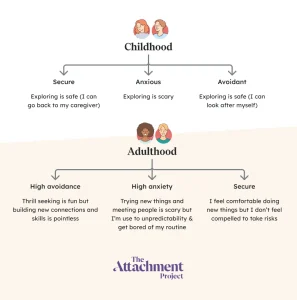
This means that if you have a dismissive-avoidant attachment style, you might feel a drive to participate in extreme sports or exciting, high-speed, risky activities, yet have little interest in joining a new club or visiting a new country if it doesn’t involve a sense of adrenaline.
If we have high attachment anxiety, we might be more afraid of exploring new things. However, relationship anxiety has been associated with Boredom Susceptibility, possibly explaining why there seems to be no overall effect on sensation seeking15.
This means that if you have an anxious-preoccupied or fearful-avoidant attachment style, you might find that even though you’re more likely to feel bored with your routine or you struggle with understimulating activities, you’re not keen on joining new groups or thrill-seeking because of the risk involved.
Keep in mind that these are just theories based on the research available, rather than strict rules. Without in-depth research in this area, it’s hard to draw specific conclusions (this is why research is a core part of our mission!).
DISCOVER YOUR ATTACHMENT STYLE
How Sensation Seeking Shapes Your Dating and Relationship Patterns
Sensation seeking doesn’t just impact how you feel about new experiences, but also how you behave in relationships. Research has found that people who score highly on sensation seeking find potential partners more attractive and are more likely to want to go on a first date, especially when the potential partner has riskier or more negative qualities3, 16.
Interestingly, sensation seeking predicts attraction to people scoring highly on narcissism but not coupling up with them17. This might speak to the high sensation seeker’s ability to accurately perceive and assess risk – they may be more open to casually dating someone with negative traits, but perhaps draw the line at committed relationships with them.
Sensation seeking also seems to be related to intentions to engage in infidelity18. In fact, significant gender differences in intention to cheat completely disappeared when sensation seeking was accounted for, meaning that men were initially more likely to want to cheat than women, but their sensation seeking scores fully explained this difference. Infidelity has actually been associated with all dimensions of sensation seeking, except for Disinhibition19.
Sensation Seeking and Dating App Behavior
Since people high on sensation seeking are more open to new experiences, they’re also more likely to be on the dating apps – whether they’re looking for casual sex or romance20. This was in part because they were more likely than others to feel able to communicate what they’re looking for, which could relate back to the higher likelihood that they have secure attachment styles.
In one study, people who were high in sensation seeking were more likely to be looking for sexual partners, more likely to be looking for committed partners (except for a highly avoidant group), had more interactions with Tinder matches both online and offline, and had a higher number of current matches21.
Sensation Seeking in Romantic Relationships: Impact on Intimacy and Connection
Sensation seeking doesn’t just impact how you look for relationships, but also how you act within them.
In a study on sensation seeking and love styles, sensation seeking was associated with Ludus – the “game playing” love style characterized by playfulness and lower levels of commitment22.
Disinhibition and Boredom Susceptibility were each individually associated with Ludus too. Experience Seeking was negatively associated with Storge, a love style characterized by familial love and relationships built on mutual respect and deep commitment. Boredom Susceptibility was also negatively correlated with Mania, an intense, dependent love style, and Agape, a selfless and caring love style.
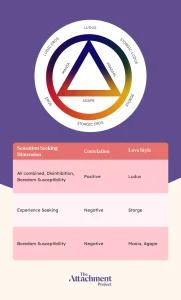
This means that people who score highly on sensation seeking are more likely to see love as fun, playful, and something of a game. In relationships, they might particularly enjoy the early stages, engage in playful flirting, and take things a little less seriously.
Sensation seeking isn’t an undesirable trait, but mismatches in sensation seeking can spell trouble for a relationship – similarity in sensation seeking scores between partners has been found to be a good predictor of relationship satisfaction23. If your partner is much higher or lower on sensation seeking than you are, you might find it difficult to see eye-to-eye about everyday things like how to spend a free evening and what to eat for dinner, as well as bigger picture things like where to live and what kind of lifestyle you want.
Interestingly, Ludus is also often associated with avoidant attachment – even though we know that sensation seeking tends to be associated with attachment security10, 24. It could be that other factors are at play and the relationships between love styles, attachment, and sensation seeking are far more complex than we know so far.
Dating and Attachment When Partners Have Mismatched Sensation Seeking Levels
If you and your partner have mismatched sensation seeking, don’t worry! With good communication, understanding, and respect for each other, your differences can be your strengths.
It’s important to agree on boundaries around sensation seeking behaviors. For example, if your partner is a thrill seeker, perhaps you will both agree that they call you to let you know they’re okay after partaking in high risk activities. Or, if you’re high on Experience Seeking but your partner prefers to stick to what they know, perhaps you both agree that you’ll try new things together at least once a month (or whichever frequency works for you) while also enjoying the same number of date nights at home.
Understanding relationship conflicts through sensation seeking and attachment theory lenses can help you to see each other’s perspective and develop greater compassion for each other. Both of these traits are different ways of experiencing and relating to the world, and there’s no wrong way to be; some pairings just need more active communication to understand each other’s differences.
START YOUR HEALTHY DATING JOURNEY
Healing and Growth: Therapeutic Approaches for Sensation Seekers
If particularly high or low sensation seeking is causing difficulties within your relationship, perhaps because your partner is very averse to stability or, on the flip side, they are unwilling to do fun things with you, then you may wish to find help from an expert. Counsellors and therapists can help you to find a way to communicate more effectively and gain a deeper understanding of yourselves and each other.
The kind of therapy you benefit from the most is specific to you, and it’s okay to try different therapists until you find one you both feel you can work with. Some therapies, like emotion-focused therapy, are more focused on addressing recurring patterns that hinder your attachment to each other. Others, like solution-focused therapy, can help you to solve a specific problem in the shorter term.
Conclusion: Integrating Sensation Seeking and Attachment for Relationship Success
Sensation seeking is more than just thrill-seeking and risk-taking – it’s a desire and willingness to try new things, even if there are risks involved. Most people score somewhere in the middle, but big differences in sensation seeking can present challenges in relationships.
By understanding, communicating, and clarifying boundaries, you can use your differences in sensation seeking to strengthen your bond. It’s not that either of you need to change, rather, you should work together to find a balance that both of you are comfortable with.
When you work together to understand your differences, these positive relationship experiences help to strengthen your attachment to each other and promote attachment security within yourselves. This, in turn, can help you to develop healthier communication patterns to better overcome conflict in the future.
Take the first steps of this journey by learning more about your attachment style: take our Attachment Quiz.
Your Questions About Sensation Seeking and Relationships Answered
Is high sensation seeking linked to cheating or keeping “backburners”?
High sensation seeking is linked to intentions to cheat; high sensation seekers are excited by new experiences and are more likely to look for romantic or sexual partners.
How does sensation seeking change throughout different relationship stages?
Sensation seekers might enjoy the “thrill of the chase” at the beginning stages of a relationship. Later in relationships, they might still prefer playful flirting and a less serious approach.
Can someone be a relationship thrill-seeker but cautious in other life areas?
It’s possible to be a thrill-seeker in relationships yet score less highly on sensation seeking, although general thrill seeking is considered one of 4 sensation seeking domains.
Does secure attachment lead to less sensation seeking behavior?
Secure attachment seems to lead to more sensation seeking behavior, likely because they have a secure base to explore from.
Is the “avoidant” attachment style more likely to seek sensation outside relationships?
The avoidant attachment style is less likely to score highly on sensation seeking, likely because their avoidance also applies to new experiences and thrills.
Does childhood attachment trauma predict adult risk-taking behavior?
Attachment disruptions in childhood predict less sensation seeking in adulthood, as avoidance and anxiety lead us to be less interested in exploring.
How can parents support healthy sensation seeking while fostering secure attachment?
Parents can support healthy sensation seeking by providing a secure base for their children to come back to – a judgement-free, safe environment where they can feel accepted and loved.
References
- Thornquist MH, Zuckerman M, Exline RV. Loving, liking, looking and sensation seeking in unmarried college couples. Personality and Individual Differences. 1991 Jan 1;12(12):1283-92.
- Zuckerman M. Behavioral expressions and biosocial bases of sensation seeking. Cambridge university press; 1994 Jun 24.
- Henderson V, Barrett DW, Curtis B. When risky is attractive: Sensation seeking and romantic partner selection. Personality and Individual Differences. 2005;38:311-25.
- Zuckerman M. Biosocial bases of sensation seeking. Biology of personality and individual differences. 2006 Jan 23:37-59.
- Roth M, Schumacher J, Brähler E. Sensation seeking in the community: Sex, age and sociodemographic comparisons on a representative German population sample. Personality and Individual Differences. 2005 Nov 1;39(7):1261-71.
- Babad S, Zwilling A, Carson KW, Fairchild V, Razak S, Robinson G, Nikulina V. Risk-taking propensity and sensation seeking in survivors of adverse childhood experiences. Journal of interpersonal violence. 2021 Oct;36(19-20):NP10670-87.
- Sussman TJ, Santaella-Tenorio J, Duarte CS, Wall MM, Ramos-Olazagasti M, Suglia SF, Canino G, Bird H, Martins SS. Do trajectories of sensation seeking vary by sex and child maltreatment subtypes?. Journal of interpersonal violence. 2022 Mar;37(5-6):NP3377-99.
- Glass J. Do Childhood Attachment and Adverse Childhood Experiences Predict Adulthood Attachment?.
- Ye Z, Wei X, Zhang J, Li H, Cao J. The impact of adverse childhood experiences on depression: the role of insecure attachment styles and emotion dysregulation strategies. Current Psychology. 2024 Feb;43(5):4016-26.
- Pace U, Madonia C, Passanisi A, Iacolino C, Di Maggio R. Is sensation seeking linked only to personality traits? The role of quality of attachment in the development of sensation seeking among Italian adolescents: A longitudinal perspective. Mediterranean Journal of Social Sciences. 2015 Mar;6(2):S1.
- Jerome EM, Liss M. Relationships between sensory processing style, adult attachment, and coping. Personality and individual differences. 2005 Apr 1;38(6):1341-52.
- Lee ON, Park GA. The mediating effects of attachment styles on the relationship between sensory processing styles and interpersonal problems in healthy university students. Occupational Therapy International. 2020;2020(1):6204120.
- Wu CH, Yang CT. Attachment and exploration in adulthood: The mediating effect of social support. International Journal of Psychology. 2012 Oct 1;47(5):346-54.
- Green JD, Campbell WK. Attachment and exploration in adults: Chronic and contextual accessibility. Personality and Social Psychology Bulletin. 2000 Apr;26(4):452-61.
- Nielsen K, Danielson S, Junior IF, Jennings TL, Gleason N, Rahm-Knigge R, Miner MH, Coleman E. Associations among boredom proneness, attachment styles, and compulsive sexual behavior. The Journal of Sexual Medicine. 2022 May 1;19(5):S132-3.
- Henderson VR, Hennessy M, Barrett DW, Martin S, Fishbein M. Tell me more: Sensation seeking and information seeking in evaluating romantic partners. Journal of Research in Personality. 2006 Oct 1;40(5):611-30.
- Grosz MP, Dufner M, Back MD, Denissen JJ. Who is open to a narcissistic romantic partner? The roles of sensation seeking, trait anxiety, and similarity. Journal of Research in Personality. 2015 Oct 1;58:84-95.
- Lalasz CB, Weigel DJ. Understanding the relationship between gender and extradyadic relations: The mediating role of sensation seeking on intentions to engage in sexual infidelity. Personality and individual differences. 2011 May 1;50(7):1079-83.
- Kumar P, Yadav VN, Manshi A, Punyasree MP. Development of Infidelity Scale and its Relationship with Dating App Motivation Scale and Sensation Seeking Scale-V. Development. 2023 Apr;4(2):97-105.
- Chan LS. Who uses dating apps? Exploring the relationships among trust, sensation-seeking, smartphone use, and the intent to use dating apps based on the integrative model. Computers in Human Behavior. 2017 Jul 1;72:246-58.
- Rochat L, Bianchi-Demicheli F, Aboujaoude E, Khazaal Y. The psychology of “swiping”: A cluster analysis of the mobile dating app Tinder. Journal of Behavioral Addictions. 2019 Dec;8(4):804-13.
- Hendrick SS, Hendrick C. Love and sexual attitudes, self-disclosure and sensation seeking. Journal of Social and Personal relationships. 1987 Aug;4(3):281-97.
- Schroth ML. Dyadic adjustment and sensation seeking compatibility. Personality and Individual Differences. 1991 Jan 1;12(5):467-71.
- Fricker J, Moore S. Relationship satisfaction: The role of love styles and attachment styles.
 Get mental health tips straight to your inbox